VeritasSmall Router Plane - reviewed *LINK*
Derek Cohen (in Perth, Australia)
>I recently completed a review of the Veritas Small Router Plane. It is available at the link below.
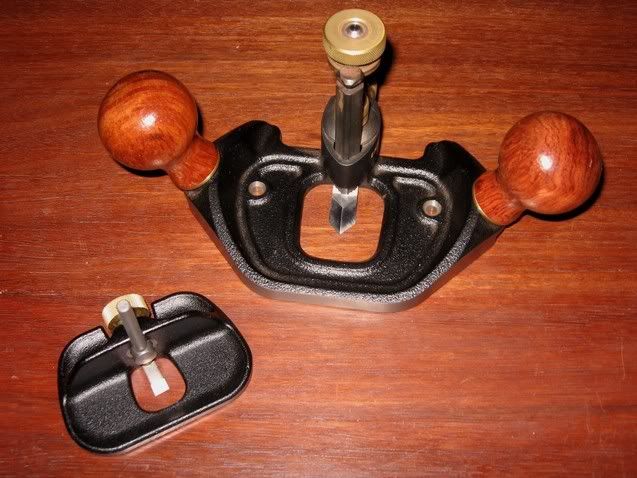
No affiliation with the website - just asked to write the review.
Regards from Perth
Re: VeritasSmall Router Plane - reviewed *LINK*
#2Re: VeritasSmall Router Plane - reviewed
wilbur
>Dang, Derek, that was fast.
I'm waiting for the day you write a review on a plane that Lee Valley hasn't even designed yet. :@)
Re: VeritasSmall Router Plane - reviewed *LINK*
#3Excellent review, Derek, thanks.
Pam Niedermayer - Austin, TX
>
Re: VeritasSmall Router Plane - reviewed *LINK*
#4Well Done, Nice Read
Jim Shaver - Oakville, Ontario
>As always Derek, Well done.
I find your reviews are always in my interest, plainly spoken and very informative.
As has been the case over the years I find I "need" a tool and invest in it from a well known supplier, and, usually within a short period of time Veritas comes out with something along the same lines, usually with more value added functional features than the tool I bought.
I was wondering, did you have a chance to compare and contrast the Veritas small router plane with the LN version?
Take care,
Jim
Re: VeritasSmall Router Plane - reviewed *LINK*
#5Usefulness
Warren in Lancaster, PA
>I wonder about the usefulness of a plane like this. Although planes of this type have appeared in catalogs for at least 30 years (there was a Stanley 271 in the 1984 Lee Valley catalog for 15.75), I have never felt the need for one. I use the larger router plane fairly often to lower the ground for carving work. I suppose the small one could be useful for lowering the ground for carving or inlay on rather small pieces of wood, but I think this advantage would be rather offset by the cramped nature of this tool. I should think that one's fingers would be tired after doing any amount of work with this tool.
The Lee Valley catalog shows the small router being used for grooving (not sure they actually used the tool to produce the grooves illustrated); most would use a plow for this work. Derek shows the tool used for hinge mortises and some people probably use a mortising plane for this work, but everyone I know just uses a chisel. As for stopped grooves, they are rare on 18th century work, more common in 20th century machine work. It is often easier to change the design and use a through plowed groove than to go to the trouble of making a stopped groove. And a large router plane would be much more comfortable to use if you were making any quantity of grooves.
Re: VeritasSmall Router Plane - reviewed *LINK*
#6Re: Usefulness
Patrick Gibbons, Channelview, TX
>I have both Stanley router planes and find that I can use the 271 with more precision than its larger brother on smaller applications. Any shallow mortise, groove, recess, etc., etc. can be cleaned out quickly with the smaller router. The time used is insignigicant and I have never experienced any cramping or pain associated with its use. I was given the larger router by my sister one Christmas and it is a recent English made version. It never seems to be precise in its depth of cut and I find myself fiddling with it constantly and still ending up with overly deep cuts. I don't quite know if this is me or the plane. I'd love to try the LN or LV to see if they perform better.
Re: VeritasSmall Router Plane - reviewed *LINK*
#7Re: Usefulness
Derek Cohen (in Perth, Australia)
>Hi Warren
You raise good points.
I was asked by a friend whether I thought the Small should have a fence or, at the least, flat sides (like the Stanley #271) so that it might run along a batten. I suppose that Veritas could have covered all bases by grinding the sides flat, but this would suggest that the Small was really just a littler Large (you understand I could not use "smaller" here :) ). In my opinion, the strength of a small router plane lies in the delicacy with which it is possible to work. In other words, I see its strength in inlay work. Which was why I pointed out that the plane should come with more blades than just the 1/4". In this regard, it is a comfortable plane. I do not see "cramped fingers" being an issue.
Would I choose the Small over the Large for hinge morticing? And would I use a router plane for hinge morticing? It depends and yes. The Small is very capable of smoothing the bottoms of the mortice of a middling sized hinge. That is what I set out to demonstrate. I would prefer to use the Large for such a mortice, but I would prefer the Small for a tiny hinge (there was a picture of it in the review). Actually, I did take pictures of morticing that hinge as well, but chose not to include them as one hinge mortice was enough. The question really is, "should one use a router plane for a hinge mortice"? The answer is, that is up to you. Often it is just as easy to use a chisel alone - easier if your skills are up to it. Sometimes one wants to be as precise as possible. No doubt some woodworkers would benefit from using a router plane.
What of stopped grooves? Whether they are a 18th Century or 20th Century phenomenon, this is a current building practice, and a router plane is the hand tool of choice (along with a chisel) for stopped grooves. And if you want to add a base to a box with through dovetails, then you have two choices: either use a plough and fill the resulting gaps with plugs, or cut stopped grooves.
I look forward to further discussion.
Regards from Perth
Derek
Re: VeritasSmall Router Plane - reviewed *LINK*
#8Re: Well Done, Nice Read
Derek Cohen (in Perth, Australia)
>I was wondering, did you have a chance to compare and contrast the Veritas small router plane with the LN version?
Hi Jim
Thanks for the kind words.
I cannot offer an opinion about the LN Small router since I have not used one. From pictures I like the square shank of the blade as this would square it automatically. On the other hand, it borrows the blade adjustment screw position from the Stanley #271, which obscures matters on the latter.


Whether the LN actually does so in practice, I have no idea. I would also look at the type of blade holding mechanism. The Veritas' spring loading is a great - no, important - feature.
Regards from Perth
Derek
Re: VeritasSmall Router Plane - reviewed *LINK*
#9Re: Usefulness
Paul Kierstead
>Or veneer the box. I asked the question about traditionally made small boxes (in the age before machines were common in small shops) a while back during a chat, and am still curious as to the construction methods. Did they sweat out a stopped groove, or just avoid it? Did they plug'n'paint? According to one participant, most were rebatted and painted, but I am not sure how thorough that answer was.
Re: VeritasSmall Router Plane - reviewed *LINK*
#10Re: Usefulness
Warren in Lancaster, PA
>Traditional boxes in the 17th an 18th centuries had bottoms nailed on. Such a box would have more interior space than the box Derek illustrates. The bottoms are 1)planed flush with the sides or are 2) covered with a molding around the bottom in fine work or 3)the bottoms are made somewhat larger than the box and are molded on the protruding edges.
There are other options. The sides could be mitered at the very bottom below the last dovetail to hide the grooves. Or the front and back of the box could be grooved for the bottom to be let into but the two end pieces of the box could be left without a groove. Also it is much faster to plug grooves that would show on the outside than to make stopped grooves. Plugged grooves are not noticeable to someone who is not wondering how the box is made. If you want to hide your joinery, you can used lapped dovetails.
Re: VeritasSmall Router Plane - reviewed *LINK*
#11Re: Usefulness
Paul Kierstead
>But were they dovetailed in the first place?
As a side question, were the bottoms just nailed, or nailed and glued. I would think the latter would encourage splits, but with small boxes, may be you could get away with it. Or maybe they lived with the splits. If they were just nailed, I'd think it might wreck a little havoc with the molding if the bottom expanded beyond the box, though if the wood was wetter then we use now (often suggested), then that would be unlikely to occur.
I find construction of some of the smaller, cheaper (relatively speaking) items to be somewhat fascinating considering the somewhat fussy methods we use now-a-days.
Re: VeritasSmall Router Plane - reviewed *LINK*
#12Re: Usefulness
Dave Anderson Chester, NH
>Hi Warren,
I have both the Stanley 272 which I've used for about 15 years and last year I bought the Lie-Nielsen version. I find them particularly useful for hinge mortising and for stopped grooves. The Stanley is uncomfortable to hold and now when I do any serious work I reach for the L-N which is both more comfortable and has a somewhat larger bearing surface and is more stable in use. I had to do the mortise for a 40" long piano hinge on a blanket chest this spring and the L-N did a great job in almost no time at all.
Re: VeritasSmall Router Plane - reviewed *LINK*
#13Thanks Dave
Warren in Lancaster, PA
>
Re: VeritasSmall Router Plane - reviewed *LINK*
#14Box construction
Warren in Lancaster, PA
>Generally in Pennsylvania, for dovetailed candle boxes, "bible" boxes, blanket chests, and the like the dovetails were glued and the bottoms were nailed on without glue in the 18th century. If you say dovetailed box with the bottom floating in a groove, I am thinking 20th century.
This does run counter to theoretical notions about cross grained construction. Sometimes practical experience is more valuable. I think that with a blanket chest, when there is stress due to change in humidity the wood compresses a bit, the nail holes distort, and the sides may bow to take up the stress. I have repaired old chests with mouse holes in the bottom, but cannot recall a problem with a split bottom. I think cracks in the bottom are usually small enough to be overlooked.
Re: VeritasSmall Router Plane - reviewed *LINK*
#15Re: Usefulness
Michael Recchione
>I got a new Stanley 271 a few years ago, and though I can't say I used it frequently, it was one thing I never regretted getting. There are times that it's a really useful little thing to have. I've used it for grounding in smaller relief carvings where it's big brother would have been too clunky to use, used it for stopped grooves in smaller work. I guess there would have been other ways to do all the things I've used it for, but it was a pretty good way to do them just the same.
Re: VeritasSmall Router Plane - reviewed *LINK*
#16Re: Usefulness
Adam Cherubini
>I find construction of some of the smaller, cheaper (relatively speaking) items to be somewhat fascinating considering the somewhat fussy methods we use now-a-day
Me too, Paul. I don't know if you got to see my latest article on 18th c drawers, but I got the sense they were very revealing of a craftsman's attitudes. Drawers are fairly utilitarian, they don't really show, so will he cut corners or won't he.
One thing I was surprised by was the amount of evidence of riven stock in drawer components. I appeared to me from the pieces I looked at that everything but the drawer front was riven. This might explain the success of nailed on bottoms. If you haven't seen that article, be sure to check it out.
Adam
Re: VeritasSmall Router Plane - reviewed *LINK*
#17Question
Denis Ch�nard, Orl�ans, Ont.
>Adam, how do you "detect" riven stock if it has been planed? Or is it that makers back then didn't bother to finish plane their stock?
Just trying to understand here...
DC
Re: VeritasSmall Router Plane - reviewed *LINK*
#18Re: Usefulness
ThomD
>Warren, I am kinda with you on this one. I love the LV full size plane, and could probably get away with no other. Since the store is only a few minutes away, I am in the lucky position to just buy stuff when I actually need it, and to be able to return it if it doesn't meet my need for whatever reason. I used to buy their tools on spec, you know, to support a small strugging Canadian company. But after a while I realized they ment to keep making them a lot faster than I could buy them!
Re: VeritasSmall Router Plane - reviewed *LINK*
#19Re: Question
Adam Cherubini
>Two ways: On the drawer bottoms we could actually see the torn grain of a split out piece. The other way is just to see that the grain is perfectly straight and perfectly quartersawn. With regular QS stock (any saws stock) the grain can run out. And the rings needn't be perfectly perpendicular to the faces to be considered quartersawn. But this stuff was.
If you're thinking there's no way to be 100% sure, I agree. But the rive marks, ring orientation, straight secondary grain are all indicators of riven material. We've also seen actual shingles used as drawer bottoms, so..
Adam
Re: VeritasSmall Router Plane - reviewed *LINK*
#20Makes sense to me, thanks!
Denis Ch�nard, Orl�ans, Ont.
>
Re: VeritasSmall Router Plane - reviewed *LINK*
#21Re: Question
Michael Recchione
>Adam, do you think this was done because the drawer bottom was considered important, or because it was considered unimportant? My guess is the latter - in the days when you couldn't just run a board through a thickness planer or drum sander, or just go grab a piece of quarter-inch plywood, the easiest way to get kind of flat thin stock was to rive it. I think they probably considered the drawer bottoms not important enough to waste a lot of time planing and thicknessing just so. I would guess these guys followed good principles of engineering and craftsmanship - you make things as good as they have to be do the job, no more, no less. Maybe you define "goodness" as "fitness for the purpose".
I remember reading one of the Jim Krenov books, where he was talking about some of his over-the-top compulsive requirements on all parts of a piece and thinking "Man, this guy's nuts!" Yet I guess that value system of cutting no corners and carrying everything to the same level of perfection that you carry the most important "show" part of a piece has become the trademark of "craftsman-made" furniture.
Along the same lines, I remember reading a cookbook many years ago. The author was talking about how to make pesto, and she was decrying American basil because the leaves were bigger than the Italian variety. In order to compensate for this shortcoming, she advocated ripping each leaf into small pieces BEFORE PUTTING IT IN THE BLENDER, where it would, of course, be chopped up to smithereens!
We may have lost something along the way to our current notions of craftsmanship - our common sense.
Re: VeritasSmall Router Plane - reviewed *LINK*
#22Good question
Adam Cherubini
>Adam, do you think this (riving drawer parts) was done because the drawer bottom was considered important, or because it was considered unimportant?
I think that's a complicated question. So you seem to be assuming the choice of materials was driven by functionality versus economy say. Naturally, I don't know the answer.
My personal experience tells me that you can conserve a lot of wood and interior draw space when the drawer bottom is thin. Where do you get thin wood in the 18th c? Resawing is a drag as is planing 4/4 down to 2/4. I think buying 2/4 stock would cost as much as 4/4. I think they paid per kerf, not for thicknesses except when they bought scantling specifically.
So i guess where I'm heading is that drawers, and especially drawer bottoms ate up a lot of sq footage of lumber. So they were probably chiefly interested in cheap, quick, and easy. I think riving fit those requirements pretty well. Philly drawer components are white cedar, likley cut in South Jersey, and floated across the Deleware with the tide. These white cedars were used extensively as roof shingles and probably clapboards. In towns where significant amount of immigration was taking place (like Philly) the building trades were busy and shingles and clapboards were probably readily available.
So that would be my guess. They used riven parts because they were cheap and it just so happens they worked okay. Keep in mind that many of these pieces were destined to hold textiles. Many of these drawers were lined with paper to protect the fabric. So a crack in a drawer bottom didn't neccessarily mean a loss of function. It may not even have been noticed (under the paper).
My point being, to answer a question like this one, I think we need to try to see things from their persepctive. I'm guessing but that's where I'm trying to come from....if that makes sense, Mike.
Adam
Re: VeritasSmall Router Plane - reviewed *LINK*
#23Re: Good question
Larry Barrett, in Maryland
>Adam
As you no doubt know, John Alexander is a proponent of the theory that riven stock was used extensively in 17th century furniture.
It would make sense to me that this tradition would have carried forward to the next few generations (at least) because that was how their grandfathers and fathers taught them.
I have read with interest your suppositions that drawer bottoms would have been made with riven shingles, because they were readily available. This could also explain why (on larger drawers) the wood was oriented front-to-back; if they had shingles to use, the shingles would not have been long enough to go side to side.
Re: VeritasSmall Router Plane - reviewed *LINK*
#24Re: Good question
MikeW
>Not to mention that riven stock in woods such as Cedars (true Cedar and otherwise), White Pine and Spruce are the fastest way to get from point A to point B.
Riving also leaves a surface which can be easily lightly planed or simply used as is.
Take care, Mike
who will one day make a riven chest...
Re: VeritasSmall Router Plane - reviewed *LINK*
#25Re: Good question
Dean J in MN
>I think buying 2/4 stock would cost as much as 4/4. I think they paid per kerf, not for thicknesses except when they bought scantling specifically.
Interesting -- I've not thought of that, nor have I run across anything with has suggested the notion of pay-by-kerf. I have run across accounts of 2/4 stock available from the sawyer, but never reasoned it would have been the same cost ad 4/4. (Too used to the modern notion of purchasing lumber I guess)
-Dean