The Lie Nielsen Face Joinery Float - Reviewed
Derek Cohen (in Perth, Australia)
>The Lie Nielsen Face Joinery Float - Reviewed
Very recently Lie Nielsen released a set of joinery floats that were fashioned after the planemaker�s floats they were producing in association with Clark & Williams. These floats are intended to aid in the fine-tuning of joints used in cabinetmaking. There are three floats in all, two for mortices and one for tenons. The float under review is the Face Float for tuning tenons.
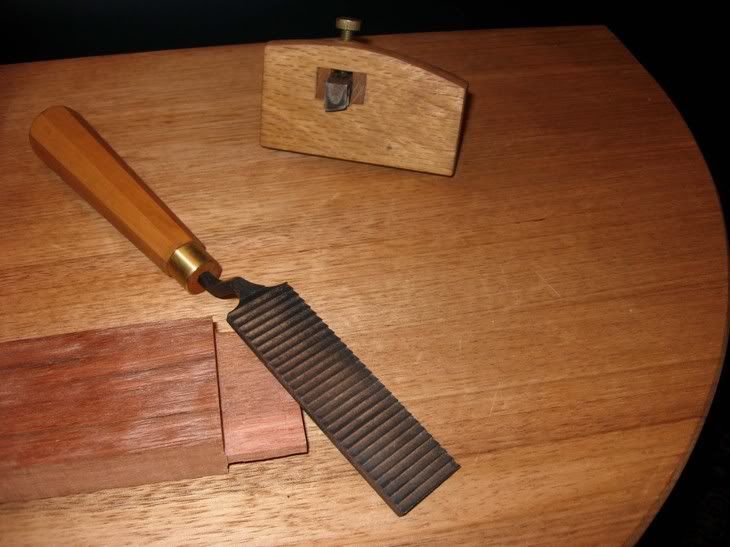
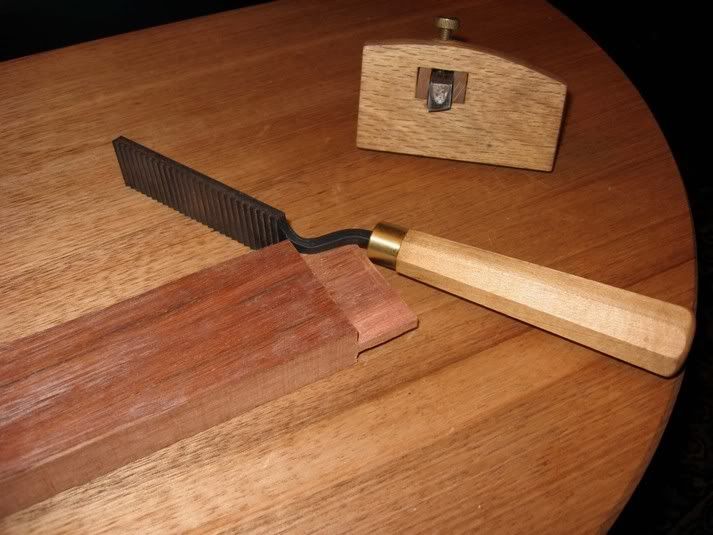
Construction and Dimensions
The face float is available in a push or pull version. I purchased the push version because I found this to be the more natural action.
According to the LN website, these are made from S-7 tool steel, hardened and tempered to RC 50-52 for edge life and resharpening ability. 8tpi, 80� rake angle, maple handles. It is 1� wide and 3 3/8� long.
Preparation
While the floats come sharpened and may be used straight out of the box, it is recommended that the teeth be first filed. I will reinforce this recommendation as I did initially use the float without filing the teeth, and was disappointed in the performance.
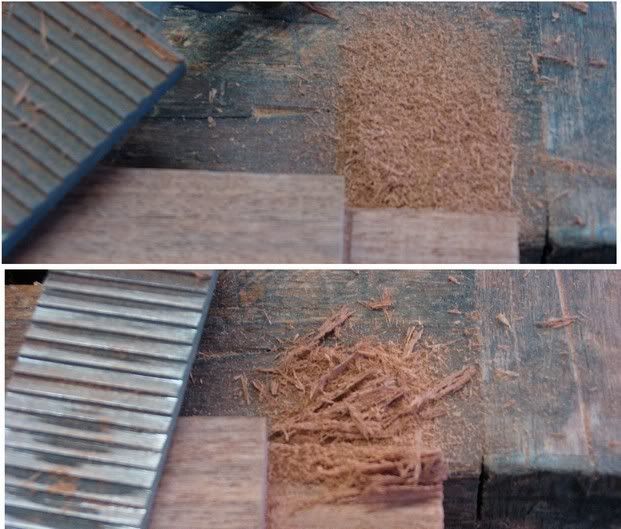
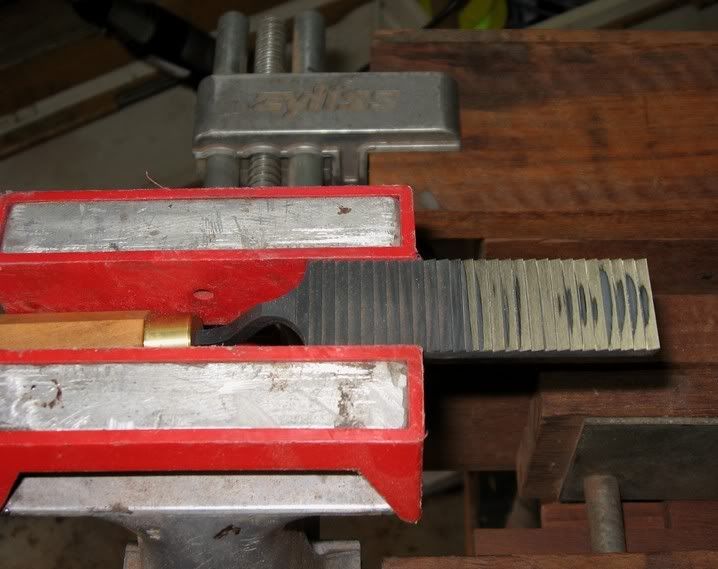
To illustrate the difference, I did a test with half the teeth filed and the other half original. Here is the result:
Filing the teeth
LN suggests a 6 inch double extra slim taper file for sharpening. I did not have one to hand, so first tried with a 4 inch double slim taper Groblet, a file I use for sharpening a 15 tpi dovetail saw. This proved to work exceedingly slowly, and so I turned to a 6� extra slim Nicholson file. This ended up being a good choice.
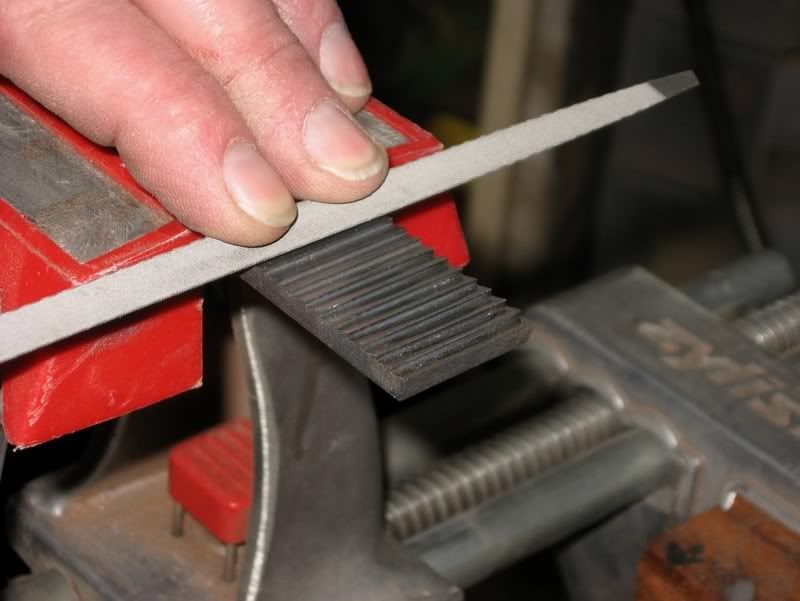
Finally I found a use for my Zyliss vise! It made a good support for filing the float.
From the LN website �.
Initial Sharpening: The black oxide coating of the floats is an aid in the initial sharpening. Simply file away the black coating to shiny metal for the first sharpening. Use care to apply a slight even pressure on the file to maintain the cutting geometry. On wider sections you may notice some very slight distortion showing as slightly low spots on the faces of the teeth. This is normal and is the result of volumetric changes and stresses of heat treating. It�s not necessary to remove the hollow, establishing a good cutting edge on the teeth is the goal.
The full instructions are on the LN website.
Below I am supporting the file flat on the face and against the gullet.
Here is the half-original, half-sharpened result. Note the hollows in some of the faces.
The LN face float is well made. Perhaps the only criticism is the need to sharpen it before it can be used. On the other hand, this will need to be done at some time anyway - not as often as a plane blade, but more much frequently than a handsaw. The initial filing was a relatively straight forward affair, and time will tell whether this is a task that remains so.
Cutting and Tuning Tenons
I generally cut tenons with either a backsaw or a bandsaw. For this assessment, I prepared a few in both Jarrah (representing hardwood) and construction Pine (representing softwood).
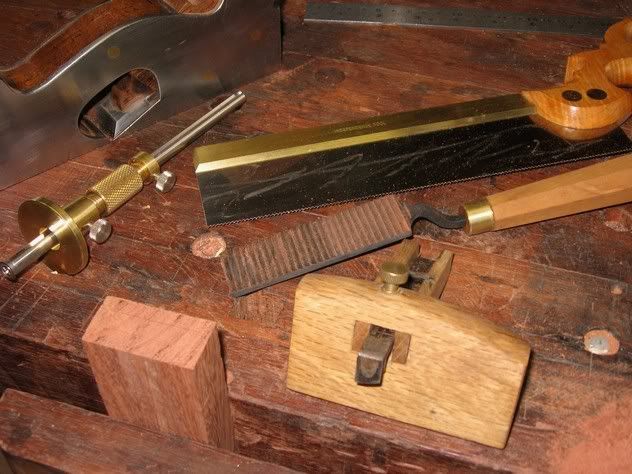
The plan is to compare tuning tenon faces using the joinery float, a rasp and a block plane.
The Joinery Float
The float is capable of removing a lot of waste very rapidly when used on hardwood. Before I sharpened the teeth, it had a feel more of a file, producing more dust than shavings. Once sharpened, the teeth could be felt biting into the wood.
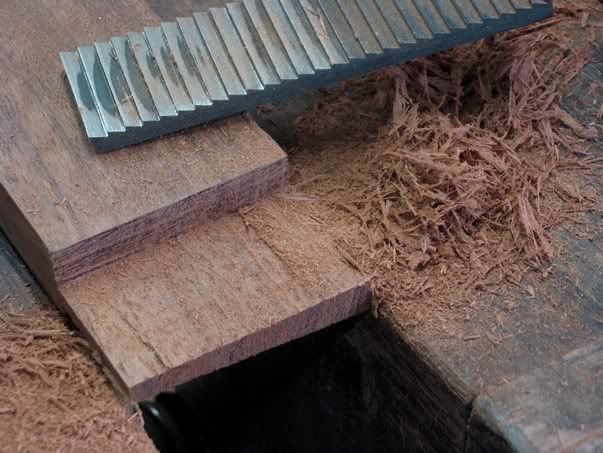
I liked the control that the float gave. It was stable in use and left a flat, smooth finish to the tenon face.
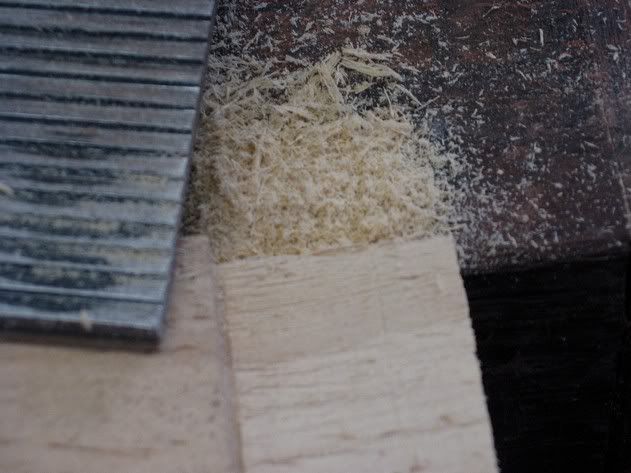
Using the float on Pine was a less satisfactory story. Cutting across the grain now produced fine shavings and sawdust.
The Rasp
I used an Auriou AU-8-250-6, which is close in grain size to a Nicholson #49. In other words, it is quite a coarse rasp.
The Auriou cut fast, leaving a marked but acceptable smooth face.
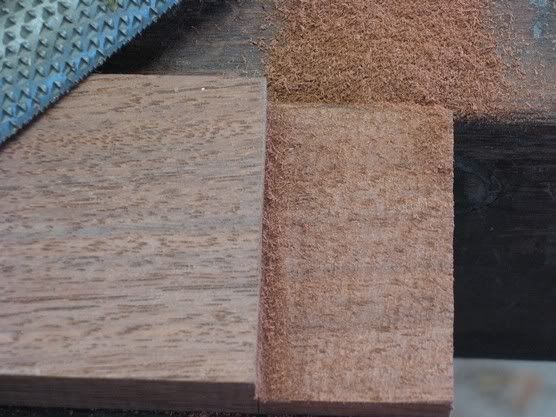
I like the rasp for use here, but I warn that use of one must be done with care. Its length makes it easy to tilt, and then it will create an off square face.
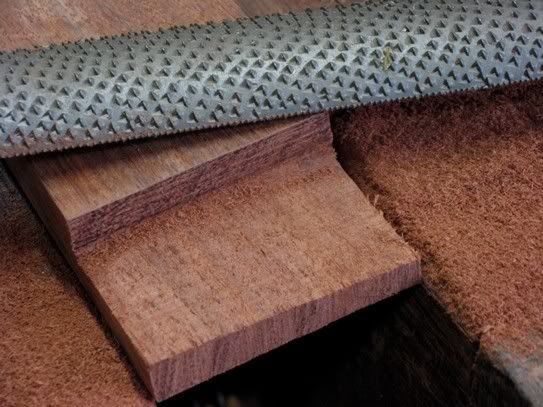
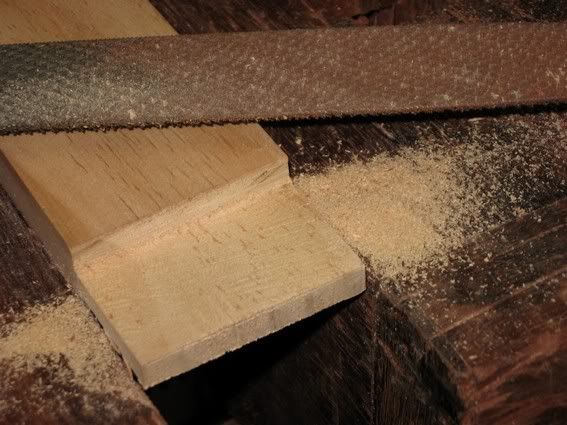
The performance of the rasp on soft Pine was very similar to that on hardwood.
The Block Plane
The handplane of choice for tuning tenon faces is the Stanley or LN #140, a skew block plane.
Here is my Stanley #140.
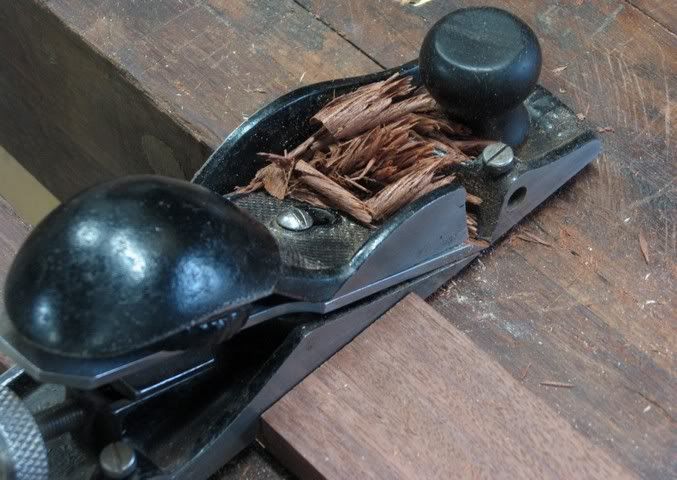
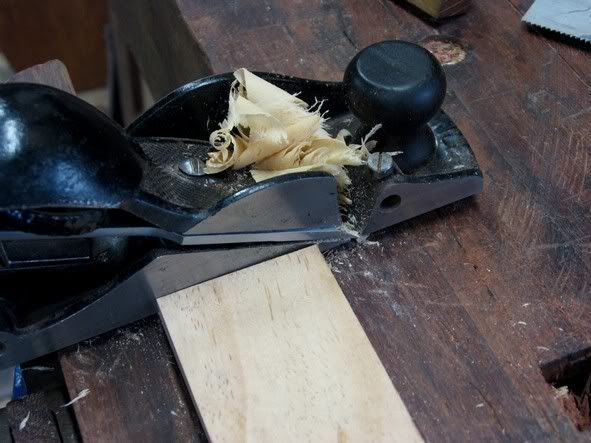
The #140 works equally well on hard- and softwood. It can remove a larger amount of waste quickly, which is, I believe, its advantage over the other tools here. It also produces the smoothest surface finish. However, like the rasp, care must be taken to keep the plane square.
Conclusions
When cutting tenons, I try to cut as close to the line as possible. Consequently, any tuning that needs to be done is usually a whisker here-or-there. A skew block plane gets the job done, but is sometimes like using a hammer to swat a fly. This is where the face float comes into its own. I liked the control it presented when removing waste. It could remove a little or a lot. The rasp is a possible alternative to the float, but it must be used with care. The bottom line is that a face float is a desirable tool for tuning tenons.
Derek Cohen
Perth, Australia
August 2007
Re: The Lie Nielsen Face Joinery Float - Reviewed
#2Re: The Lie Nielsen Face Joinery Float - Reviewed
Joel
>Any particular reason you didn't use a shoulder plane - that's what they are for. What I love about shoulder planes is that I can take a caliper to the tenon, take a caliper to the shoulder, and then figure out how many .001 I need to take - and get a perfect fit in one shot of testing. Saves a lot of time when fitting a lot of tenons (although I do try to get it right the first time when sawing).
Note: I'm not suggesting the floats are a bad tool or anything but just why you didn't use a shoulder plane in your comparison.
Re: The Lie Nielsen Face Joinery Float - Reviewed
#3Re: The Lie Nielsen Face Joinery Float - Reviewed
Brent in Montreal
>Hi Derek.....I notice you bought the push version. Did you try the pull model, and if so what was your reasoning for buying the push model?
Re: The Lie Nielsen Face Joinery Float - Reviewed
#4Re: The Lie Nielsen Face Joinery Float - Reviewed
Derek Cohen (in Perth, Australia)
>Any particular reason you didn't use a shoulder plane - that's what they are for.
Hi Joel
This is something I avoided discussing. Perhaps I should have as this face float is just one of several options in trimming tenon faces - but I did not want to detract too much from the tool by launching into a wider discussion of the choices we all make in performing this task.
I know that some use a shoulder plane for tuning tenon faces. I do so myself at times - usually when I am lazy and do not want to reach for a more appropriate tool. Of course, I am respectfully disagreeing with you that a shoulder plane is designed to be used here.
Shoulder planes are, as I view them, designed to be used for tuning shoulders. Yes, they are precision planes and can take a fine shaving, but most common shoulder planes are poorly balanced when used on tenon faces. Say that the average shoulder plane is 3/4" wide, then it will have little registration. Move up to a large, wide shoulder plane, such as a 1 1/4" to 1 1/2", and matters may improve - unless the height of the plane increases in proportion, again making it unwieldy to hold and judge angles on such a small surface. I am not saying that it cannot be done - as I said earlier, I do it too on occasions - but it is not as ideal as the tools that are designed for this task.

The #140 is designed for the task of planing across the grain and is ideally suited for truing tenon faces. Even Patrick Leach approves of it! I could add here that I have now acquired an early LN #140, one that needed a full restoration as it was very neglected in its life. I have done enough work on it to compare it against the Stanley I have used for some years. I think that the LN will be a much better performer than the Stanley, even with the tuning I did on the latter. So this promises to be an even better plane for the task of tuning tenon faces than before. Certainly, far better than any shoulder plane I have tried, and this included my 1 1/4" infill that you can see in the group picture.
While on the topic of shoulder planes that may be used, the lower-centre-of-gravity ones are going to be easier to manage. This is the one time I would prefer a Stanley #9X over a LV or LN.
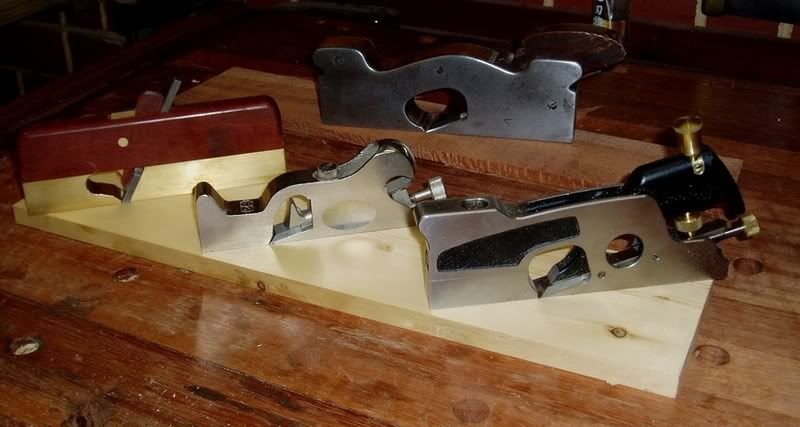
Regards from Perth
Derek
Re: The Lie Nielsen Face Joinery Float - Reviewed
#5Re: The Lie Nielsen Face Joinery Float - Reviewed
Joel
>I have to disagree with you pretty strongly.
The 140 - on a historical basis is a fairly rare tool. And on a tenon is is far far harder to control than a proper shoulder plane. It just isn't as rock solid and doesn't have the super fine mouth. (The finer the mouth of the shoulder plane the easier it is to use - not because of tearout but because of even entry and exit on the wood you want 1/32" or less). I have a 140 somewhere - but I haven't felt the urge to pull it out for decades.
"Say that the average shoulder plane is 3/4" wide, then it will have little registration. Move up to a large, wide shoulder plane, such as a 1 1/4" to 1 1/2", and matters may improve - unless the height of the plane increases in proportion, again making it unwieldy to hold and judge angles on such a small surface."
The most common historical width is 1 1/4" and the 1 1/2" width is less common but actually a little better in use. As for the size and height - bigger is better. This is what people actually used. Most people these days don't actually know how to hold a shoulder plane. For the Preston varieties pull it towards you with your thumb and forefinger grabbing the back fingerholds and the palm resting on the middle. This way it becomes a precision tool. The way you are holding the shoulder plane in the picture and clamping the work, won't give you as good results.
Note: I have nothing against floats and I am really curious why they disappeared from common cabinetmaking practice. I am also really happy that they are available once again on the market - especially considering that a float costs a lot less than a proper shoulder plane and they are darn useful tools.
Re: The Lie Nielsen Face Joinery Float - Reviewed
#6Re: The Lie Nielsen Face Joinery Float - Reviewed
Derek Cohen (in Perth, Australia)
>The 140 - on a historical basis is a fairly rare tool. And on a tenon is is far far harder to control than a proper shoulder plane. It just isn't as rock solid and doesn't have the super fine mouth.
Hi Joel
The point you raise here is where we begin to overlap in our views. One of the reasons I was curious about this float was because, as I noted in the review, the #140 (as well as a rasp) requires careful orientation to prevent creating an unsquare surface (less of an issue if there is a little waste to remove), and its size can make this more difficult to gauge. But then one can say this for any tool, including a shoulder plane. It is just that a narrow shoulder plane is tippy.
I wonder how many here have a user 1 1/4" wide shoulder plane? So many posts to date have indicated that large shoulder planes are considered too heavy and unwieldy for comfort. I happen to like a large shoulder plane, and my 1 1/4" infill is my go-to because it is a great all-rounder. However, the LV Medium, at 3/4", is far nicer to use on shoulders. And this is, I believe, more the norm when it comes to purchasing and using a shoulder plane. By extention, this leaves most users with a shoulder plane that does not suit trimming tenons (again, in my view).

Regards from Perth
Derek
Re: The Lie Nielsen Face Joinery Float - Reviewed
#7I'm curious
Bill Houghton, Sebastopol, CA
>what about the face float makes it more likely to remain square than the other two tools, as implied in your review. It would seem to me just as prone to this fault, since it, like the other two, is a workmanship-of-risk tool - that is, not jigged in any way to remain square.
Re: The Lie Nielsen Face Joinery Float - Reviewed
#8Re: The Lie Nielsen Face Joinery Float - Reviewed
Joel
>Derek,
You are talking about modern tools. I'm interested in historic professional practice. A century ago 1 1/4" or wider shoulder planes were the norm for finer work. I can't imagine any professional cabinetmaker (paid on piecework) shifting between two basically similar tools to trim shoulder and face - just takes too long and tools are expensive. I collect shoulder planes but I don't recall every using a 3/4" one for anything. I have my goto 1 1/4" in my workbench and a 1 1/2" that is sharp for tricky stuff (which I rarely use). a heavy wider shoulder plane is great on shoulders too.
Re: The Lie Nielsen Face Joinery Float - Reviewed
#9It would also be interesting to compare *LINK*
Bill Houghton, Sebastopol, CA
>the float to a vixen file (see link), a similar tool but for the curved teeth, at a lower price. I believe these were originally intended for aluminum, but I understand they're quite effective on wood (embarrassing admission: I picked up a pristine one at a garage sale a while back but have yet to touch it to a piece of wood; I plead kitchen remodel).
One retailer's vixen file listing
Re: The Lie Nielsen Face Joinery Float - Reviewed
#10Re: I'm curious
Derek Cohen (in Perth, Australia)
>Hi Bill
Good question, one that I will offer an opinion on in regard to my limited exposure with the float to date.
The float has a more delicate feel to it, and it offers more immediate feedback. It is more akin to holding and using a paring chisel than pushing a plane (although it acts like a scraper plane). Further, the float works best by using a gentle downward pressure, and this is centered over a short distance (compared to the greater length of a rasp and even the moderate length of a #140), so there is less likelihood of tipping the cutting area.
Hopefully others, such as Larry Williams and Mike Wenzloff, will offer their experiences and views here.
(I can see that a few additions/revisions are desired by the time I post this review on a website).
Regards from Perth
Derek
Re: The Lie Nielsen Face Joinery Float - Reviewed
#11Re: It would also be interesting to compare
Derek Cohen (in Perth, Australia)
>Ha! I had the same thought after I saw one in a bargain bin at the recent Perth Wood Show. Then I wondered just how I might re-sharpen it ... I lack the needed curved files! :)
Regards from Perth
Derek
Re: The Lie Nielsen Face Joinery Float - Reviewed
#12Re: I'm curious
MikeW
>I had wonderful 1 1/8" infill shoulder plane. And it work as well as any shoulder plane I ever had. A snap in trimming shoulders. Very controllable in touching up the faces of tenons.
Over time I stopped using it in favor of files (if there is a near fit off the saw) or rasps (more than a couple strokes). My choice was one of speed and utility. I can fit a tenon faster using either of those two tools.
I have made floats in the past. Really, they are simply more aggressive for cross-grained tenon faces than I need. Which is why I don't revive them from some forgotten box in the attic over the shop.
I think a float with a higher ridge/tooth count per inch would be a better option for me. If I make another it will be finer than the former ones I have used. The LN one you have, derek, is 8 ppi (I hate using that designation for floats. Should be tpi rated). At least for the scale of work I do, an 11 or 12 tpi (12/13 ppi) would be better.
fwiw, the Vixen files work fine with the exception that for me they tend to skew one way or another if the file is not kept ver flat on the work. Perhaps that feedback is good, though. If it is skewing right that means the left edge of the file is digging in.
Maybe I'll make a few new floats for tenon faces and experiment with the tpi.
Take care, Mike
Confession time. The only shoulder plane I kept is the little LN 1/2" infill. All others I have sold off. The LN is a sweet little bugger and trims any furniture-sized tenon shoulders I have needed to.
Re: The Lie Nielsen Face Joinery Float - Reviewed
#13Vixen files? Is that what they're called?
Denis Ch�nard, Orl�ans, Ont.
>I have more files than knowledge about them...
I have one, flat with curved teeth like in the link, 10 TPI, and two half-round ones (teeth on the convex side only), one 9 and the other 12 TPI. I know where to score a straight teeth one, maybe I'll get it too...
These files (I thought they were called mill files) really eat wood, and leave a very nice finish (almost hand-planed like) with a light touch.
The ones I have are "man-sized" (sorry Pam :-), 14" long. I love them...
DC
Re: The Lie Nielsen Face Joinery Float - Reviewed
#14a.k.a. dreadnought files in UK/Aust terms.
Andrew F in Australia
>
Re: The Lie Nielsen Face Joinery Float - Reviewed
#15Man sized?
Pam Niedermayer - Austin, TX
>The ones I have are "man-sized" (sorry Pam :-), 14" long. I love them...
This is such a peculiar evaluation that I find I must respond. Do you mean you feel manly when you use them? I honestly don't know of a 14" hand tool that would be difficult for women to handle.
Pam, who thinks saying something so uncute and then apologizing immediately for having done so is no apology and tells me that, for whatever reason, you meant to be uncute
Re: The Lie Nielsen Face Joinery Float - Reviewed
#16Re: The Lie Nielsen Face Joinery Float - Reviewed
Pam Niedermayer - Austin, TX
>I use the LN large shoulder plane all the time, often for adjusting tenons, and only pull out the LN 140 for large mistakes in this application. I'm currently in the process of replacing this 140 use with Japanese skewed rebate planes since I recently found a matching pair of Tsunesaburo.
Pam
Re: The Lie Nielsen Face Joinery Float - Reviewed
#17Historic Practice
Warren in Lancaster, PA
>I don't think you will find any floats of this kind in the Seaton chest. A century ago there were already tenoning machines in common use. I don't think that shoulder planes are actually as old as machine methods of making tenons.
The cabinetmakers I know all use either shoulder planes or paring chisels. The chisel has the advantage that you can control the amount removed in each swipe.
Re: The Lie Nielsen Face Joinery Float - Reviewed
#18Re: Historic Practice
Joel
>You're right. Shoulder planes first appear in the mid 1850's. Before that there were metal rebate planes which appeared in the 1810-1825 era (I think I don't think there is any hard numbers on that) but a rebate plane isn't nearly as useful for tenons as a shoulder plane. (too low and nothing to grab) I don't think there are floats in the Seaton chest (but I could be wrong) or in the Phyfe chest (but he does have infill rebate planes) but both chests have a far number of files which aren't individually described. THe Sheffield key does illustrate a float but it is of a different geometry than the new ones. However none of this precludes the use of a float in joinery today. things do change. My only real question is why a comparison with a shoulder plane wasn't included in Derek's article (which he explained), and now that you mention it, how about paring chisels too, both far more common tools for this operation than a 140.
Re: The Lie Nielsen Face Joinery Float - Reviewed
#19Re: Historic Practice
Derek Cohen (in Perth, Australia)
>..how about paring chisels too..
And we could also add a router plane.

I also frequently use paring chisels for this task too. To answer the question, the article is about illustrating the joinery floats. I thought that too many alternatives would make it an article about cutting and tuning tenons, and detract from the float.
There is a good idea here, nevertheless - a comparison of all tenon technique.
Regards from Perth
Derek
Re: The Lie Nielsen Face Joinery Float - Reviewed
#20Re: Hysterical Practice
MikeW
>I suppose a comparative article of all the way a tenon could be fitted would interest some--but I cannot fathom why.
If I had made that suggestion, it would have been a sarcastic way of suggesting to Joel to have at it. I don't think you would be as sarcastic as me, though.
The idea that a review/demonstration of a particular tool turning into people wanking on about alternatives is dumb to me. Folks, it's just a view into one way of fitting a tenon. If it doesn't fit into your idea of "hysterical accuracy" pick a method you think is.
If someone came up with a list of 20 ways, sure enough once published people would have complaints why 5 more we not included--with hysterical reasons why they should have.
Ok, I admit I'm tired and being a bit pissy. Sorry for that.
Take care, Mike
Re: The Lie Nielsen Face Joinery Float - Reviewed
#21Look at it this way
Denis Ch�nard, Orl�ans, Ont.
>In my poorly worded statement, my thinking was in the line of "man-sized" as opposed to "boy-sized".
My apology/wink was in the sense that, by comparing men and boys, I left the female gender out of the comparison...
I plead English being my second language :-)
DC
Re: The Lie Nielsen Face Joinery Float - Reviewed
#22This review convinces me that
Wiley Horne--So. Calif.
>I want a couple of these floats. I know Larry has been developing the idea for some time, so am sure there is thought and design aplenty there.
The surface that Derek gets is what convinces me, along with his observation about the feedback he gets off the wood as the tool cuts.
I have the same question as Brent: Do you get the push one or the pull one? The pull has some intuitive appeal, but then I heard (maybe from Larry) that the first tooth on the push version is very useful, and can be used something like a paring chisel.
Thanks for a good and useful review.
Wiley
Re: The Lie Nielsen Face Joinery Float - Reviewed
#23Re: This review convinces me that
MikeW
>Derek answered the question of pull/push--and the why--in his first post.
I'm a firm believer in coarse and fine files, along with rasps for adjusting tenon faces. The cranked handles on these seem like a good idea. I've made my own floats in the past, just not cranked ones. I'll have to make a few.
For paring cuts, I have a few firmers (real ones, not semi-beveled)chisels that I have ground blunt to about a 80 degree angle. They make for very controlled paring cuts, taking a fine shaving. That is said because if the pull version sounds better for you as regards the float, consider making a paring chisel ground at the 80 degree area for use when it is advantageous to use it.
Take care, Mike
Re: The Lie Nielsen Face Joinery Float - Reviewed
#24Re: Hysterical Practice
Joel
>Mike,
It is a fair question in an article on the use of a tool for tuning tenons to ask for a comparison with the two most common ways of tuning a tenon - with a wide shoulder plane, and with a chisel. My question is why it was left out - which Derek answered.
In general the more comparative information an article it is the better it is as a review, otherwise it is simply a product description.
Re: The Lie Nielsen Face Joinery Float - Reviewed
#25It's all in the wrist
Bill Houghton, Sebastopol, CA
>or, as my Dad would have said, you have to hold your mouth right.
I don't know whether the acid sharpening method would work on these or not.