WoodCentral Forums

Est. 1998 — 27 years of woodworking knowledge

Choosing a rasp

Posts

Choosing a rasp

#1

Choosing a rasp

Ian (in Sydney, Australia)

>Was working on a project last weekend that involved shaping and smoothing a heart shaped cutout in a plank.

I was not particularly happy with the selection of hardware store bought rasps and files I current use. So it must be time to buy some good ones. (I'm still accelerating down the slope)

I'm looking at getting a selection of Auriou rasps and/or the Nicholson #49 and #50.

Can I get some advice on what would be a good general purpose selection of rasp lengths and teeth density.

Re: Choosing a rasp

#2

Re: Choosing a rasp

Dean J in MN

>I suggest a Nicholson #50 to start. No need to go get a "set" of rasps until you know what that #50 can not do. I find the #50 and some files are all I need for the vast majority of work. So, pick up a #50 and work. After a while you'll be able to answer your own question. Do you need a finer tooth? Tighter radius on the half round side? Longer? Shorter? Swiss pattern important to your work?

But, I bet you'll find that #50 and a handful of files will get you a long way.

-Dean

Re: Choosing a rasp

#3

Re: Choosing a rasp

Tony - Memphis

>I haven't tried the Ariou, though they have gotten some good press. I like the pointed tip idea, that would come in handy. I only have one and it is the #49. That's what was required for a class I took several years back and it has served me well. For reference, I use it on mahogany, walnut, cherry, etc. I always follow the rasp with a file (wood file!) I got from Lee Valley I think. There are some good techniques to minimize the tracks they leave. I think Phil Lowe has written about them in FWW. Nothing more fun than shaping a cabriole leg with a nice rasp and file. Very rewarding!

Tony

Re: Choosing a rasp

#4

Re: Choosing a rasp

MikeW

>Another option to the Aurious (which I can recommend without reservation) are the set of 3 from Joel at Tools for Working Wood. I hear good things about them, don't rust which may be important depending on the shed you have in OZ.

What the better rasps get you is the ability to have a finer surface, in part by simply varying the pressure. Which means less file work.

But don't underestimate files alone, either. Files themselves can be quite aggressive to fine, especially the harder the wood. And with wood in the hardness range of say African Blackwood, you can strip the teeth off of an Auriou. Ask me or Konrad.

I suspect Joel's rasps will not suffer the same fate as the teeth are a little larger at the bases and they are a different metal. The Nicholsons and files will simply go dull rather than snap teeth off--and faster the harder the wood. A soak in citric acid periodically for a day will revitalize them.

I depend on rasps and files. I cannot see using one or the other. To me, they go hand in hand.

Take care, Mike

Re: Choosing a rasp

#5

Re: Choosing a rasp

Robin Corell in Atascadero, CA

>I find a nicholson #50 and a half round #2 bastard meet most my needs. My only complaint of the nicholson is that the teeth do not go all the way to the edge. this is rarely a problem but it is something I have wondered about the other high end rasps.

I would also recomend picking up a file card to clean your rasps and files if you don't already have one. My saw sharpener tells me that wood pitch can react with meatal in a corosive action that dulls teeth. I don't know how true this is but it is nice to get a rasp out and have it nice an clean.

Years ago I made some litle scabbards for all my files out of a mannilla file folder and a bit of glue. It seemed like it took more time remebering to do it and tracking down the materials then it did to actually do it and they really protect the files and allow me to store them in a drawer. If I remember correctly I did it at about the same time I shelled out a chunk of change for the #50.

Robin Corell

Re: Choosing a rasp

#6

Re: Choosing a rasp

Ernie Miller

>I bought the 49 & 50 a couple years back when St james? Some boat supply place back east had them on sale half off. can't think of a better purchase of a new tool I have made in a long time.

Re: Choosing a rasp

#8

Re: Choosing a rasp

Doug Littlejohn

>While I am a relative NuBe and certainly do not have the experience that Mike would have, I answered this same question for myself by buying both the 49 and the 50. These combined with my bastards and rattails, can create a very smooth surface yet allows me to agressively remove material as well. (to date, I have been very pleased with the way I went).

What I really have learned to like in the higher quality rasps (read those with random teeth) is that with some care and attention, you can get a very smooth surface just from the rasp itself. If you move it in the same relative motion (ie:track the teeth in the same place) the randomness or tooth stagger, allows for teeth in other rows to effectively not track in the same ruts so instead of compounding the tooth cuts, they tend to smooth inbetween the previous rows teeth, etc. At least that's how I see if working.

For sure, I can keep it very smooth when I try, on the level of say 100 grit paper. This of course then makes it pretty easy to smooth up with either files or sandpaper ready for finishing.

If you are not in a hurry, various of the smaller vendors have these two on sale periodicly and you can save quite a bit, I think I paid less than $60 including shipping, closer to $50 as I recall, for the 2 of them when I bought mine.

Can't attest to anything but the Nicholsons but I would presume that higher quality buys you even more controlability of the material removal and the quality of the surface left.

Re: Choosing a rasp

#9

Have you tried these instead? *LINK*

Denis Ch�nard, Orl�ans, Ont.

>LV sells Nicholson milled-tooth files that are quite nice, work as quickly, and leave a nicer surface than rasps. See link below.

One step higher is the Nicholson Supersteel. Similar principle as above, but incredibly aggressive if pushed hard, yet leaves surfaces almost hand-planed looking with a light touch. Only available in flat style, unfortunately.

DC


Nicholson Milled-Tooth files

Re: Choosing a rasp

#10

Re: Choosing a rasp

Wiley Horne--So. Calif.

>Ian,

The sequence I like is Auriou 11, 13, 14, and then into the files. This is on temperate zone hardwoods. I also have an Auriou 15, which is a wonderful tool, but I still tend to jump from the 14 to a cut 1 or 2 Grobet. I have had Nicholson 49 and 50--these are good for a wide range of tasks, but as soon as you're down into the details, like that heart you were shaping, the Auriou's shine, because they're toothed all the way to the edge, and have a knife-shaped edge and a tapered point, which means that you can detail the points of the heart with the fine rasp, and then move to a half-round file.

In the Auriou sequence, there is a big jump from the 11 and 13 cabinetmaker's series into the 14 and 15 modeler's series. Big jump from 13 to 14.

I would encourage you, whatever other decisions you make, to have the Auriou 14, because it is far finer than either the Auriou 13 or the Nicholson 50, plus it is a good entry into the files. I like the longer #14 (8"), but some like the shorter 4" or 5".

Wiley

Re: Choosing a rasp

#11

Re: Have you tried these instead?

Denis Ch�nard, Orl�ans, Ont.

>Uh... It should have read Supershear...

DC

Re: Choosing a rasp

#12

Re: Choosing a rasp

MikeW

>I whole heartedly recommend the sequence Wiley mentions. I also have a large 12 (well, OK, we have about 20 or so of the things all told) I use for softer woods which the 11 may rip the end grain from.

In general, I would add that as the rasp is finer, a shorter one is good. At least for us.

Take care, Mike

Re: Choosing a rasp

#13

Re: Choosing a rasp

Peter Evans

>Ian, I have a #50 and really like it. I assume you know LN Oz stock Nicholson and are getting Auriou (c. A$120 each for 8-10" rasps - or at least that is what I was told at Wood Show) soon. If you are coming to the TTTG Dovetail Workshop next Sunday let me know and I will bring the #50 for you to try. The very cheap Chinese swiss pattern hand made I have tried from $ shops are pretty aggressive, but work.

Do you need the expensive rasps?

I have tested my file/rasp 'collection' recently on Blackbutt, a very hard and strong (and splintery) Eucalyptus timber of high density and moderately difficult to work with hand tools. I found some old cabinet rasps (Nicholson and Wiltshire, NOS from flea market) satisfactory for shaping; quickly refined the shape with the #50 (new, cheap on eBay); and finished off with an 8" Grobet 2nd cut "Farmers Friend" (new, cheap from 2nd hand shop). End grain shone at the end, sandpaper would have spoiled it, and not an Auriou in sight.

Cheers Peter in Sydney

Re: Choosing a rasp

#15

Re: Choosing a rasp

Peter Evans

>True Derek, but high postage costs make the exercise only a little worthwhile. As I will be in US soon for a number of weeks, I may take the opportunity to pick up a few things.

Cheers

Peter in Sydney

Re: Choosing a rasp

#16

Re: Choosing a rasp

Derek Cohen (in Perth, Australia)

>Wiley and Mike

I appreciate you naming your choices - but the numbers do not correlate with those Auriou Cabinetmaker's rasps on offer at the usual sites (LN, LV, The Best Things, TFWW). Where did you purchase yours?

If I showed you what I use to shape saw and plane totes you would be horrified! This includes a really rough set of Chinese rifflers, and several Nicholson files (the so-called "wood rasp" being rougher than my 5 o'clock shadow).

Your list is too large to afford in one hit. Can it be "simplified" or reduced to essentials? I want a decent starter set up of 2 or 3 rasps (or 4 if both the #49 and #50 are included). Can it be done?

Is there any point in getting both the Nicholson #49 and #50? While not as good as an Auriou, are they still cost-effective as a user early in the rasping chain - or are they doomed to be replaced by an Auriou?

I note that LN sell a combination 8" or 10" Auriou 11 and 14. The only problem (?) is that this is a flat rasp. Still, together with one of the Nicholsons (which? or both?) and this could be a good combination. But what then of the half-round option?

Follow with one more Auriou for detail work, such as the Modeller's rasp in either 13 or 15?

Confused in Perth

Derek

Re: Choosing a rasp

#17

Derek, thank for jumping in ...

Ian (in Sydney, Australia)

>and asking the sort of follow-up questions I was thinking about

also thanks to Mike and Wiley

Re: Choosing a rasp

#18

Rasps that swing both ways... *LINK*

David Barnett - SW Florida

>Structured carbide toothed files/rasps are very useful, cut on either the push or pull stroke (really helpful for shifting wood grain), can be unclogged with a propane torch (esp. nice for wet or resinous wood), work nicely on heavily silicated woods such as teak, koa, etc. without dulling, leave polite finishes, can shape wood one minute and stone the next, seemingly last forever, and on and on.

I wouldn't necessarily consider them an alternative to Auriou (superb) and Nicholson rasps (workhorses), if one can afford both, but I wouldn't be without the 8" half-rounds in at least two grit sizes. LV carries the 6" Kutzalls -- great size for detail work and the price is right.

TCS carries a wider range of Kutzall 6" and 8" rasps in several grits. What's more, they carry a must-have line of reasonably priced detailing rifflers for carvers/sculptors.


Structured-tooth handtools - The Compleat Sculptor

Re: Choosing a rasp

#19

Re: Choosing a rasp

MikeW

>Sorry--guilty of obscurity...

The numbers (11, 12, 13, etc.) relate to coarseness--grain--of the rasps. In that sense they do correspond to The Best Things et al numbering. For instance, I have these 3 (from a previous invoice)

AU-4-250-11 250mm - 10" Auriou Rasp G11 (Fine)

AU-6-200-12 200mm - 8" Auriou Rasp G12 (Fine)

AU-8-150-13 150mm - 6" Auriou Rasp G13 (Extra-Fine)

The last number in the series corresponds to the grain (coarseness) where the smaller the number, the coarser it is. So the grain 11 above is coarser than the grain 13.

The rest of The Best Things numbering system that means something to you would be the first number. That indicates the sweep of the half-round portion. The smaller the number, the flatter the half-round profile.

The middle number is the length in mm. So the first one above is 250 mm in length.

But--it's best for y'all to talk with Lee at TBT or decide from the pages concerning the lengths and sweeps of the half-round portions for your intended purposes. Lee's recommendation will probably suit you to a T.

Take care, Mike

Re: Choosing a rasp

#20

Reply to Derek

Wiley Horne--So. Calif.

>Hi Derek,

I'll interline with your post above.....

___________

I appreciate you naming your choices - but the numbers do not correlate with those Auriou Cabinetmaker's rasps on offer at the usual sites (LN, LV, The Best Things, TFWW). Where did you purchase yours?

________

Derek, I bought mine from Joel at Tools for Working Wood. The Auriou rasps I was referring to were the Cabinetmakers and Modelers rasps--11 and 13 are the Cabinetmakers series; 14 is from the Modelers series. As for terminology, LV, LN, and TFWW use the Cabinetmakers and Modelers terminology. The Best Things uses Series 4 to refer to Cabinetmakers and Series 6 to refer to Modelers. I might note that Best Things also sells a Series 8--this series is said on the Auriou website (www.auriou.com) to have larger teeth than the Cabinetmakers or Modelers series, and is intended to be used before them. I advise sticking to the Cabinetmakers and Modelers series. By the way, if you check out the Auriou site, pick French language, then 'outils pour bois', then 'rapes'--I mention this because my browser cannot pull up any detail on the English pages.

_____________

Your list is too large to afford in one hit. Can it be "simplified" or reduced to essentials? I want a decent starter set up of 2 or 3 rasps (or 4 if both the #49 and #50 are included). Can it be done?

____________

Derek, my list is Cabinetmakers 11 and 13, and Modelers 14--that's three. In general, I think Nicholson 49 can substitute for Auriou 11 or 12 and Nicholson 50 for Auriou 13; however, for pierced work (like Ian was mentioning) you still need a tapered and edged rasp, whether Auriou or Chinese or what have you.

______________

Is there any point in getting both the Nicholson #49 and #50? While not as good as an Auriou, are they still cost-effective as a user early in the rasping chain - or are they doomed to be replaced by an Auriou?

______________

Nicholson 49 and 50 are plenty good, and very cost effective. For me, I have learned over many years to buy the thing I actually want in the first place, and that way I will only buy a given item once, rather than many times over. It all depends on what is economy for you.

___________

I note that LN sell a combination 8" or 10" Auriou 11 and 14. The only problem (?) is that this is a flat rasp. Still, together with one of the Nicholsons (which? or both?) and this could be a good combination. But what then of the half-round option?

______________

In my opinion, the combination flat rasp you describe would not mix well with Nicholson, because the flat 11 side is competing with the Nicholson 49, while the flat 14 side limits you to flat surfaces. The Auriou 14 is fantastic, but much more useful in the Modeler's series.

I don't know what the 'half round' option refers to.

_________

Follow with one more Auriou for detail work, such as the Modeller's rasp in either 13 or 15?

_______________

I really like the Auriou 14 Modelers rasp for detailed work.

Finally, I hope this extensive opining does not sound like I am proselyting for Auriou. In fact, I think there are numerous other options at less cost to remove wood in controlled fashion, including all those mentioned in this thread.

The LN/Clark & Williams collaboration on joinery floats is pretty intriguing IMO.

Wiley
Re: Choosing a rasp

#21

The Oliver catalog of Kutzall files/rasps *LINK*

David Barnett - SW Florida

>Combination files, and in addition to the 6" and 8" files, 4", 10" and 12" models, too.


Kutzall SSG and carbide grit files

Re: Choosing a rasp

#22

Coarser still

Steve Hamlin

>Other thing to bear in mind is that, as I think is common with most rasps/files, the courseness is relative to size - so a 12" Auriou 10 is more aggressive than an 8" Auriou 10.

I went a little rasp mad a month or so back, and acquired a 12" Auriou #3 - WOW - a beast, but it has adjusted my thinking. It can still produce a reasonable finish - FAST, so I'd now probably say 12" #3 half round, followed by cabinet rasps 10" #9 and 8" #11-ish would be a good start point. Beyond these, in the absence of finer toothed rasps one can get away with one-step-courser-than-final sanding by adjusting the angle of attack on the final strokes. Unless you need tight inside curves, I find the modeller's rasps less useful - to the extent that, for flat(ish) work, I find the extra width of a Stewmac Dragon rasp outweighs the quality of finish of an Auriou as an intermediate step.

Cheers

Steve

Re: Choosing a rasp

#23

One last (!) question *LINK*

Derek Cohen (in Perth, Australia)

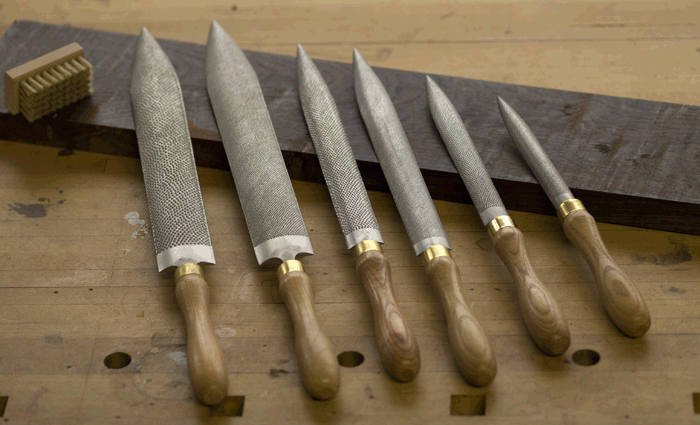
>Before I pull the trigger on three Auriou rasps, can anyone comment on the set of three Gramercy rasps, as sold by Joel at TFWW (link below). They received a good review in Pop Woodworking (which should be enough of a recommendation to satisfy anyone, except those anal like myself). Notably, they are well made and significantly less (about $50 less) in cost than the Aurious.


Bob Lang wrote: The set of three rasps I tested had progressively finer teeth as they decreased in size, which makes them a good combination of tools to go from rough shaping to fine work. Compared side by side with the Aurious there was no significant difference in performance. I�ll pocket the savings and buy another Gramercy rasp or two.


Regards from Perth

Derek


Gramercy Tools Hand Cut Cabinetmaker's Rasps

Re: Choosing a rasp

#24

Re: One last (!) question

Steve Hamlin

>Hi Derek

Just done a quick side by side of the larger Gramercy (LG), middle Gramercy (MG), an Auriou 12" #8 and a fine 10" Dragon.

Tooth size (large to small): LG, MG, Auriou, Dragon. Quite a big difference between LG and MG.

Tooth Density (Lots to sparce): Dragon, MG, LG, Auriou

Most to least aggressive: Dragon, Auriou, LG, MG - but very close between the first three. This is also the order of the widths (wide to narrow) across all four.

Quality of finish (from great to OK): Auriou - MG - (small diff) - Dragon, LG

Edge treatment

Auriou - teeth right up to the edge, which is finely serrated.

Dragon - teeth right up to the edge, which is safe

Gramercy - teeth maybe 1/16" from edge, which is deeply serrated.

I like the Gramercy rasps, but they do somehow feel a little 'undefined' in use compared to the others, as if the SS teeth just aren't as sharp. But definitely good for the outlay.

And that probably just muddied the waters :)

(Did try to take a pic, but couldn't get anything useful with my webcam)

Cheers

Steve

Re: Choosing a rasp

#25

Re: Addendum

Steve Hamlin

>Should have added that (no doubt because I have others) I find the largest Gramercy the least useful (exception being where width/radius are significant), but would say the other two alone are worth the price of the set.

Steve

👍 This page answered my questions

Your vote helps other woodworkers quickly find the answers and techniques that actually work in the shop.