Home Articles Forums Gallery Marketplace Videos

WoodCentral Forums

Knowledge You Can Build On — Est. 1998

Urban Salvaged Hardwood Slabs, Milled In-House from Rare Trees. Shop Unique Walnut Stock.

Finish ID?

Posts

Finish ID?

#1

Finish ID?

Scott in Douglassville

>Hi, all -

The camera I'm working on needs some refinishing. There are a few spots of crazing(?):
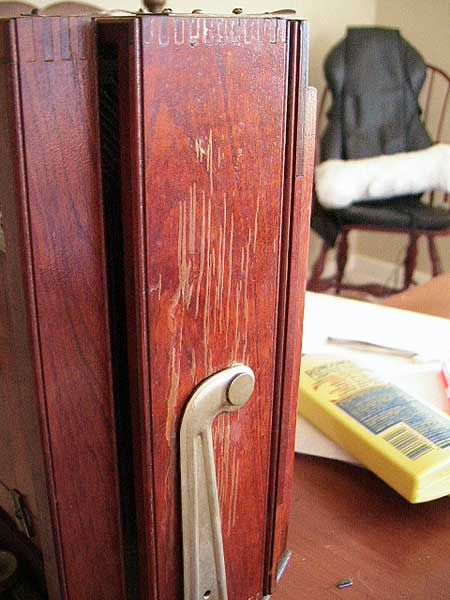


Anyone able to ID the finish type from the look of the peel? The camera was made in Rochester, NY, somwhere between 1907 and 1925. I'd rather not strip and refinish everything if I can figure out how to resolublize what's there (as in shellac) or just remove the finish coat.

Thanks!

Re: Finish ID?

#2

Re: Finish ID?

Stephen Shepherd in the State of Deseret

>Doesn't look like crazing, it looks like the finish is delaminating. You can test for shellac, which can be repaired, by testing in a conspicuous place with a cotton swab and alcohol. Some should come off and turn the tip of the swab orange. If it is shellac then you can repair with a thin coat of thinned shellac.

It looks like a later nitro-cellulose finish. Was the Camera refinished or is it the original finish?

Stephen

Re: Finish ID?

#3

Re: Finish ID?

Scott in Douglassville

>It's the original finish, Stephen. Would laquer thinner let me test for nitrocellulose? I'm sure that's a stupid question...

Re: Finish ID?

#4

Looks like

jim reed @ tallahassee

>cheep lacquer to me. Test it with laq thinner. Also test as mentioned with alcohol. Does not look like shellac to me. That usually gets dark and powdery. My experience with antique furniture around the same era tells me that you should strip it. Delaminating finish like that is bad news. When you apply new finish, it may cause additional delamination, especially around the spots where the finish is gone. The good news is that the original finish is probably pretty brittle and you may be able to scrape it off pretty easily. Good luck.

Re: Finish ID?

#5

Re: Finish ID?

Dave Anderson Chester, NH

>I'm hardly an expert, but I did grow up outside Kodaktown (Rochester). They made film and the early films, both movie and still were nitrocelluose based. I'd bet money it's lacquer. Not cheap so much, but rather it's was the only lacquer available in the early days and Eastman Kodak was one of the first to adopt it.

Re: Finish ID?

#6

If it is...

Scott in Douglassville

>...what can be done to salvage it? I'd really rather avoid stripping it and refinishing unless aboslutely necessary, 'cause it seems to be mostly stained birch. I'd either have to retain the stain or take it to bare wood and restain it. Either way, I'd like to keep this operation as simple as possible...

Re: Finish ID?

#7

Maybe an option....

Ellis Walentine, Host

>... would be to try a reamalgamator. These are solvent blends that dissolve the existing, failed finish and reconstitute it as a thin version of its former self. I don't have much experience with these products, but that might be your least invasive way to reestablish a base on which you can build a new topcoat.

I think Formby's makes one, and I'm sure that refinishing supply companies can recommend something.

Ellis Walentine, Host

Re: Finish ID?

#8

Spookey...

Scott Burr in Ben Lomond CA

>Reminds me of the movie "Re-animator". But, they never come back "quite" right.

Sounds like interesting stuff!

Re: Finish ID?

#9

Re: Finish ID?

Stephen Shepherd in the State of Deseret

>Of course it is nitro cellulose, let me think what is Kodak film?

Your best bet is to strip it off and replace it with a nitrocellulose lacquer, just like the original. Scraping would be the best the finish is brittle. Stripping will remove some of the stain on the birch and that can be a problem. Nitro cellulose at its finest (gun cotton).

Now here is an interesting story, I had to strip some large benches for a restaurant one time and I tried everything, then I thought I would heat up the finish with a torch to try and soften it. When I applied the torch the finish ignited and completely burned away in a matter of seconds leaving only light ash to brush off. Never encountered that before but I did make good money on that job.

The problem with the 'spooky' amalgamators is that they are a mixture of stripper and finish and they never work well.

Stephen

Re: Finish ID?

#10

Thanks, guys...

Scott in Douglassville

>Well, looks like I'll be scraping and maybe sanding. If the stain won't stay on, I'll have to redo the whole thing. Hope not.

I'm getting close to being able to order a new bellows. When I get there, and the bellows are off, I'll strip the hardware off and see what I can do with the finish.

Thanks for the help, guys.

Re: Finish ID?

#11

Removing nitrocellulose lacquer...

Scott in Douglassville

>Ok, I have a question on this: If I scrape the dried, brittle nitrocellulose lacquer off the wood, then do repeated wipedowns with lacquer thinner, will I remove most of the old finish, leaving the stain, and be ready to apply new NC lacquer?

I'm facing this same process in a couple other projects - I've "inherited" a few contact printing frames, all early 1900s, out of Rochester, NY. Wood and finish looks the same as the camera.

Let me know what y'all think.

Scott

Re: Finish ID?

#12

a possible flaw in the approach

Bill Tindal, E.TN

>The lacquer film will be slow to dissolve. It may be that the solvent evaporates before it has a chance to dissolve the lacquer film. Why not use stripper? It has gunk in it to slow its evaporation. It will no more or less remove the stain than the lacquer solvent.

Re: Finish ID?

#13

Both approaches...

Scott in Douglassville

>Well, I used lacquer thinner on one end, and liquid stripper (not gel) on t'other. Can you tell which was which?


Scrubbed on with an old rag, rubbed for maybe 15-30 seconds with each. Clean enough for my purposes. On this, at least.

The finish on the camera looks much better, though it's in worse shape. I think it'll clean up fine, then it'll get a new coat (or five...) of lacquer.

Re: Finish ID?

#14

Re: Both approaches...

Stephen Shepherd in the State of Deseret

>If you use stripper make sure you clean up all excess even out of the fine cracks and crevices. Any remaining stripper residue can contaminate the lacquer finish and cause problems.

Wiping down with lacquer thinner looks like a better choice and no stripper residue to deal with.

Stephen

Re: Finish ID?

#15

Re: Both approaches...

Scott in Douglassville

>Thanks, Stephen. I'm actually looking forward to taking the camera apart now (will be sending the bellows off for replacement in the next few weeks). Will be scraping and washing, then re-lacquering it, replacing screws, fixing the last few cracks. Gonna be one fine machine when it's done!

Re: Finish ID?

#17

Re: I don't know...

Scott in Douglassville

>FWIW, that was the wash-with-lacquer-thinner side.

The Wooster sleeve was from a "brush comb" I found at Lowe's. Has a blunt steel comb on one side for cleaning paint brushes; the other side is a very soft brass brush, perfect for working into tight areas while stripping old finish.

Re: Finish ID?

#19

Re: So....

Scott in Douglassville

>Lacquer thinner. Refinished the stock lensboard yesterday with the thinner, spray lacuer, and steel wool. Looks new. In fact, I'm making a new back for the camera right now out of mahogany. Going to lacquer/steel wool it, too.

Pics when things are done.

Re: Finish ID?

#20

What do you use for color...

Stephen Shepherd in the State of Deseret

>if you need to re-stain or stain the new? Have you tried alkanet root and linseed oil? It is a great stain for mahogany and to make birch look like mahogany.

Stephen

Re: Finish ID?

#21

Re: What do you use for color...

Scott in Douglassville

>I'll look for some, Stephen. Thanks.

Let me ask you this, though: With woods that darken significantly (like mahogany and cherry), will stain used when the wood is light lead to extremely dark colors when the wood ages? I've always been hesitant to stain cherry and mahogany because it seems like, as the wood ages, it'd get impossibly muddy and dark...

Re: Finish ID?

#22

Re: What do you use for color...

Stephen Shepherd in the State of Deseret

>The advantage or disadvantage of alkanet root is that it is a vegetable base and is fugitive. So as the cherry or mahogany darken the finish lightenes.

I would recommend you accelerate the color change by exposure to uv radiation and or an atmosphere of pure oxygen (use caution). Once you have all surfaces worked, expose them to sunlight to help things along.

Stephen

Re: Finish ID?

#23

Re: What do you use for color...

Scott in Douglassville

>I'll keep looking. Found some, and it was fairly cheap (about $3.50), but the shipping was about $15!

I like the idea of a fugitive finish on mahogany. I'll probably let the reducing back I made yesterday suntan, but will find some of the alkanet root for future projects.

Thanks for the great info.

Re: Finish ID?

#24

You want some real red...

Stephen Shepherd in the State of Deseret

>gets some Dragons Blood. Not eye of newt and toe of frog stuff, this is a sap from a rattan palm, Dracaena Draco, it is a coloring agent and binder. It can be dissolved in either water or alcohol, can add it to shellac or make spirit varnish. I make red ink out of it, not that I need red ink, I supply it to the local bank. Also an interesting incense.

Stephen

Re: Finish ID?

#25

Alkanet root - tips?

Scott in Douglassville

>Ok, I ordered some Alkanet root powder - 3 oz with shipping was about $6. I've been removing parts from the camera, scrubbing gently with a very soft brass bristle brush, and rinsing repeatedly, all with lacquer thinner. Seems to be taking the old lacquer down to bare wood, without removing any noticible stain. Refinishing with spray lacquer.

There are a few places where I'll need to add new wood - either birch (like the rest of the camera) or real mahogany. Either way, I'll be trying the alkanet root as a colorant.

Any suggestions on recipe, application, topcoat?

Scott


img