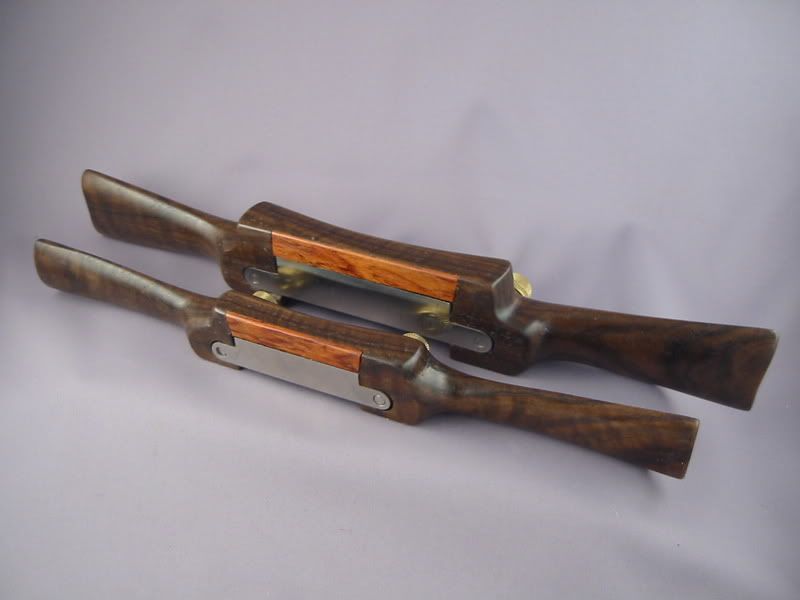
Awhile ago I bought a couple of Lee Valley spoke shave kits. They make a large and a small kit, so I made a pair. I had them roughed out in January, but finally finished them today.
I chose some curly claro walnut for my shave bodies.
These were fun to make, the wood is a matched pair from a cut off from some pepper mills I am about to make.
The sole plates that came in the kit were brass, I thought replacing them with some rosewood looked better.
The finish is three coast of shellac followed by a carnauba wax application with my Beal buffing system.
It was fun to make some tools that fit my hands, shaping the handles with rasps and files was a very satisfying process. I think I will make another set with radiused soles.
I am taking a John Robinson class in a few weeks making a Windsor three legged stool, these should come in handy then.
>Jim, they are absolutely beautiful, and they look as though they will be good users as well. Any difference in the designs of the two, or is it just size?
>Some things to be aware of when you start playing with them. I made a nice cherry one with a Hock blade a while back, these were some of my findings...
-You may find that this particular breed of spokeshave is prone to having a bit of flex in the blade, so fine shavings in the center may be a little harder to make than you think, compared to the LN/LV offerings in Brinze and Iron, where the blade is fully supported. One thing I finally realized is that spokeshaves aren't quite the same thing as planes, despite obvious similarities in the mind of the user. There's no sin in using the center of the blade for heavier cute, and the edges for thinner trimmings.
-I used Ebony for my wear plate, not rosewood, but it does work very well. That said, avoid running the thing at a 45 degree angle along a corner of some square stock. It's just wood, but the concentrated pressure on that edge will wear some nifty grooves in your rosewood. Come at it at somethign of an angle, and round in from the flat spots, instead of rounding over the sharp corners.
-Not having the Lee Valley kit, I don't know what they say in the directions. Hock suggested having a slight (1-2 degree) bevel, coming up in front of the blade. Having the flat side of the blade inlaid into a flat surface will very nicely keep the cutting edge from engaging. If it's fine shavings you're after, keep that slope very shallow. Not that it isn't convenient sometimes to hog off more material at a time until you start to approach your final shape.
-Lastly, I find the occasional coat of Myland's paste wax does wonders to keep the thing feeling smooth and sexy. Wax isn't the most durable of finishes, but it sure does feel nice in the hand if you keep it up well.