Making Lever Caps and Lever Cap Screws in the Back *LINK*
Derek Cohen (in Perth, Australia)
>
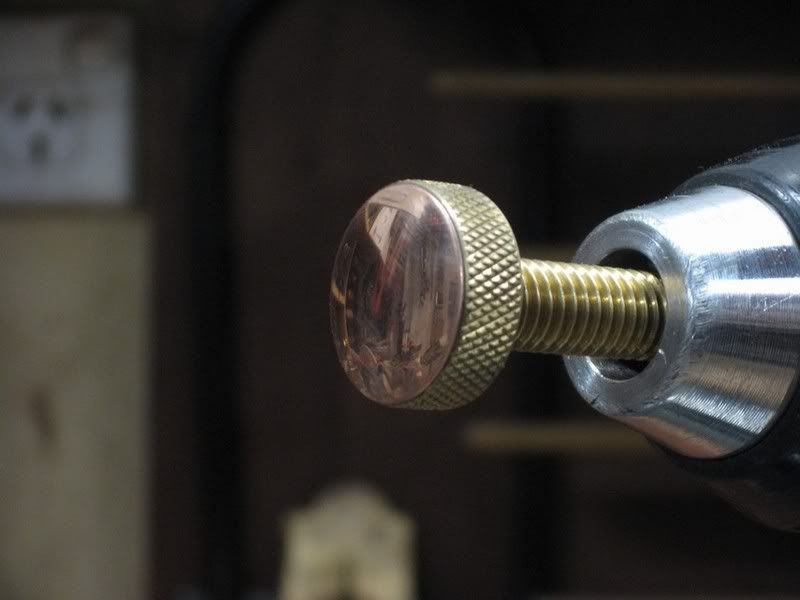
As mentioned in my recent post on building a jointer, below is a link to an article I have completed on building lever caps and cap screws with basic tools.
I hope this is useful.
Regards from Perth
Re: Making Lever Caps and Lever Cap Screws in the Back *LINK*
#2Re: Making Lever Caps and Lever Cap Screws in the
Ernie Miller
>Great idea I am going to have to steal that one. I Will modify it slightly for a smaller plane I want to make. Thanks!
Re: Making Lever Caps and Lever Cap Screws in the Back *LINK*
#3Re: Making Lever Caps and Lever Cap Screws in the
Barryvabeach
>Derek, great post. You are not cheating all that much. I bought a metal lathe to do things like threading rods and knurling parts and only later learned that machinists would not commonly cut threads on a rod like the cap screw you made because it is cheaper ( in terms of labor) and easier to buy threaded rod in long sections - all thread - then cut off the section you want and drill, tap , and locktite it to the head. For ex, for the lever cap screws, it might be easier to buy all thread, or even a long screw, drill a hole part way through the brass pin, then tap it and loctite the end of the screw into the pin and cut off the screw to length. Barry
Re: Making Lever Caps and Lever Cap Screws in the Back *LINK*
#4Clever
Bill Houghton, Sebastopol, CA
>Various lamp parts can be used similarly to make smaller knurled screws, as for a metal spokeshave.
Re: Making Lever Caps and Lever Cap Screws in the Back *LINK*
#5Re: Clever
steve knight
>wax will work better to keep epoxy from where you want it. but remember brass and epoxy don't hang together. there is a chemical reaction and the two will pop apart with not a huge amount of force. don't ask me how I learned of that.
Re: Making Lever Caps and Lever Cap Screws in the Back *LINK*
#6Re: Clever
Derek Cohen (in Perth, Australia)
>Hi Steve
As I mentioned before, in the 5 years I have been doing this I have not had a problem with separation of brass and epoxy. I suppose the reason is that there is relatively little stress exerted on the construction, plus the internals provide a good deal of "keying" (unlike two smooth surfaces in an infill).
Regards from Perth
Derek
Re: Making Lever Caps and Lever Cap Screws in the Back *LINK*
#7Thanks Derek, Most Helpful!
Frank D. in Montreal
>
Re: Making Lever Caps and Lever Cap Screws in the Back *LINK*
#8Re: Making Lever Caps and Lever Cap Screws in the
Andrew Lunn
>Thanks for the tutorial Derek! Very ingenious and interesting. I enjoyed it quite a bit. Keep up the fine work!
Andrew
Re: Making Lever Caps and Lever Cap Screws in the Back *LINK*
#9Re: Great tutorial -- source for knurled screws
Dave Mount, NE Minnesota
>Thanks for posting this and the many other tutorials Derek -- when I look at these tutorials I not only gain knowledge about how to make whatever it is that you're making, I also get ideas about how to apply your techniques to other things. With no one local to brainstorm these kinds of things with, having access to other's expertise and experiences is hugely valuable.
I'm sure not trying to take the fun out of the fabrication process for anyone, but for those that don't want to take on the thumbscrew fabrication, I thought I'd mention that McMaster-Carr sells knurled screws in a wide variety of sizes. In brass, they only go up to a 1/4" x 20 thread with a 1/2" knurled head, but if one is willing to go to stainless (they have plain steel ones too) you can go all the way up to a 1/2" thread and a 1.25" head. They also have knurled nuts.
I only recently was put on to McMaster-Carr (Scott Burr often mentions them) but I am really impressed with their website and their selection. The way they allow you to zero in on what you need through searching is really cool -- in this case, type in "knurled" in the search window on the left and you'll see what I mean. It's really handy when you don't know exactly what you want and want to see the options that are available. I haven't ordered from them yet, but I'm about to. I also noticed that their prices for O-1 tool steel seem to be a little lower than MSC, who I have ordered from previously. MSC's website is similar in general concept, but it's far clunkier. I don't know if McMaster-Carr is an option outside the U.S.
Anyway, thanks again for putting in the time to assemble these tutorials -- I really appreciate it.
Best,
Dave
Re: Making Lever Caps and Lever Cap Screws in the Back *LINK*
#10Re: Clever
steve knight
>yes you have the holes to fill so it will hold. but letting people know bass and epoxy dont' stick is a good tip. I bet if you cated the brass with something then it would work pretty well. but it does not take much force to breat the bond.
something that will stick is a silicone adhisive. sticks to about anything and makes a perment bond between things.
Re: Making Lever Caps and Lever Cap Screws in the Back *LINK*
#11Thanks Derek, Very informative!
Scott Burr in Ben Lomond CA
>