WoodCentral Forums

Est. 1998 — 27 years of woodworking knowledge

LV Mag-Jig� Magnetic Clamps *LINK*

Posts

LV Mag-Jig� Magnetic Clamps *LINK*

#1

LV Mag-Jig� Magnetic Clamps *LINK*

Pam Niedermayer - Austin, TX

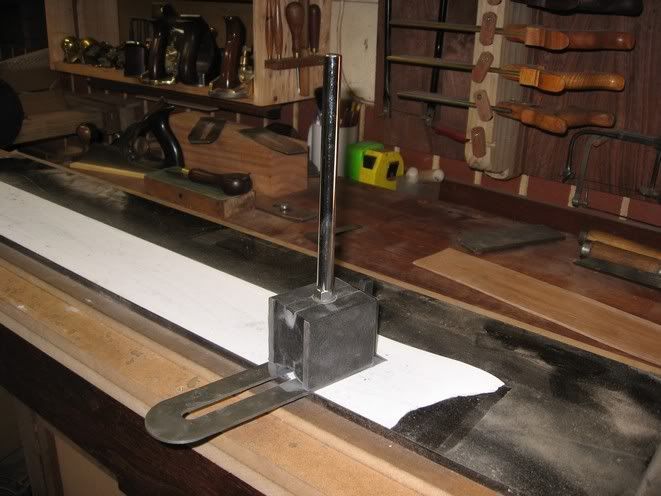
>Rob or anyone else much more clever than I, I don't get this tool. I don't understand how exactly it clamps the jig shown to the bandsaw table shown or what good it does to mount the magnet in the fence base, as is implied when following the View link for the 30 mm version. Seems to me the way it should work would be to place the magnet under the table. However, it sounds like it might be very useful. Help!

Pam


Mag-Jig� Magnetic Clamps

Re: LV Mag-Jig� Magnetic Clamps *LINK*

#2

Re: LV Mag-Jig� Magnetic Clamps

ThomD

>See the plywood resaw fence in the background of the picture you have linked? It is held to the table by means of these clamps. The clamps rotate out of magnetic alignment when the knob is turned, and have hitherto been used to mount lamps, coolant sprayers, indicator stands, etc... to power or machine tools. I used my mag base light a lot, and idicator base occasionally.

This LV product allows one to make one's own applications like the fence shown. The cool deal is that extremely powerful magnets that would be impractical to mount fixed and move about by hand can be used.

Could these be used to make clamp clamps, as for securing a bridge to a guitar?. Sure/maybe, but the price seems a little high in this particular case, though you do get two magnets for the bucks. Here is the original kind of deal used by machinists.

http://busybeetools.ca/cgi-bin/picture10?&NETID=1759380320071389647&NTITEM=B223

Re: LV Mag-Jig� Magnetic Clamps *LINK*

#3

Re: LV Mag-Jig� Magnetic Clamps

Dean Lapinel

>The photo above the view link shows the magnet within the unit. Turning the knob lowers the magnet allowing contact with the metal.

Dean

Re: LV Mag-Jig� Magnetic Clamps *LINK*

#4

Re: LV Mag-Jig� Magnetic Clamps

ThomD

>I could be wrong, but I think it rotates the mags so they net out?

Re: LV Mag-Jig� Magnetic Clamps *LINK*

#5

Re: LV Mag-Jig� Magnetic Clamps

Pam Niedermayer - Austin, TX

>Aha, got it, thanks, Thom. These are jig installed, not easily portable among several jigs/clamps. I was thinking about them more like earth magnet use than what they are.

Pam

Re: LV Mag-Jig� Magnetic Clamps *LINK*

#6

That agrees with the LV description, Thom.

Pam Niedermayer - Austin, TX

>

Re: LV Mag-Jig� Magnetic Clamps *LINK*

#7

Steve Kubien

Re: LV Mag-Jig� Magnetic Clamps

Steve Kubien

>It wouldn't be too tough to move them around if that's what you want to do. I believe that each mag is held in place by 2 screws.

Just a thought.

Steve Kubien

Ajax, Ontario

Re: LV Mag-Jig� Magnetic Clamps *LINK*

#8

Re: LV Mag-Jig� Magnetic Clamps

Paul Kierstead

>One wonders if the screws are really necessary, assuming picking up and storing the jig is not an issue. Also assuming the fit is very good of course.

Maybe you could wedge them in :)

Re: LV Mag-Jig� Magnetic Clamps *LINK*

#9

Re: LV Mag-Jig� Magnetic Clamps

Pam Niedermayer - Austin, TX

>Thanks, Steve. I was thinking of all those power tool places I need an adjustable fence now and then, such as on the CMS, router table, foot mortiser, etc., where now I have to use C clamps.

Pam

Re: LV Mag-Jig� Magnetic Clamps *LINK*

#10

Applications

Derek Cohen (in Perth, Australia)

>Think of these magnets as the same as the ones in a dial indicator. You turn the knob to turn on the magnetic force, then turn a gain to switch it off (as so move the dial indicator/jig/etc).

I have used the dial indicator to grip a plane or chisel blade so that I could hold it flat while grinding and honing.

By hand:


By machine:


Of course other applications, such as positioning and attaching fences on router tables or bandsaws or finger boards ... a multitude of areas... is possible with these little magnets.

I think I will put in an order myself!

Regards from Perth

Derek

Re: LV Mag-Jig� Magnetic Clamps *LINK*

#11

Re: Applications

Pam Niedermayer - Austin, TX

>Those are very cool applications, Derek, perfect for sharpening big Japanese blades (assuming that wrought iron is sufficiently ferrous), would save a couple of finger tips from rude cuts and bruises. Do you know approximately how many pounds of force your blade holding requires?

Pam

Re: LV Mag-Jig� Magnetic Clamps *LINK*

#12

Re: LV Mag-Jig� Magnetic Clamps

Gary Tenney

>That is correct. The magnets are aligned with their north and south poles cancelling for moveing the device, and when the poles are aligned north end to south end they become one powerful magnet by the Lines of Flux linking and becoming common as in one single larger magnet. As in ,Like poles attract, unlike poles repel!

Gary

Re: LV Mag-Jig� Magnetic Clamps *LINK*

#13

Re: Applications *LINK*

Derek Cohen (in Perth, Australia)

>Do you know approximately how many pounds of force your blade holding requires?

Hi Pam

In terms of figures such as lbs/sq in or similar, then no. However, for hand sharpening the magnet provides a great deal of support, which translates into downforce, stability and, ultimately, a faster and better sharpening process. I used this in a tutorial I wrote a little while ago on flattening backs of blades (link below).

For machine work, such as the belt sander (e.g. for flattening blades) or disk sander (e.g. surface grinding knife blades), the dial indicator's magnetic power is only just enough. I would prefer a little more, so my recommendation is to use the higher rated of the LV magnets, perhaps even double them up in this situation.

Regards from Perth

Derek


Lapping the backs of blades

Re: LV Mag-Jig� Magnetic Clamps *LINK*

#14

Re: LV Mag-Jig� Magnetic Clamps

Ernie Miller

>Pammy now you have me thinking? that's bad. when I gear up for toy's for Tot's production I do alot of production work on the cut off sled and other tools. I wonder if a peice of sheet inlayed and screwed to the cut off sled would be enough to hold down temporary fences for making identical length parts? If they could do that I could see hoe a person wouldn't have to make a bunch of special production jigs for each toy. I think I have 7 special sleds for just the F16 fighter plane. I could start to make differant toys with out having to make new jigs every time.

Re: LV Mag-Jig� Magnetic Clamps *LINK*

#15

Re: LV Mag-Jig� Magnetic Clamps

Thomas Skaggs, Foothills of Mount Level

>I wonder if there is a maximum distance of separation between the magnets? Is there a distance where they would be rendered ineffective? That may have some affect on the size or type of jig they could be used for. Or so I would think.

Tom

Re: LV Mag-Jig� Magnetic Clamps *LINK*

#16

And

Bill Houghton, Sebastopol, CA

>it looks from the photos like Rob's elves left enough finger room that you might be able to use a knurled nut to hold it on, thus making switching even faster (if slightly more expensive).

Re: LV Mag-Jig� Magnetic Clamps *LINK*

#17

Re: LV Mag-Jig� Magnetic Clamps

Dan Donaldson

>In general, these types of magnets are designed to be in contact with the metal they are sticking to. The holding power would be greatly reduced if they were not touching. That would limit the thickness of the base they were mounted into unless you mortised them in so that the bottom was flush with the bottom of the fixture and in contact with the resting surface.

Re: LV Mag-Jig� Magnetic Clamps *LINK*

#18

Yep, my train of thought, too. :)

Pam Niedermayer - Austin, TX

>

Re: LV Mag-Jig� Magnetic Clamps *LINK*

#19

Cool idea, Bill.

Pam Niedermayer - Austin, TX

>

Re: LV Mag-Jig� Magnetic Clamps *LINK*

#20

Re: LV Mag-Jig� Magnetic Clamps

ThomD

>"In general, these types of magnets are designed to be in contact with the metal they are sticking to. The holding power would be greatly reduced if they were not touching."

Sounds good to me, but on the machinists versions the magnet is contained within the base, is not visible, or in contact. Also the bases are relieved in various clever ways for contour or to bridge rough surfaces. Obviously one wants them close and probably touching if your jig is otherwise wood, the machinist versions are metal based. The other side of the issue is the rotating function allows very powerful magnets to be used conveniently, so they seem to be able to make some work even if they aren't in contact.

Re: LV Mag-Jig� Magnetic Clamps *LINK*

#21

Re: LV Mag-Jig� Magnetic Clamps

Dan Donaldson

>Not sure, but I seem to remember that the bottom of the machinist ones do sit on the metal they are holding to.(not necessarily all of it, but at least some edges) The magnets don't necessarily touch, but the metal base should, or close to it. the metal frame of most of these acts to concentrate the field when the magnets are aligned. The tend to lose quite a bit of holding power if they are not set down. I may be wrong on this, but that is what I weem to remember. A question: How well do they hold if you put a 1/4 inch piece of wood under it between the holder and the surface?

Re: LV Mag-Jig� Magnetic Clamps *LINK*

#22

Re: LV Mag-Jig� Magnetic Clamps

ThomD

>I think you are spot on, in everything you say there.

Re: LV Mag-Jig� Magnetic Clamps *LINK*

#23

Tried an experiment

Dan Donaldson

>I got curious about this and what I had remembered. One of the problems with being an engineer, I guess;-)

I don't have one of those bases that turn on and off, but I do have a magnetic feather board. It has a large permanent super magnet on the bottom that sits on the table in use. This is not quite the same, but I think it is similar to one of those switchable ones when turned on. Under normal conditions (contacting the table etc.) it can be pulled up with one hand, but with difficulty. I tried pushing it to one side and it took a considerable amount of force. I wanted a thin spacer, so I used a paper towel. With one layer under it, It was not too difficult to remove it with one hand, and I could push it around on the table with fair effort. I then put two layers under it. In this configuration, I could lift it up easily and push it around the table with one finger. At least with this one, contact is very important.

👍 This page answered my questions

Your vote helps other woodworkers quickly find the answers and techniques that actually work in the shop.