WoodCentral Forums

Est. 1998 — 27 years of woodworking knowledge

Skew chisel question

Posts

Skew chisel question

#1

Skew chisel question

Scott Burr in Ben Lomond, CA

>What would be a good skew angle for chisels. I picked up a 4 pack of Marples blue chips and want to turn them into skews. 45 deg makes a somewhat logical choice but I want to check with you all to see what you think.

Thanks, Scott suffering through a head cold on a very rainy night.

Re: Skew chisel question

#2

30 degrees.

Paul Kierstead

>Or is it 60 ... kind of depends on where you are measuring. The tip would form a 60 angle from the usual position.

Re: Skew chisel question

#4

Re: good thread

Derek Cohen (in Perth, Australia)

>BB

That was a good thread on fishtail verses skew chisels. I would not change anything said there other than to add that I have added a couple of skew chisels to my armoury, as well as buying a couple of Japanese fishtail chisels.

I gave the skew chisels some thought and what I came up with was to grind the angle at 20 degrees. I made a set in 3/8" and I am getting a 1/4" set from Blue Spruce (to match my dovetail chisels, of course!).

Why 20 degrees? Firstly, since these are used for cleaning out pins in half-blind dovetails, the narrower the tails, the wider the pins. So the skew chisel does not need to be narrow. A narrow one, however, has a wider range since it can cut on a diagonal and, in so doing, needs to do so with a slight slicing action. 20 degree offers a good compromise between a push and a slice. Note that a 1:8 ratio (to be used on a push) equates to 10 degrees.

Interestingly, shortly after I ordered these from Dave, I noticed that Lie Nielson were also offering skew chisels in these same sizes (1/4" and 3/8") and at 20 degrees. Great minds ... :)

Here is an illustration of the slicing action:
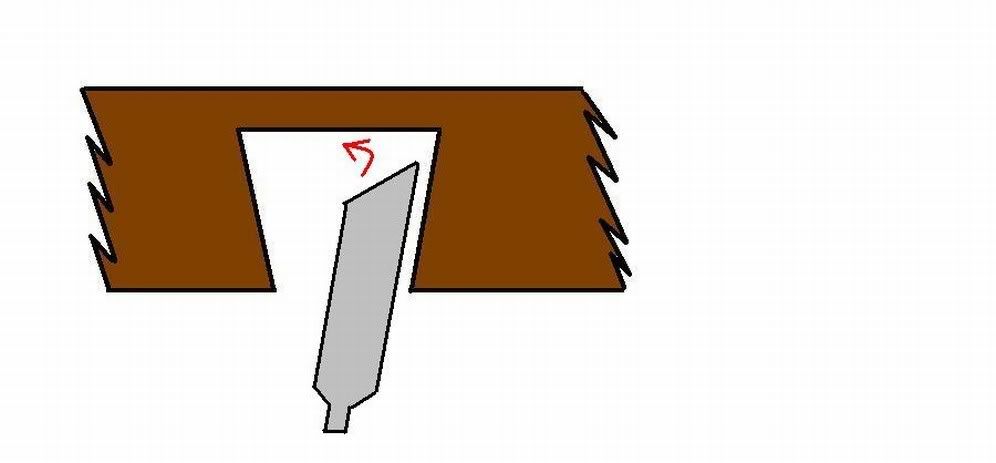


I still like the fishtails for a push pare.

Regards from Perth

Derek

Re: Skew chisel question

#5

My recommendation

jim reed @ tallahassee

>is that you pick an angle and start with the smallest chisel. Large ones can be a chore to grind. If you start with the smallest, you will have less work and can then use it in a few projects. You may find an angle that is just right for what you do. Or you may find that you need to make them all different. As for me, I use 45 degree angles on 1/4" chisels and use them exclusively for cleaning out blind dovetails. Good luck with your grinding. Don't forget the dust protection.

Re: Skew chisel question

#6

what are they used for?

bill tindal, E.TN

>I made a right and left handed skew when we made our chisels and they have set on the bench ever since, unused. I don't know if I am missing an opportunity or I just haven't done anything that needs them.

BTW, the CPM 3V steel has gotten some exposure among us as plane irons, but where it has excelled beyond expectations is for chisels. For the kind of work chisels do, abrasive wear is not much of a factor. Imagine paring the equivalent amount of a typical planing job. But toughness is a big issue for a chisel, especially if they are pounded on. The 3V steel excels in toughness and it shows up in edge life.

Re: Skew chisel question

#7

Re: Skew chisel question

Paul in NJ

>I grind my skew angle to about ~15-20 degrees, a little more than my dovetail angles. I found I only need one 1/4" skew chisel to clean the sockets of my blind dovetails. My chisel is a used, relatively short, straight sided firmer. With a 25-degree flat bevel, there is plenty of registration when I flip it over to do the other corner. I find no need for a second paired chisel and that speeds things up and cuts down on bench top clutter.

Paul Dzioba

Re: Skew chisel question

#8

Re: good thread

paul womack

>That was a good thread on fishtail verses skew chisels.

Yeah, I know it wasn't quite the same question, but the discussion raised most of the relevant points, albeit from a slightly different POV.

BugBear

Re: Skew chisel question

#9

I'm with Bill

Adam Cherubini

>I don't have a skew chisel and I don't feel I desperately need one. Moreover, I don't even have bevel sided chisels. I don't find any disadvantage in dovetail work whatsoever. My concern is that this is another industrial revolution way of thinking- the sense that one needs to "jig" a specific cut. That may be unfair here and I'm talking out of both sides of my outh because I have specialty tools for other operations. But generally, I think its a good default position to avoid such things.

That said, I use the skewed end of my striking knife quite a bit and wonder if this isn't superior (in its thinness and handy presence at the bench).

Okay- so I'm just thinking out loud here. If we were voting I'd vote pretty low, like 10-15 degrees as a skew angle. You can ignore the other stuff!

Adam

Re: Skew chisel question

#10

Whatever suits your work

Denis Ch�nard, Orl�ans, Ont.

>That's what I did. I bought a few old BE chisels for that purpose, ground them to about twice the DT angle I was using at the time (can't give you a number, those were eyeballed too) to make sure I could reach the DT corners. My guess would be about 20 degrees. I then honed them to about 15 degree bevel angle, since they take such a light cut the shallow bevel takes it without trouble so far.

DC

Re: Skew chisel question

#11

25 deg. skew, 20 deg. bevel

Jay Samuels

>

Re: Skew chisel question

#12

I take it you don't make a lot of small pinned...

Scott Burr in Ben Lomond, CA

>or english style DT. Just a guess on my part.

Re: Skew chisel question

#13

Thanks JIm

Scott Burr in Ben Lomond, CA

>No worries... Safty glasses and good dust mask all the way!

Re: Skew chisel question

#14

Thanks All

Scott Burr sneezing/runny nose in Ben Lomond

>Did a little home work on the subject last night. They seem to range from 20-35 deg. Derek and LN use 20deg most others 35. I'll start with one at 20 and one at 45 just to play around. After all their only Marples and didn't cost alot. I know they won't be used all that much but, it's like my LN#9. It's nice to have around when it's needed.

Re: Skew chisel question

#15

Re: I take it you don't make a lot of small pinned

Warren in Lancaster, PA

>I made a 1/4 skew about 30 years ago thinking I would use it for dovetails, but I gradually stopped using it. I don't think I've even looked for it since I moved into my new shop in 1985. It just isn't needed.

I have a chisel that is skewed at about 25 degrees that I use a lot in carving. A carving chisel is more delicate: 1/8 inch at its thickest tapering to 1/16 at the start of the bevel and beveled on both sides so there is no right or left. I have never been tempted to use it for joinery.

If you have a use in mind, I would make the chisel with as little skew as you can get away with. You might think that one with a more extreme skew would be more versatile, but you lose efficiency as the cutting edge gets more angled away from the direction of force.

Re: Skew chisel question

#16

You're right, Scott

Adam Cherubini

>I don't do a lot of that sort of work. I know some guys make these things so small that the top of the gap is only one saw kerf wide. I don't think I've ever made pins that small. Do guys use skews for that? I usually size my dts for specific chisels and I think the smaller pins I've done have 1/4" or 5/16" backs. So I have room to slip an 1/8" chisel in there to clean out the corners.

Adam

Re: Skew chisel question

#18

Nope, won't be using them for that...

Scott Burr in Ben Lomond CA

>Mostly for cleaning 1/2 blinds and into obtruse corner angles. I was just courious because all you use firmers (correct term?) chisels.

👍 This page answered my questions

Your vote helps other woodworkers quickly find the answers and techniques that actually work in the shop.