Marking/cutting gauge
Derek Cohen (in Perth, Australia)
>This design is taken from a Woodjoy gauge I have admired. I guess imitation is a sincere form of flattery.
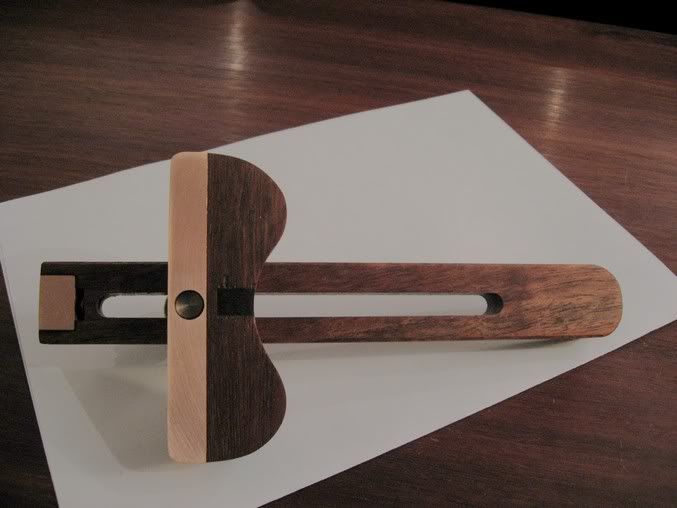
I made all the parts with the exception of the Veritas knob. The blade is an ex-spadebit, V-edged so that it can cut in either direction.
The construction is brass, Tasmanian Blackwood (top) and Jarrah (below).
The fence is reversable to mark curved edges. The face is 3".


Thanks for looking
Regards from Perth
Derek
Re: Marking/cutting gauge
#2Re: Marking/cutting gauge
Pam Niedermayer - Austin, TX
>Great looking gauge, Derek. I've long liked the looks of that Woodjoy, too.
Pam
Re: Marking/cutting gauge
#3details?
bill tindall
>would you please provide details for how the cutting assemply is made- how is knife secured, how assembly is held in the wood "fork", how slot was made.
Re: Marking/cutting gauge
#4Re: details?
Derek Cohen (in Perth, Australia)
>would you please provide details for how the cutting assemply is made- how is knife secured, how assembly is held in the wood "fork", how slot was made.
Hi Bill
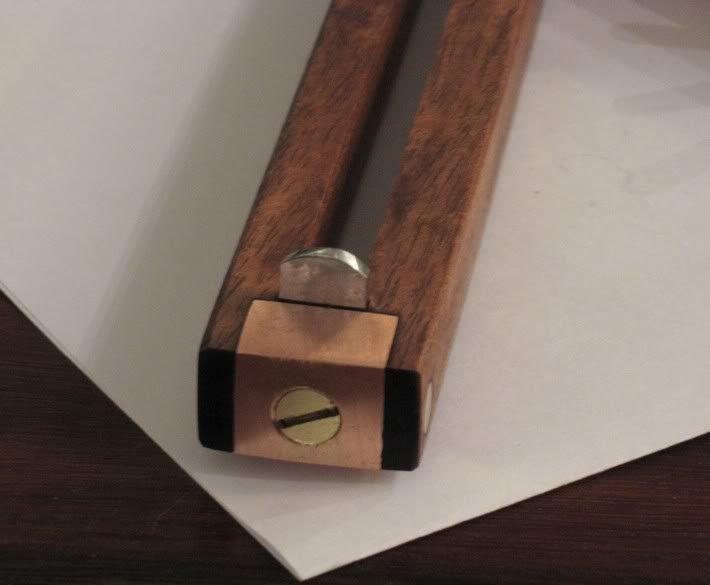
The knife is secured by a screw from the front end of the arm. Further, the knife is also held within a mortice so that there can be no sideways movement.
I shaped the brass end, cut and fitted it to the arm flush to the end of the mortice, then removed this to cut the mortice for the knife. After a dry fit I epoxied the brass end, pinned it with brass rod (1/3 of the way in from each side - not all the way through), and drilled and tapped the thread for the knife-holding screw.
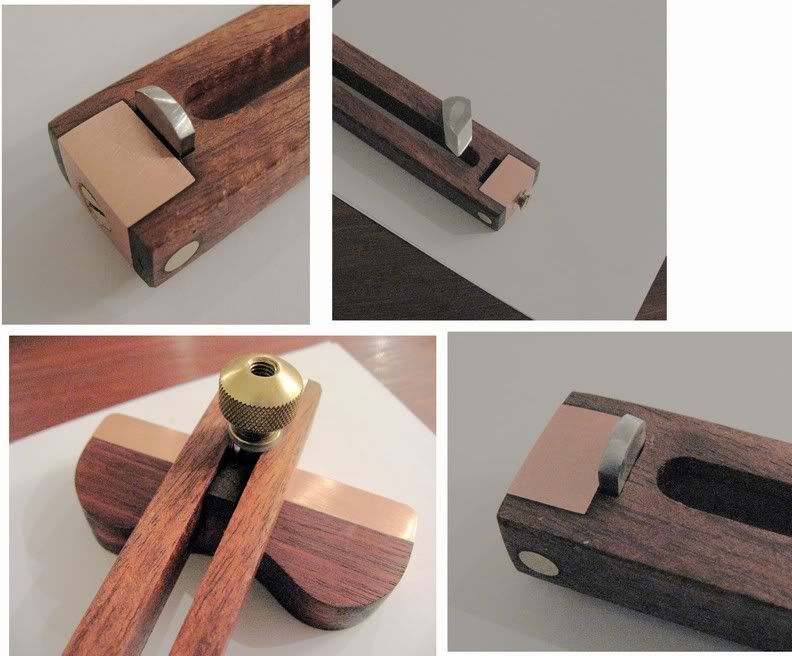
The other feature is the tenon that keeps the fence square to the sliding arm. This can just be seen at the rear of the knob.
The slot was made with a 'tailed router (sometimes it is the easiest and best tool)!
My apologies if the pics are not as clear as possible - having a little difficulty tonight.
Regards from Perth
Derek
Re: Marking/cutting gauge
#5thanks, that was clear
bill tindall
Re: Marking/cutting gauge
#6Nice job Derek. Thanks for sharing.
V Parisian
Re: Marking/cutting gauge
#7Re: Marking/cutting gauge
Paul Kierstead
>Very Nice! I have been contemplating making one myself, although more in the 'panel guage' I think it likes to be called (large fence, long arm). I wasn't thinking so nice as yours, it is inspirational.
So, how is the performance? I would be betting very good.
Re: Marking/cutting gauge
#8Nice job there Derek!
Frank D. in Montreal
Re: Marking/cutting gauge
#9Very nice!
Scott Burr in Ben Lomond CA
>Why does the brass look like copper? Nice job on the gauge.
Re: Marking/cutting gauge
#10Re: Very nice!
Derek Cohen (in Perth, Australia)
>Hi Scott
The brass is indeed quite pink. I am not sure why, that is, what the percentage of copper is in it. For all I know it may be copper! I was told it was brass at the metal salvage yard (where I bought several pieces some years ago). It is certainly very hard both to cut and grind. I have used it before, once to build a lever cap for an infill plane. It has easily withstood all the stresses heaped on it in this area.
Regards from Perth
Derek
Re: Marking/cutting gauge
#11Re: Marking/cutting gauge
paul womack
>I would worry (perhaps needlessly...) that the positioning knob has a comparatively small area of contact with the arm; this may increase the pressure suffiently to make dent the wood, making adjustment "notchy".
I hasd such an issue with my scratch stock design, leading to a REALLY big washer under my original washer.
(perhaps your woods are harder... ;-)
http://www.geocities.com/plybench/scratch.html
BugBear
Re: Marking/cutting gauge
#12Re: washer
Derek Cohen (in Perth, Australia)
>BB
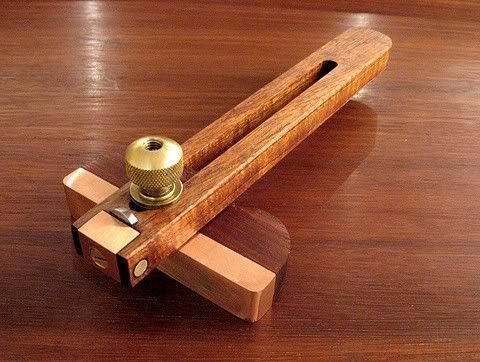
After consideration, I have added a larger brasswasher. Thanks.
Regards from Perth
Derek
Re: Marking/cutting gauge
#13Re: washer
paul womack
>Thanks Derek; I'm glad you took my comments in the constructive way that they were intended.
("tone" in a written forum is *so* difficult...)
BugBear