WoodCentral Forums

Est. 1998 — 27 years of woodworking knowledge

"Different" vice dog?

Posts

"Different" vice dog?

#1

"Different" vice dog?

Edward in Vancouver


>Ever since I got my new LV jack, I'm starting to notice the metal dog on my vice more, haven't had any nicks yet, and I don't want any either.

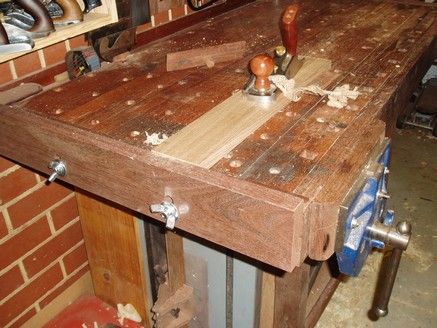
The vice in question is a 13", uh...Asian copy of a Record. Tops of the jaw are flush with the surface of my bench, the dog is a hunk of steel, about 1"wide and maybe 3/8" thick, with a wingnut to set it's height. On the outside face are cast two holes to accept screws for a wood jaw. I mounted the fixed jaw of the vice BEHIND the maple 1x4 running the face of the bench, thus the maple 1x4 is the jaw pad of the fixed jaw, and the moveable jaw is plain cast iron, haven't gotten around to making a wood jaw pad yet.

So I got to thinking...

What would happen if I cut two vertical slots in a nice piece of maple I've been saving, countersunk the slots to accept a bolt head, popped the piece into the jaw with the bolts protruding through the two screw holes and tightend the bolts from the outside face with wingnuts? This would allow me to have a wood bench dog running the entire length of the vice jaw, adjustable height, with an option to drop down the dog (or jaw pad, I guess) so the top of the vice is flush with the bench top, and also keeping the option of using my steel vice dog as well.

Anyone try this? Would it work or should I just replace the metal dog with a piece of wood?
Re: "Different" vice dog?

#2

Vice dog vs vise dog

jim reed @ tallahassee


>One sniffs drugs and the other snares wood. Sorry, but I couldn't help myself. As for the posted problem, I have always thought of the little tab as an emergency holder, kinda like a *pup*. My dogs are 1 1/2 billets of steel and they really *dog* a board down on the bench. Have you had any problems? Do you think the little tab will snap off?

Re: "Different" vice dog?

#3

Re: Vice dog vs vise dog

Edward in Vancouver


>Don't quite follow you. It's not a question of the steel dog being strong enough, but a question of a ham handed guy (me) potentially nicking his plane iron on the metal dog.

Re: "Different" vice dog?

#5

Strong dogs

jim reed @ tallahassee


>My point is that the large dogs are incredibly strong. With only 1/4" exposed I can clamp with enough pressure to warp a board (4/4 x 6" hardwood). I am guessing that you need to raise your vise pin at least an inch to work. In my opinion, vise pins should not be confused with bench dogs. Dogs are cambered in and also have a waffle face. Vise pins are normally smooth and have no camber. Because of that you have to raise them to work and thus put your plane iron at risk. Vises like yours are often used as side vises anyway. Why not get a bench screw and mount it on the end and use proper dogs?

Re: "Different" vice dog?

#6

Sweeeet.........

V Parisian

Re: "Different" vice dog?

#7

Re: Vice dog vs vise dog

ThomD


>As long as you keep it low enough... However, you will probably snag the metal dog someday. One option would be an aluminum or brass dog, just drill and tap a bar of the appropriate size, for your current screw and you will have a metal dog that is probably strong enough. All it will do to your blade if you snag a non-ferous metal is dull your blade probably not chip it.

Re: "Different" vice dog?

#8

Re: "Different" vice dog?

Edward in Vancouver


>Thanks Derek, that makes a whole lot of sense. While researching my "ideal design" for a workbench, can't remember which book, but thre was a description of workbench that had no vices (?!) but only an adjustable plane stop. The author claimed it was all you needed since clamping the work could put an unintentional twist or bow to the board being planed.

That being said, me being ham-handed and all, I've never really had anyone show me how to use a plane or how to secure wood to a bench to plane it. Everything I've learned so far is through books and posts on this site--not saying this an ideal way to learn, but it's the only one available to me. Until now, I had been securing the board against the vice dog and two bench dogs on the long edge of my bench. Hence my aprehension of nicking my iron. I have made a strip of wood about 3/4"thick and secured two 3/4"dowels in it, enabling me to pop it into my 3/4 grid of holes in my bench, but this is not ideal since the board that suppports my work is often thicker than the work itself. Also take into consideration that I am ham handed and have unintentionally pushed my work off of the stop or skewed it. Yes, I know my technique needs work, alot of it, but I am putting energy and thought into the process and enjoying what I get out of it.

Re: "Different" vice dog?

#9

Replace the steel dog with wood ??

Ian (in Sydney Australia)


>If the vise is a Record copy, then the steel dog should come out and you can replace it with a piece of hard wood.

Re: "Different" vice dog?

#10

Re: "Different" vice dog?

Dave OH


>Re:

I have made a strip of wood about 3/4"thick and secured two 3/4"dowels in it, enabling me to pop it into my 3/4 grid of holes in my bench, but this is not ideal since the board that suppports my work is often thicker than the work itself. Also take into consideration that I am ham handed and have unintentionally pushed my work off of the stop or skewed it.

Edward, you should consider making an L shaped stop to fit your "grid" of dog holes. This would help with the skewing and hold the work fast at 90 deg. If you plane the L down to 3/8 or 1/2 it would be lower than most common stock available so no more troubles either.

Dave

Re: "Different" vice dog?

#11

Re: "Different" vice dog?

Paul M. in San Diego


>I was forced to learn how to plane into a stop via lazyness. I finished the base and top of my bench, but it took me a while to add the vises. So I got quite a lot of practice planing with just a stop. I still do this quite often, as the vises just add aditional operations to open and close them. Once you learn to do the dance of planing into the stop, it's just easier that way than fussing with vises.

👍 This page answered my questions

Your vote helps other woodworkers quickly find the answers and techniques that actually work in the shop.