WoodCentral Forums

Est. 1998 — 27 years of woodworking knowledge

A question in regard to modifying Japanese chisels

Posts

A question in regard to modifying Japanese chisels

#1

A question in regard to modifying Japanese chisels

Derek Cohen (in Perth, Australia)


>I have a couple of Japanese bench chisels that I am thinking of modifying. Bascally, I would like to use them for dovetailing. The sides are too thick as they stand, and my idea is to grind away the excess steel. This should not be too difficult since the reinforcing steel is softer than the cutting steel. However I am unsure whether this procedure will significantly effect the integrity of the chisel(s).

Has any one done this, or have views on the proposed modification?

Regards from Perth

Derek
Re: A question in regard to modifying Japanese chisels

#2

Re: A question in regard to modifying Japanese chi

mikew


>Cannot imagine it would affect a thing, Derek. The DT Japanese chisels have a significantly steep side, which exposes more of the hard steel on the edge of the sides.

Keep the heat down, and have at it.

Take care, Mike

Re: A question in regard to modifying Japanese chisels

#3

Re: A question in regard to modifying Japanese chi

ThomD


>One thing to keep in mind is that in order to get into the corners, it is rarely necesarry to have the same angle as the dovetail itself. Depending on the size we are talking about, the saw kerf gets right into the corner and then for the chisel to get there too, it only needs to be as angled as the angle from the ramianing wood to the outside of the saw slot. Even if you want to get right into the corner, the cut can be more effective with a tiny skewing of the chisel, such as is possible with the chisel sized for the waste and not the full waste plus kerf cut, again allowing less angle to be taken, from the sides of the chisel.

As far as grinding is concerned you can grind these chisels on sanders and wheels, or by hand. If you use power, then you can just dip them in water. as long as the film of water is still present you are probably in the 200F plus range, and probably aren't going to draw the temper. Some Japanese chisels are HSS and you can grind them as hard as you like.

I like to use gunsmith's cold bluing to restore the surface and give it a fraction of rust resistance after I have ground the chisel.

Re: A question in regard to modifying Japanese chisels

#4

Re: A question in regard to modifying Japanese chi

David Charlesworth


>I have rehoned the edges of two Japanese chisels to approximately 1;6.

This was slow but safe. The angled surface did not go the full length of the blade. A combination of grinding & honing would be much more efficient. Some jigging was used for the honing.

Re: A question in regard to modifying Japanese chisels

#5

Re: A question in regard to modifying Japanese chi

Derek Cohen (in Perth, Australia)


>Thanks Mike, Thom and David.

David, with memories of a recent thread in which you made a strong case for defined edges, just how sharp a side edge do you grind, or view as ideal, in a dovetail chisel?

My plan is to make up a jig for my large bench sander (which is quite slow - less than half that of a grinder) and rough in the sides using 60 or 80 grit. After than I will more onto a 120 grit, then waterstones. 1:6 is also what I had in mind since this should account for all angles, both hard and softwood.

I was wondering what or even if it was necessary to repaint the sides. Do they really need this? I rarely have a problem with rust in my workshop.

Regards from Perth

Derek

Re: A question in regard to modifying Japanese chisels

#6

Re: A question in regard to modifying Japanese chi

Ian in Sydney (on his notebook again)


>Derek

your chisels must be radically different to mine.

to do what you're contemplating requires the removal of so little metal that I would do it with a coarse diamond or water stone.

as to rust, thinking back 30 years to the little metalurgy I did as part of my engineering degree, because two different steels (metals) are bonded together, there is an elevated potential for corrosion at the contact line. So I suggest a protetive coating is warranted

regards

Ian

Re: A question in regard to modifying Japanese chisels

#7

Re: A question in regard to modifying Japanese chi

Derek Cohen (in Perth, Australia)


>Ian

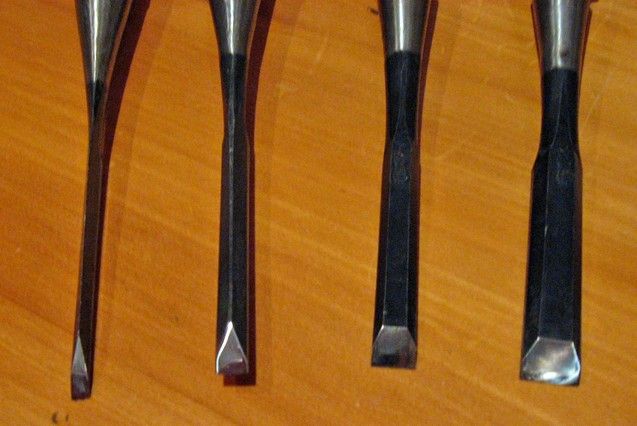
There is a big enough difference between my Japanese dovetail chisels (which I would like to "tune up" with a little honing of the sides as well) and the Japanese bench chisels that I want to convert to dovetail chisels (which I believe will need grinding).

From left to right: 1/8" dovetail, 1/4" dovetail, 9 mm bench, 12 mm bench.


Regards from Perth

Derek

Re: A question in regard to modifying Japanese chisels

#8

Re: A question in regard to modifying Japanese chi

wilbur


>Converting a Japanese bench chisel to a dovetail chisel might not be very feasible. Certainly the sides of a Japanese chisel can be altered by grinding or honing. Remember, though, that the lamination of a Japanese bench chisel is such that the hard steel also runs up the sides of the chisel as well as covering the bottom flat side, like a squarish "U". If you grind down a Japanese bench chisel so that it now has the triangular profile of a dovetail chisel, there's a good chance that you'll lose a good portion of the side lamination. How this will affect the function of the chisel I'm not sure, but I'd be nervous about doing this.

One alternative that was suggested to me by Wiley Horne is not to try to put a pure triangular crossection on the chisel, but to bevel the sides to about a 75-80 degree angle with the flat bottom of the chisel. This should provide enough relief to get you into the corners of a dovetail, if you approach the corner of the dovetail at an angle.

Re: A question in regard to modifying Japanese chisels

#9

Re: A question in regard to modifying Japanese chi

David Charlesworth


>Derek,

One in six works for me as I never use a lower angles on my dovetails.

Perhaps just a gnat's whisker lower???

I have big rust problems due to coastal location with prevailing onshore winds. {very bad for the surf!) So use Camellia oil routinely. No above average rust issue with the sides, though I'm sure the metallurgical advice below is correct.

Re: A question in regard to modifying Japanese chisels

#10

Re: A question in regard to modifying Japanese chi

ThomD


>It would be curious to know exactly where the Japanese dovetail bench chisel comes from, I have yet to see much light dovetail work in Japanese furniture, or an example of a Japanese worker cutting them. Whenever I have seen a Japanes craftsman at work, or one trained over there, they have really been wailing on their chisels. To really get the power out of them they are capable of, there is a significant difference in stiffness in the full dovetail blade. Used in the delicate maner one sees in wester hands I can't see there would be much advantage to the stouter blade.

I bought my first set of chisels, Ouchiis, that were specially side ground at the factory I think it was like 81 degrees. So none of this has really affected me that much. I never think about the side angles that much. I think the idea of tightly matched chisels is slightly bogus, since one still needs to know ones way around the pins, in the end how difficult is it to just cut them out.

Re: A question in regard to modifying Japanese chisels

#11

Re: A question in regard to modifying Japanese chi

ThomD


>The bluing is a chemical treatment, it makes the chisel sport a black oxide coating. I dip the whole thing in and everything goes black makes a nice effect on the hollow, and lets one see how any flatening is progressing.

Robert Majors wrote some tripe about sharpening the sides edges back in the 70s or 80s, so that is what I did. Back then I had the bad habit of holding the chisels by the blades, and cut myself pretty relentlessly, which didn't really bother me that much, but didn't make me feel any more competant either. I never really saw any particular advantage, and I don't see this as being a comon approach amoung Japanese craftsmen (not that that should govern us). I think some do it, and others don't more often the latter.

I have never seen any rust on the interface. Anyway, some of the chsiels have the hard metal curled well up the edges. I'm not sure where all this stuff falls on the galvanic series, but it doesn't seem to be a big problem. I have had wet and reasonably dry shops and the parts that most comonly got a little rust on them were the machine formed hoops.

Re: A question in regard to modifying Japanese chisels

#12

Re: A question in regard to modifying Japanese chi

ThomD


>I think that is what is under consideration here. Not converting them into Japanese style dovetail chisels just converting them into chisels more closely suited to dovetailing. I think the triangular shaped Japanese chisels are ground into the sides pretty heavily, so that might not constitute a significant difference after the grinding was over, even if it is persued to a significant degree. Can't check mine right now, so I don't know for sure.

Re: A question in regard to modifying Japanese chisels

#13

Re: A question in regard to modifying Japanese chi

Ian in Sydney (on his notebook again)


>Derek

I wasn't envisioning reproducing the full triangular shape of a DT chisel.

The right angled sides of my bench chisels (to where the bevel starts) is 2mm high, give or take a few thou. Relieving the whole side to say 1:6 would require the removal of a triangular shape about 2.2mm wide and 0.3mm thick. Not a lot to take off by hand with a coarse stone or file.

Ian

Re: A question in regard to modifying Japanese chisels

#14

Re: A question in regard to modifying Japanese chi

Derek Cohen (in Perth, Australia)


>Hi Ian

I had not even considered using a file since I thought one would not cut well enough, but the idea is very tempting.... a file and a 1:6 marking square to check the angle along the way. I prefer the sound of this to a grinder.

Regards from Perth

Derek

Re: A question in regard to modifying Japanese chisels

#15

Re: A question in regard to modifying Japanese chi

ThomD


>The file will skate on the hardened steel, but it would take the iron. You can see where all that is at the bevel.

👍 This page answered my questions

Your vote helps other woodworkers quickly find the answers and techniques that actually work in the shop.