WoodCentral Forums

Est. 1998 — 27 years of woodworking knowledge

Broken Iron

Posts

Broken Iron

#1

Broken Iron

Marc in Luxembourg

>I have this old T&G matched pair. I cleaned both and the T-plane works fine, but the G-plane has a broken iron. You see it on the pic, the location of fracture is one inch from the bevel. It's a laminated iron and the cutting steel (carbon s.) would considerably be diminished, if I'd cut off at the crack.

Two questions: Is cutting off the only solution? How will I do, with a saw or should I break off, the iron clamped in a vise with pliers? As I am not sure, what makes less damage, what doesn't change the temper, I d'appreciate your ideas.

Marc
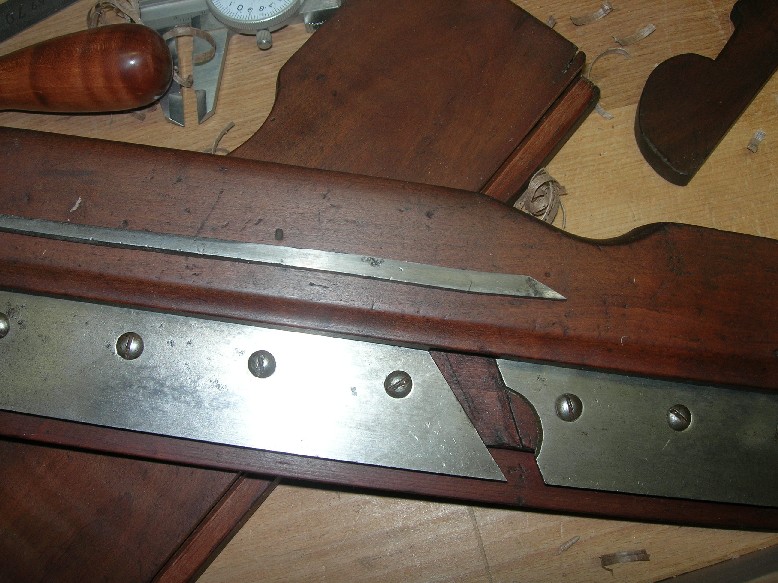

img

Re: Broken Iron

#2

Hmmmm....

Scott Burr in Ben Lomond CA

>Well, breaking it off won't ruin the temper. You could use a dremel tool with a cutoff blade to get a good clean cut. Just don't rush it and cool the blade in water as you go. My biggest concern is... Does the iron taper up the sides of the blade? If so, you could shorten it up to where the "t" won't fit in the "g".

Re: Broken Iron

#3

Blacksmith

Dean Lapinel

>A blacksmith could repair that with ease.

Re: Broken Iron

#4

Re: Sure!

Marc in Luxembourg

>Scott, ya see it correctly. The iron has taper. I made this Hmmmm too, seeing it. Well, I'd have to grind half a mm.

Re: Broken Iron

#5

Re: Blacksmith

ThomD

>It would be faster and easier to make a new one. On a small section like that re-welding it would do more harm than good. One could probably grind into it and then arc weld it, put the tip in a vice so the heat doesn't travel, but you would still possibly loose the temper. Of course it could be re-tempered. So is grinding and welding actually easier that sawing out a piece of O1? Depends on the specifics.

Re: Broken Iron

#6

Re: Broken Iron

todd hughes

>I think that iron is history, if you cut it back that far you will probably be about out of the steel bit and into the soft iron. I guess it could be brazed or welded but way more trouble then it would be worth and with no gurantee. Much easier to make another iron either out of scratch or from another old one [my choice].

Have you tried it like it is? Might work OK and if it doesn't and it breaks off what have you lost? Crack probably has been there a long time. Almost looks like it was from burning the iron when it was forged but just speculating now...Todd

Re: Broken Iron

#7

Re: Thanks to ya all...

Marc in Luxembourg

>I broke it off this morning. Well in fact first I tapered the iron on a water grinding wheel, took me 10 minutes , extended the notch with a file, and had to saw because the soft iron didn't break. The bit steel is almost as thick on the new bevel and I have an inch of bit steel length. That is enough for me. I the flattened the back, grinded a new bevel and sharpened. It performs gorgeously well.

For the blacksmith, we don't have one in the region for 20 years or so. So this didn't work.

The iron chattered with the broken tip, so I had to repair, i.e. shorten.

Thanks for your answers.

Marc

Re: Broken Iron

#8

Yes, I know Marc has moved on with this...

Vic Parisian

>However, I was thinking maybe silver solder? What say you "in the Know" guys? Why not? Or if a possible repair, why?

Victor - who once apon a time saw specs on the strength of silver solder welds that looked pretty impressive.

Re: Broken Iron

#9

Re: Blacksmith

Marc in Luxembourg

>I heard O1 several times now. But I merely know A2 as a good steel for plane irons. So what is this with O1? A new formula? As you say: "So is grinding and welding actually easier that sawing out a piece of O1?" What about the temper if I'd saw a piece outta O1 bar? Would I have to temper again or not? It sounds a little bit as I hadn't to do so.

Would be glad to have more information on the subject,

Marc

Re: Broken Iron

#10

Re: Blacksmith

Joe Rogers, Northern Virginia

>Mark...O1 is oil hardened high carbon steel. Probably what is close to the steel that is the edge material of your broken cutter. The A2 is a harder tougher alloy and I believe is air (A)hardened. I may be wrong but this is what I remember reading here. Perhaps others may add to or correct this information.JR

Re: Broken Iron

#11

Re: Blacksmith

Dan Donaldson

>Actually, it is the A2 that is the new formula. O1 or something similar is what most non-exotic plane irons are made of.

Re: Broken Iron

#12

Re: Yes, I know Marc has moved on with this...

todd hughes

>To heat it up enough to silver solder it would take the temper out and it would have to be re hardened and tempered. To reharden it you would have to heat it up hot enough to unsolder it and you would be back at square one....Todd

Re: Broken Iron

#13

Heh, heh. :)

Pam Niedermayer - Austin, TX

>

Re: Broken Iron

#14

Re: Blacksmith & LV

ThomD

>Leaving aside all the hype about plane irons, O1 is easily purchase in North America, at least In just about any metal store. It comes ground like a finished plane blade already, one just needs to cut it out and add the bevel. I can usually make a standard plane blade in about 10 minutes with O1, but I have a metal cutting bandsaw, very cheap about the cost of an electric drill. One does then need to heat treat the metal, but I think a clean blade would likely be a better starting point than trying to weld the thing you already have. Depends on the particular set-up.

O1 is a very plain vanilla steel and is easily heat treated in a home shop, however it doesn't react like many other plain vanilla steels. Steels are unique just like various woods.

I was interested to hear Rob Lee's coments about "making" us all make our own handles for planes and spokeshaves. I think we are on the verge of a ton of people making their own tools, and folks like LV are working up a parallel strategy. I has seen a bunch of magazines this year carry heat treating article. There are several article like that just this month. One recomending using the kitchen stove for hardening. It's can be so easy I think that once people get over the initial hurdle they will wonder why they waited so long. This is just a general coment, I think you already make some tools.

Re: Broken Iron

#15

Re: Blacksmith & LV

todd hughes

>How could use a kitchen stove for hardening steel ?.....Maybe if you had a gas burner you might could do something with very tiny parts but I think you would have a hard time getting anything else hot enough....Todd

Re: Broken Iron

#16

Re: Blacksmith & LV

William Duffield, on the Cohansey

>You can temper the O1 steel in the oven, after you've hardened it, but hardening it requires about 1500� F, for which you will need something much more robust than a kitchen stove.

Robust doesn't need to be expensive or complicated. I built a furnace from a couple of $2 fire bricks, a $30 torch that works with either propane or MAPP, and a quart of peanut oil in a coffee can. Between quenchings, I keep the peanut oil warm in my potpouri glue pot. My setup is not robust enough to weld a tool steel edge to a wroght iron blade body, but it will harden a large enough piece of O1 to make a groove plane blade.

I suspect Todd's forge cost him quite a bit less than mine, and his will handle much larger blades, to boot. However, his uses coal, and you have to expend a bit of effort cranking the blower.

The following photo is from George's Basement:


Re: Broken Iron

#17

Re: Broken Iron

paul womack

>Hmm. In sequence.

1) Try it!

2) Grind it back, and hope you still have some steel.

3) Get a "fairly near" plough iron, and grind to fit.

Plough irons are fairly common (round my way, anyway). Certainly more common than T&G blades.

BugBear

👍 This page answered my questions

Your vote helps other woodworkers quickly find the answers and techniques that actually work in the shop.