WoodCentral Forums

Est. 1998 — 27 years of woodworking knowledge

A good day

Posts

A good day

#1

A good day

Moses Yoder in White Pigeon, MI

>I was debating whether to heat my shop and spend a few hours puttering around but have decided I will spend the day puttering around with my family instead. I have to get up around 5 am most days, so when I sleep in till 6 I had a really good night's sleep. The rest of the family of course has to sleep in a while longer if they are going to sleep in. So this morning I finished a book called "Wild at Heart" by John Eldredge, a very good book that every man should read. Now once again find myself on the web, and having just read the article about how difficult it was to put together a Shepherd plane kit and seeing the one in FWW with all of the gaps showing (I can't believe they didn't doctor up that photo better) I wandered over to the Shepherd site. I notice it has changed quite a bit, but I see the plane I want is still there. I get $20 per week to spend on tools, which is a good sum of money, but the plane I want would require not spending any tool money for 6 months; not sure that will ever happen. But someday it will. And then I can see for myself just how difficult it is to put one together, but I am thinking for someone who actually has some woodworking experience it would be challenging and fun but not that difficult. The plane I would put together would be the Norris style A6 smoother with the brass sides. Some day in the future I'll let you know how it goes.

Re: A good day

#2

Indeed!

WoodburnBob

>I've spent the last couple hours doing just about what you've been doing and enjoyed the flow and sense of serenity in what you wrote.

I was curious which article you read about the infill kit, if it was about "how difficult" rather than how easy. There are plenty of things written up about how easy it is thought to be.

I followed your suggestion and took a look at what you're yearning for. Wow! $469 seems to be a chunk of money for a kit. It'd be interesting to learn, just for a sense of "added value", what the relative allocations are for raw materials, machining and "earnings". The photo of the finished infill is attractive enough in its own way, but I prefer the antique looks of the originals. I can't see there'd be much difference in time between tuning an original and assembling the kit. Different strokes...and all that, I guess.

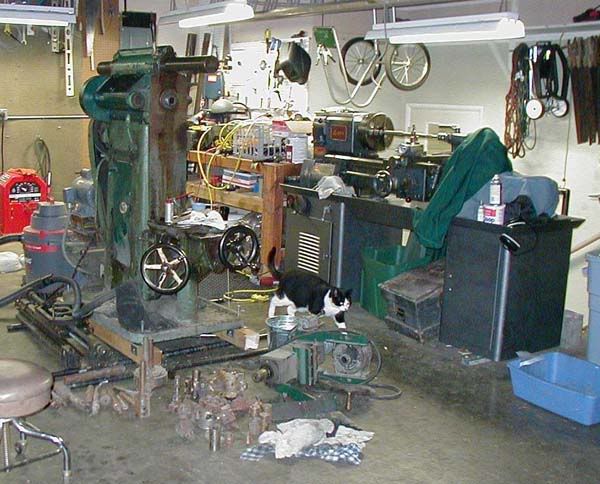
Just to do a little reciprocal sharing, I saved up my lunch money for 6 months and bought this for $250 last month. Not the cat, the horizontal mill and all the tooling in the middle of the floor. Weighs in at about 3500 lbs. Impressed? Dated from somewhere in the vicinity of WWI. I'm still experimenting with different approaches to getting a plane sole flat. Of course, my fantasy is to mill some infill bodies for myself.

Image hosted by Photobucket.com

Image hosted by Photobucket.com

Re: A good day

#3

Re: old iron

Moses Yoder in White Pigeon, MI

>I like old iron, although I have figured out I am going to want to focus on certain things in my life because there simply will not be enough time to explore everything I am interested in. The only old iron chunk I plan on having in my shop at some point will be an old 36" band saw. Your milling machine (?) looks interesting, and I believe you will have many hours of fun with it.

When I first started reading about the building of infills I wanted to make my own from scratch. I did a bit of research on the materials and found I could easily spend about $200 for the materials to make a nice brass sided infill with naval brass sides, and then have to cut all the dovetails and all the rest of the things that go with it. When I first heard about the Shepherd kits I knew that this was the infill project that fit me perfectly; I would get to learn the process and challenge my skills and yet be fairly certain that I would end up with a tool that is both highly functional and beautiful. An original old Norris, although I might own a few at some point in my life, is not what interests me at this point simply because I would not be assembling it from the ground up.

I imagine the actual cost of the materials for the Shepherd kits is less than 25% of the cost of the kit. The overhead of running a company is what makes things cost what they do; salaries, machinery, machinery maintenance, etc. I do a lot of pricing work for the company I work for and most of our night stands sell for about the same price as the Norris A6 kit Shepherd is selling, and the materials to build that nightstand cost us around $80, and if I remember right we build them in less than 4 hours.

Re: A good day

#4

Re: A good day

Dave Anderson Chester,NH

>Hi Moses, the key to making a Shepherd kit is to be very careful when doing the dovetails. You have to hit hard enough with the ball peen hammer to deform the metal to fit, but you also must hit accurately. If you miss while hitting the metal and the hammer glances off to the side you end up working harder to grind out the dings and dents you have left in the sole and the sidewalls. It doesn't effect the performance of the plane, but it is really offensive to look at and detracts from the aesthetics. I've built 2 of their planes and am very pleased with both the #7 Spiers smoother and my chariot plane. Feel free to email me if you have questions.

Happy Thanksgiving

Re: A good day

#5

Patience

Frank D. in Montreal

>As nice as the Shepherd kits are, you have to be patient when you order from them. I ordered several kits, what, it must have been 6 months ago (I've stopped counting...) and still have not gotten them. I don't want to unduly disparage them, I wish them nothing but the best, but I also think they have some serious issues to deal with if they want to build a loyal customer base.

Re: A good day

#6

Re: Some Cost Comments...

Doug Evans

>Hi Moses:

Just thought I would add a $0.02 on the associated costs, although you are right on the money about the overheads.

Part of the issue for costs in a small company like ours is the evolution of the business. You start out with processes that are relatively simple out of necessity. At the same time, you cannot limit your thinking to that's the way its always going to be. There are very good cases in point with our Lever Cap/Screw combination and our Norris Adjuster assemblies.

There will be a few folks out with pencils and calculators here but damn the torpedos... Up until a week ago, the lever cap and screw combination was 28% of the retail prices of a smoother (at batch quantities). Now, with higher volumes and a more direct link to a supplier we have managed to cut that back to 23% (primarily achieved through the screws). We expect that in the new year, we will be able to go after he lever caps in the spring, and we are considering a couple of process strategies to do so - it is the last hurdle for the bulk of the manufacturing cost. Most folks would take as long to build a lever cap from a block, as we would take to assemble an entire plane. Maybe you have the time to do that once but, you dont have the time to do that 20 or 30 times a month. Our custom lever cap square thread taps cost as much as our planes (many of the others do not do this). If you take 50 bronze bars into a CNC shop with your geometry and the guy figues he has to fixture them three times and buy custom taps, etc., he isnt coming back with a $5 piece price.

Like others, we use 6 machined components in our adjusters. Up until recently, we have been using a "moonlighting" machinist in his basement to make them. After he had made his fixtures, he was taking 4 1/2 hours to make each one. About mid-summer, as volumes were rising, we found a high volume machine shop to make these for us. As we were a smaller order (200 vs. 10000 sets), they slated us for a September delivery. It is now late Noevember, and although we have the majority of the components to make adjusters, our machinist is still making two of the smaller components. And the savings... about 25% from the old manually made ones. More importantly, we will begin January with a two year supply of adjusters and a process has been put in place to provide them with rapid throughput.

Since June, we have created well over 50 CNC machining routines for our own CNC Router. The average hourly rate for such a machine in our area is $60 an hour (ie. a buck a minute). Most of our bench plane wood is fixtured five times. Bringing this work in-house provides us with far-improved cash-flow, greater manufacturing efficiencies and reduced inventories but, it now takes our time - what is our time and that of our machine worth? It aint $60 and hour but, it aint $40 an hour either (otherwise we might as well be running 3 shifts of kitchen cabinet bulkheads for some other guy). We estimate that we have moved from 15% of our parts being made in-house to 85% in the past few months.

All that said and no disrespect but, if we saw a way to get to 25% - we would get there.

Regards,

Doug
👍 This page answered my questions

Your vote helps other woodworkers quickly find the answers and techniques that actually work in the shop.