Tote considerations: technical
Lyn J. Mangiameli
>Heres a bit of expansion on the differences betweent the older style and the new handles.
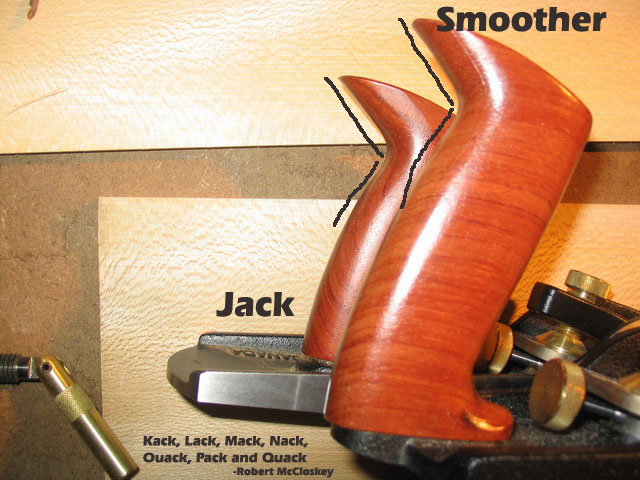
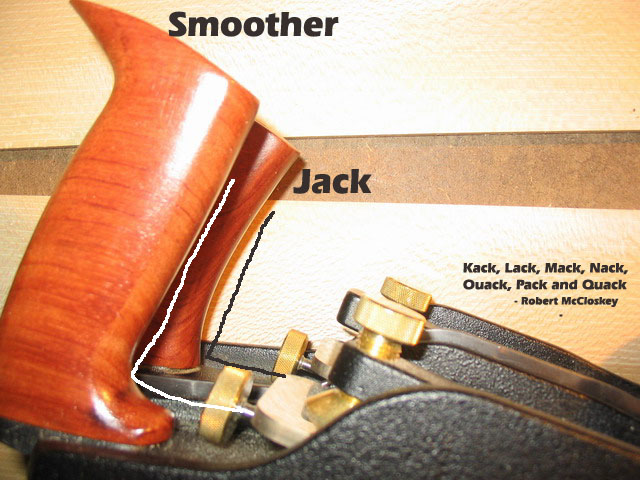
There is not a lot of difference on the rear "push" side of the tote compared to the earlier version. Overall, the new style tote is a little taller (about a half inch) because Lee Valley added the toe at the front of the tote, and raised the overall height a bit.
My complaint is that they have added a belly at the front of the tote , or as they would explain it, they have "contoured the front to better match the natural grip of the fingers." I disagree with the better match part.
Before getting detailed about it, let me put my criticisms into a larger perspective. It seems to me that a Western tote design must address two related issues: One, it must allow for the most efficient application of force to drive the plane in a forwards and slightly downward direction; Two, it must allow for the most anatomically and physiologically sound application of force. The first involves such things as making sure the direction of application of force is consistent with direction the plane needs to go (e.g, the the tote is centered on the plane and has a bit of a angle so force is directed downwards as well as forward), and having the force be directed as close as possible to the center of gravity of the plane body,which in turn needs to be as close as possible to the level of the cutting edge (e.g., the gripping area of the handle shouldn't be far up above the center of gravity of the plane body). The second involves allowing the alignment of the joints to be the most stable, and the muscles to be most efficiently used.
Now all of this is more complicated when one considers that a tote is going to be gripped by hands of different size (though palm width is fairly consistent, length of fingers and thickness of hands and fingers isn't), and that the height at which one planes relative to body size may vary considerably (even if the bench height is consistent, the distance the planing surface rises above the bench may differ according to size and type of project). Thus, a good tote desing must allow for variation in grip.
So, my complaints with the new LV tote:
Raising the height of the gripping area of the tote, even though slight, means the gripping area is now higher than before with respect to the center of gravity of the plane, and there fore the application of force is farther from the cutting edge. More technically what this means is that for the same stance and grip, there is now a small, but significant (at least for me) decrease in the downward force vector of the pushing hand, at most typical planing heights. The upside is that it is slightly nicer to have the lower finger nestled against a wooden toe, and it gives a bit more clearance of the hand above the work surface (the latter never having been a problem for me).
The older tote offered a bit more hand space than the new one. This allowed many, and specifically me, to move my hand up and down the tote slightly to generate different gripping angles. Not only would this have helped deal with the new height changes, but it allows anyone to more easily align the body for different planing heights. This is a significant issue, as again I will say that we do not plane at a consistent height for all our projects. For example, there will be times when one needs to plane the side of a box or drawer at a higher position than would be optimal, at other times we will be working on the surface of a table or desk that is resting on its own legs. I found the old handle accommodated these gripping angle changes better than the new one, and for that matter, beter than the more sharply angled Lie-Nielsen totes.
This is all exacebated by the protruding belly now added to the front of the tote. This has changed the front of the tote from a slightly concave shape to a convex shape. This belly tends to force the hand to the center of the tote (vertically), which may be fine for a hand which fills the entire tote, but forces hands of smaller size to ride higher than necessary, and makes it less comfortable to vary grip height to achieve differences in wrist and forearm alignment. I suspect that those whose hands have always fully filled the tote will find the new tote as good or superior to the old one, for most others, this is a regressive design.
I'll add another complaint about this belly. While the most efficient and ergonomic appliction of force is in a line consistend with direction of plane travel (i.e, your wrist and forearm are in alignment with the force, and your shoulder joint is right behind them), this is not always practical when planing large flat surfaces like tables and desks. Sometimes you need to grip a bit from the side. The more oval the tote, and the more bellied the tote, the less accommodating the tote will be to these necessary changes of grip. Even wonder why the best front knobs tend to be round, it's because we grip the front knob more or less from the side. A tote needs to accomodate this as well. An example of a tote style that is excellent in accommodating this is the yoke tote on Continental style planes like the ECE Primus.
Some of the R&D folks at LV are enamored by this new grip style because it mimiks a style on some new power drills. I'd say that a power drill handle is a very poor model on which to design a tote handle. Just consider for yourself how differently the forces are between the two.
I could go on quite a bit more on this, but I've probably worn through on you patience already. Let me just close with this. If you want to know how a vertical style tote should be shaped, remove your existing tote, take a couple of sticks of modeling clay into your hand, then assume a planing stance and place your hand on the plane as you would grip a tote. Squeeze lightly to form the clay into the shape your hand would really like to take. I am quite confident that the shape you view when releasing the clay will bear little resemblence to the shape of the new LV tote, or most other totes for that matter. Maybe some day, will be able to have the option of thermoform handles that truly custom fit for our hands. I keep saying it and maybe someday it will become true, the next big advancement in plane design is going to be in the area of ergonomics. In the meantime, you can use the clay technique to guide you in modifying the wooden grips found on your current plane.