Dishing out table top question
Tim Caley - North Little Rock
>How can I dish out a table top about 1/2" deep without a lathe? I have an electron burning router, but I would like to not have to use it if possible.
Est. 1998 — 27 years of woodworking knowledge
Dishing out table top question
Tim Caley - North Little Rock
>How can I dish out a table top about 1/2" deep without a lathe? I have an electron burning router, but I would like to not have to use it if possible.
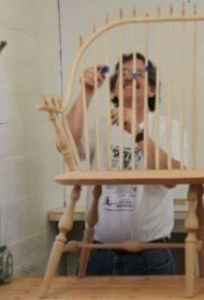
Re: Dishing out table top question
JL
>How about a scorp or an inshave?
Huh?
Pam Niedermayer - Austin, TX
>I don't understand at all. First, what does "dish out a table top" mean? Second, what would a lathe have to do with anything?
Conceivably a router could create a "dished" area in a table, but so could a rounding plane, the scorp shown above, a convex spokeshave, and a compass plane, among others.
Pam
Re: Huh?
paul womack
>Second, what would a lathe have to do with anything?
I assume the OP thought of making (in effect) a rather large and shallow bowl ;-)
BugBear
Re: Dishing out table top question
paul womack
>Take a look at the solutions adopted by luthiers for making curved backs for instrument (e.g. cellos and couble basses), but mainly at the techniques used for hollowing the solid seats of chairs.
BugBear
Re: Huh?
Tim Caley - North Little Rock
>The Margon book that I am working from refers to turning the tabletop by swinging the tailstock of a lathe outboard and running the lathe very slowly. Right now all I have is a basic set of planes. That is why I was looking for ideas of what to use. The top has an integral edge with a cove cut along the inside of the edge, so I couldn't use standard bench type planes to recess the center section. The table is similiar to the one attached. I wish mine looked that good! This is very much a learning project.
Re: Huh?
JL
>You could "hollow" out the inside of the table with a scorp or inshave followed by a compass plane or travisher. It will take a while. If you choose to do it this way, anchor the work securely and make sure that it is solidly on the bench - maybe in some sort of "cradle". If you have a really sharp scorp, you can hollow fairly quickly. Your wrists and arms will be very tired afterwards (DAMHIKT). Frankly, I'd rather use a lathe.
Aha *LINK*
Pam Niedermayer - Austin, TX
>Now I understand, thanks. I agree with Paul that an examination of violin maker techniques is a good idea.
For this type work I use mostly carving like techniques, such as: 1) a 1" Japanese sort-of-crank chicel for major roughing out (Shank is bent at about 45�, it works like a bevel down chisel. You can spend a lot more, like $500, and get a huge crank neck that I only lust after, check the Hiraide site for Tasai crank neck chisels.); 2) then I route to level using a 071 on supports to accomodate the recess; 3) then I rasp with a curved Auriou; 4) scrape as needed.
If I were doing a lot of these, I'd build a big enough lathe. The above process is enjoyable, but not particularly efficient.
Re: Huh?
john jesseph
>That is lathe work, I think.
I vote for the router. I have a fair amount of experience with scorps and inshaves, and I think you would end up getting most of it done pretty fast, but fiddling a long time getting it level and out to the edge, not to mention the inside edge detail.
I will look at home for a pic from a FWW/Williamsburg session showing a top like that on the great lathe...
Re: Aha
Clay C in Miami
>I am crazy about the one Auriou I (so far) have - but I hadn't seen those before, Pam. I wonder why they're called 'ironing' rasps? The implication of Joel's copy is that it's not the curve that makes 'em 'ironing' rasps, so presumably it's the cranked neck ...
Clay
Re: Dishing out table top question
Dave Anderson Chester, NH
>The easiest hand tool way I know is with a #71 or #71 1/2 router plane or the equivalent in a brand other than Stanley. Make parallel cuts the full blade width across the top making sure you leave a full blade width of unremoved wood between each cut. This keeps the router palane from tipping and makes the depth all one level. After you have made it all the way across the top go back and chisel out the remaining stock between your rows. Next you clean it all up by resetting the router plane to take a shalow fuinishing cut. Final cleanup is with a card scraper.
Of course it's faster with power tools including a lathe.

Re: Aha
Jack Guzman from Maine
>Those aren't that expensive either(considering the price that auriou gets for some of their rasps).---Jack
Joel, why are these called "ironing" rasps?
Pam Niedermayer - Austin, TX
>
Yep, very reasonably priced.
Pam Niedermayer - Austin, TX
>
Re: Joel, why are these called "ironing" rasps?
Joel
>I'm guessing but they kind of look like miniature irons used for pressing details of complicated clothing and hats.