WoodCentral Forums

Est. 1998 — 27 years of woodworking knowledge

Tearout when removing dt waste

Posts

Tearout when removing dt waste

#1

Tearout when removing dt waste

Jeremy Osner

>Hi all -- long time! I've been working for a little while now on a wall unit for Sylvia (after several months of no woodworking). Tonight I was cutting some dovetail pins in poplar, and getting probably the best results I have gotten to date with dovetails -- I am still getting some tearout though, and wondering (a) is there a good way to avoid this, and (b) is it worthwhile making an effort to avoid it, or is it inconsequential?

The technique I am using is as follows: starting on the outside edge (where the wider end of the tail goes), drive the chisel in to the marked line with about 5 solid whacks. Then flip the board over, and repeatedly: drive the chisel in to the marked line, then drive the chisel in to the waste between the line and the end of the board, to create some working room. When you get through the board the waste should come away fairly clean except you will need to clean up a bit at the sides.

The tearout I get is from the waste that is being pushed out by the chisel's bevel, pulling with it some of the grain that has not yet been cut through. (One time when I unthinkingly levered the chisel out, there was quite a lot of tearout, but generally it is in very thin lines.) Is this a sign the chisel is getting too dull? It looks quite sharp still but I have a history of not sharpening frequently enough. And is this tearout bad in any way? It will not be visible in the finished piece and I can't figure out how it would compromise the quality of the finished joint. If it would, lemme know.
Re: Tearout when removing dt waste

#2

Re: Tearout when removing dt waste

John K in Hastings, MN

>You're being pretty aggressive with pounding the chisel. If the chisel is sharp and remains sharp, it shouldn't tear out. What you're doing is tough on an edge, soft chisels can fold the edge real quick.

If that isn't the cause, you could always rough chop 1/32" or so from the line then carefully pare to the line.

John

Re: Tearout when removing dt waste

#3

Re: Tearout when removing dt waste

Alan Bierbaum

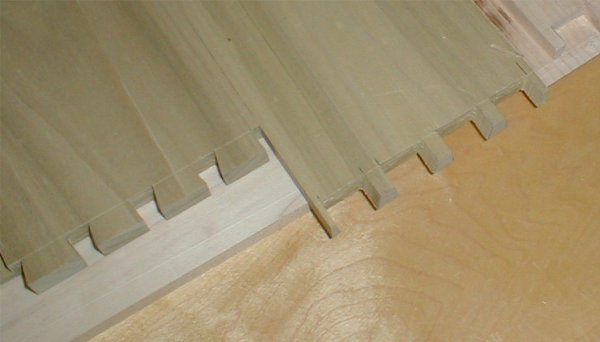
>If the tearout is in the end grain; it probably will not make any difference in the joint strength. Attached is a picture of freshly chopped dovetails in poplar made with sharp chisels. If the detail shows up on your monitor; you will note that there is almost no end grain tearout.


img

Re: Tearout when removing dt waste

#4

Re: Tearout when removing dt waste

Dan Donaldson

>I get the same thing, but don't worry about it. That area adds next to nothing to the strength of the joint and is not visible. I can keep from doing it by taking more time and finer cuts, but at the end of the day, it takes me twice as long for no benefit, so I just get them done and don't worry about the tearout. My goal (not always achieved ;-)) is to saw, make the fewest number of whacks on the chisel and assemple with no trimming at all. Once in awhile I even succeed;-)

Re: Tearout when removing dt waste

#5

Jack Guzman from Maine

Re: Tearout when removing dt waste

Jack Guzman from Maine

>Like everyone said,it don't hurt the joint. If it bothers you though,you could saw most of the waste with a jewelers or coping saw.Pare the rest to the line.---Jack

Re: Tearout when removing dt waste

#6

A lesson of waste....

Scott Burr Ben Lomond,CA

>Twas the night after Christmas...And all through the house, Jeremy was cutting DT's like a louse. Santa should have come down the chimney with care. He needed to drop a coping saw into his stocking with care. Cut out the waste with the saw no damage, no fuss. Cleane up a chisel no muff no fuss! Use a guide board if you must, so they�ll be square. If not they�ll be no square DT tonight.

So I leave saying this� pin before tails are a must for a first!

Re: Tearout when removing dt waste

#7

I hate coping saws

Jeremy Osner

>Thanks for the advice everyone (and thanks Scott for the lovely poem)! I have tried once roughing with a coping saw; never again! Reckon I will hone the edge a little and not worry about the tearout.

Re: Tearout when removing dt waste

#8

how to avoid

bill tindall

>I hate coping saws too; too slow.

The one useful thing I got from the Klause video is how to avoid this problem (which as others have stated is really not a problem).

You get splinters or a hole because the last bit of waste breaks off rather than being cut off. The solution is to provide support so it doesn't break.

Gain clearance for chiseling "at the line" by making a vee cut. Don't remove all the waste wood by splitting the end of the waste and removing the whole chip. By chopping a vee at the line, the end of the waste is still there to support the rest of the waste while down chopping. Hence, it doesn't break off and leave the ragged splinters or hole.

Re: Tearout when removing dt waste

#9

Re: I hate coping saws

Derek Cohen (in Perth, Australia)

>Jeremy

I wonder why you dislike a coping saw?

Try a fret saw instead, or a jeweller's saw (a smaller version). These have much finer blades than the coping saw's, infact are capable of being slid down the kerf made by your dt saw.

I can recommend this method highly. Although I have not worked with poplar, I have cut a good many dovetails in pine, which I consider to be a real test of end grain chisel work. The procedure was: dt saw, then remove waste with fret saw to within 2 mm of the line, followed by a sharp (!) paring chisel (for soft wood I use Berg chisels with 20 degree bevels - these have a noticeable difference over even 25 degree bevels in terms of ease of paring, and this is especially evident when my Japanese chisels - with 30 degree bevels - are used). Note that paring is not chopping - an obvious point but one that is ignored when we get impatient and begin to remove more in one go. It is at this point that tear out starts.

Regards (presently in Cape Town, South Africa; London next week!)

Derek

👍 This page answered my questions

Your vote helps other woodworkers quickly find the answers and techniques that actually work in the shop.