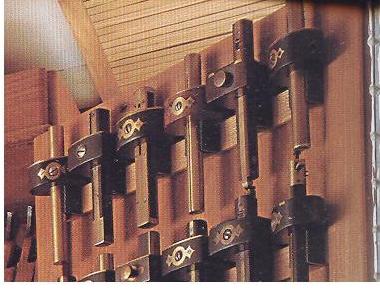
Re: Mortising Gauge *LINK*
William Duffield, on the Cohansey
>All I'm going to offer are some observations on design shortcomings of various gauges that can result in inconsistencies, inaccuracies, and inconveniences.
First, I would not recommend the all-beech gauges because the beech fence wears and the plastic knob cannot securely lock the beech beam. A brass face, and a brass knob against a brass strip in the beam work a lot better for a lot longer. Still, if there is any side-to-side play between the beam and the square hole in the fence, the beam can move and change your adjustment.
Mortise gauges benefit from cutters that are beveled only on the inside, like the Japanese gauges the others have mentioned, and that can be removed for sharpening.
If one wedge, or thumbscrew locks/loosens both cutters simultaneously, you will have extreme difficulties adjusting the distance between the fence and the near side of the gauge without also adversely affecting the width of the mortise and tenon. Since both widths should be the same, and won't change unless you change your mortise chisel, you don't want that setting to move every time you move your fence. This is a common shortcoming of all the Oriental gauges I have seen.
I currently use a Crown, similar in design to the fancy Marples in the link. L-V sells the Crown for $42.50. These two are the only currently manufactured ones that I know of that allow adjusting the fence without changing the width of the mortise. I still don't like the possibility that the beam will rotate a couple of degrees, and that the blades are not removable.
Dave Jaske, at Blue Spruce Tool Works, builds an elegant gauge, with alas only one cutter, that solves the beam rotation issue. Stanley and others, in olden times, built gauges that also attempted to solve this problem, but putting the thumbscrew on the side, instead of on the bottom of the fence.
For more options, you might want to pursue antique Stanley and other manufacturers' products. For example, reference the The Stanley Gage Page
As far as I know, the ultimate mortise gauge has not yet been invented. I could go on and on regarding its requirements, with comments on visibility of the cutters, shape, size and ergonomics of the fence, micro-adjustments, graduations, etc. marking wheels, bevel angles, types of steel, etc. but it doesn't matter a lot, because you should be able to adapt to whatever you have, and fix your errors, or the gauges errors, with planes, paring chisels, veneer glued to the cheeks, liberal application of modern glues, pinned tenons, etc.