WoodCentral Forums

Est. 1998 — 27 years of woodworking knowledge

lining a box

Posts

lining a box

#1

lining a box

Mike MacDonald

>I've almost completed the small memories box that LOML requested for christmas and have made a last minute decision to line it, I'm thinking of using some deer hide that I tanned this fall.

I've never actually lined a box before and I'm looking for any and all suggestions on how to go about getting a wrinkle free finish.

For glue I was thinking of contact cement..paint on a little, smooth leather, repeat...Is this what I should be doing?

Should I be trying to use one piece of leather or apply it in several steps?

or should I for go the leather all together and use something else?

The box is about 13x10x4 and has a couple of small tills inside.

Re: lining a box

#2

Re: lining a box

Adam Cherubini, NJ

>Paper was used for linings in small work boxes of the 18th and 19th centuries. Pale greens, pinks and blues were used. No idea how the paper was fit. You can guess it was held in with thinned hide glue.

I've been thinking of such a project. I'll probably use hide glue, but 3M makes a spray on contact cement used for automotive upholstery that would probably do a great job.

I'd reconsider the deer hide. Tanned deer hide was probably cheaper than paper 200 years ago. There must be a reason why they didn't use it. I'd save that hide for items that really can use it well. A few years ago i used some scrap deer hide to make small draw string pouches (or purses) to hold small nails. Plow irons and brace bits were held in leather (probably cow hide) rolls.

Adam

Re: lining a box

#3

David Barnett

Re: lining a box

David Barnett

>I prefer lining cases and boxes with material folded over card stock sections (Bristol board is nice), so no glued or cut edges are seen. That's the idea: hide the glue, hide the cut edges. For very thin linings in fine or plush boxes I like a bit of batting or padding, too.

The first thing I would suggest is that the thickness and suppleness of your leather match the scale of your box tills or compartments. Generally, you'd want it thin enough to fold over single-weight card stock without any resistance or bulging. If the leather does not turn easily, you'll need to skive it until it yields. Half-inch overturns are sufficient.

Cover the sides first, as a rule, then press in the flooring rectangles, hiding all raw and glued edges.

Contact cement will work, of course, but smells unpleasant. I much prefer boiled paste or hot hide glue. Knox gelatin will work just fine if you don't have woodworker's hide glue on hand. You could use a hot glue gun, but practice applying it thinly, avoiding runs and bumps. Bulldog clamps are handy but patient fingers work well if not too sensitive to heat.

Re: lining a box

#4

Re: lining a box

Ernie Miller *Topeka

>that is the same way I do it. I use the heavy cardboard from hanging files.

Re: lining a box

#5

David Barnett

Good point...

David Barnett

>Depending on how you tanned your hide (brain tanning?), it may not be the most suitable lining, especially for things easily tarnished or corroded.

Acid-free papers are always a safe choice, and appropriate handmade or mouldmade sheets are easily found online and at good art stores. Most are reasonably priced. Hand marbles and combs are good choices.

And there are silks, velvets, and buffered bookbinding leathers; French calf, Niger goat, parchments, vellums - just about anything archival quality will do (again, buffered neutral).

Or perhaps something personal and sentimental: a bit of heirloom gown, family linen, an applique of Grandma's handmade antimacassar?

Re: lining a box

#6

Re: lining a box

Todd Hughes

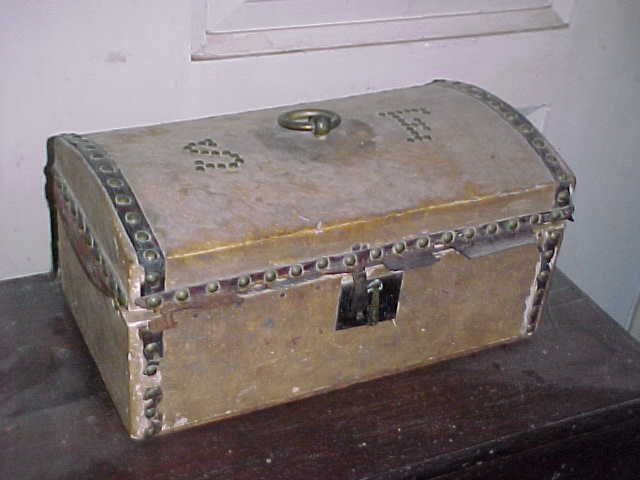
>I sort of collect these older boxes and the deer hide is put on the outside, often with the hair on, while inside is lined with paper.Somtimes wall paper and often you see where they used old news papers.I have also had Horse Hide, Calf and seal skin covered boxes all with the hair on.Of course some are covered with just leather. Often you will see patterns done with brass tacks including initials.Antique people will somtimes strip off the old ,[and no doubt ratty] hides and refinish the wood and buff the tacks bright......Todd

Re: lining a box

#7

Re: lining a box

Adam Cherubini, NJ

>I'm not sure what boxes Todd is talking about.

But they sound a bit like cousins of the 18th century luggage called (gee I hope I spell this correctly) portmanteau (?). Its basically a light wooden frame covered with a heavy hide, essentially glued and tacked in place. These are sometimes round topped or nearly cylindrical. I think this was done to prevent people from stacking things on top of them (like those old cheap "steamer" trunks we see so frequently in these parts).

I think it would be fun to make a few of these, but I'm not sure what I'd do with them.

I think the linings in boxes like yours were installed for esthetics, but also to prevent textiles or other valuable from getting damaged by the thin splintery stock.

I too have seen stuff like wall paper used as linings. Never have seen precious textiles as linings. I see those in pin cushions, doll clothes (rarely) and other usable items.

Adam

Re: lining a box

#8

Heres one...

Todd Hughes

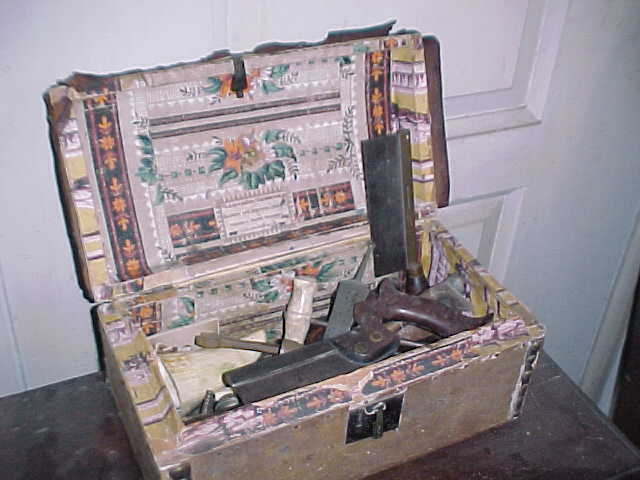
>box measures about 14 X 7 in. with a slight dome top.Covered in deer hide with most of the hair now loss, with leather trim that has a "pinked" trim.Brass decorative tacks with the original owners intials.Inside is lined with colorful "wall paper" and has the label of a Lancaster Pa. maker that worked in the late 1700's and early 1800. The brass pull at the top is a little unusual and i never could make up my mind if original but has been on it a long time.I use it to hold little trinkets that I like, small tools , whale teeth, carved ivory stuff, etc. Sets on top of my "Gentlemans" Tool Chest.....Todd


img

Re: lining a box

#9

Heres it is Open 

Todd Hughes

>


img

Re: lining a box

#10

Re: lining a box

Tom Ryan

>A method that was suggested on this forum for lining with felt (less elegant than many of the suggestions here):

Take double-sided tape, and cover the bottom of the felt, with the pieces of tape touching but not overlapping. Leave the backing paper on the tape. Cut and trim to fit. Then remove the backing and stick it down.

I've thought of doing this on my (relatively crude) boxes so I could get away with a plywood bottom.

Re: lining a box

#11

I do that also.

Dan Donaldson

>It sure makes it easier to hide/eliminate the cut edges. Just need to be sure that the cardboard is sized to allow for the material thickness at the edges so it fits. DAMHIKT;-)

Re: lining a box

#12

Thanks Todd

Adam Cherubini, NJ

>Thanks Todd. That paper is hard to love. There's no accounting for taste.

Re: lining a box

#13

Re: Thanks Todd

Todd Hughes

>I actually think it is quite attractive,it,[and the original makers card] was one of the reasons I bought it. Very hard to find these boxes with the original paper this nice. People often don't realise it but lots of early American items were what we would consider "Gaudy" colored today.Have to confess I really like this kind of stuff, painted my Kitchen Bright Blue and Yellow after all.......Todd

Re: lining a box

#14

Re: Thanks Todd

Jeff Schmidt (KY)

>And isn't your workbench blue?

Re: lining a box

#15

Re: Thanks Todd

Ernie Miller Topeka

>Ya but it's probably ford tractor blue. it was a can of paing in a box he bought at an auction and just ised what was on hand. Geez were talking Todd here!

Re: lining a box

#16

Todd has a bench?

Bob Hackett

>I thought he just stacked all his vices in a corner.(that`d be quite a pile wouldn`t it?);^)

Mainely,Bob

Re: lining a box

#17

Well......

Todd Hughes

>had to use that left over paint from my kitchen for somthing.[True!]Also used it for my front gate and door trim.I have sort of devoloped an interest in the Old Gulla Slave beliefs from the Ga. coastal islands and they always painted thier doors and windows this color blue believeing it kept evil spirits and such away so I figured I would give it a try too....Seems to be working......Todd

👍 This page answered my questions

Your vote helps other woodworkers quickly find the answers and techniques that actually work in the shop.