WoodCentral Forums

Est. 1998 — 27 years of woodworking knowledge

Planing a square edge (long).

Posts

Planing a square edge (long).

#1

Planing a square edge (long).

Paul Kierstead

>OKOK, hardly a new problem that has never been discussed before, but WTH I am going to bring it up again. Prepping stock by hand is getting increasingly easy; I now rarely shy away from boards wider then my jointer as I don't mind flattening them my self. I happily trim true TS and BS edges; Actually, I am finding my "person tool heaven" to be a Bandsaw, planes and thickness planer (lets face it, thicknessing by hand isn't the most fun thing in the world). But getting a square edge, particularly and edge which requires a lot of planing, ah...pain. Methods I know of:

1) Use lateral adjuster. Works OK for getting the blade square to the sole, but is kind of coarse and I have not had a good experience with it to "correct" an edge.

2) Use a shooting board. I have one I use for board ends and it works quite well, but shooting a long board this way (or wide panel) would seem to be troublesome. I guess I could make a huge one and try it out, but I have doubts...

3) Try adjusting pressure on the plane. I couldn't make this work.

4) Use one of those squaring thingies, such as this:

http://www.leevalley.com/wood/page.asp?page=41716&category=1,41182&ccurrency=1&SID=

Hasn't worked out so well. With a heavy plane, it is kinda hard to keep the fence against the board square; maybe I just need more practice with it?

5) Use Jeff Gorman's method of a convex blade:

http://www.amgron.clara.net/planingpoints/edgeplaning/squareedgeindex.htm

Now this one intrigues me, but I have reservations. For one, I am not so sure that the absolute plane control required can be had anytime soon (looks like a *lot* of experience required). Secondly, I normally do glue joints using the two boards face-to-face method, which works extremely well and I am loath to risk by having a convex blade. Maybe I could do it on my Jack plane and use it to "true" the edge and then finish with a square bladed jointer. I ain't buying another #8 anytime soon so I have have both available...

Any help or input would be greatly appreciated. Or just sympathy :)
Re: Planing a square edge (long).

#2

Re: Planing a square edge (long).

joel

>2 things:

1: learn to hold the plane square - it's easier with wooden planes but even with metal planes you can learn to feel if the plane is tilted. Once learned this planing square was much more consistent.

2: this is the most important. If the wood is out of sqaure - DON'T try tilting the plane. Take off a series partial width strokes on the high side - with the plane held level. I use a finger as a fence to guide the plane. Once I learned this planing square became really easy.

NB - some people prefer a cambered blade for this purpose - it exaggerates the effect of planing a partial width stroke - and it goes faster - I don't use it but I understand why some people like it.

Re: Planing a square edge (long).

#3

Re: Planing a square edge (long).

paul womack

>I don't like the "partial shaving" idea, since it (must?) leave a faceted surface, on which the plane cannot run true.

The cambered blade is used to take a full width, but tapered, shaving. Thus, there is always a flat surface on which to reference/run your plane.

I saw a magazine article by David Charlesworth that went into this in great, and useful, detail.

IIRC it was in Furniture and Cabinet Making. It may have found its way into his book or DVD by now.

There was a tip about using a small double square that was STUNNING.

BugBear

Re: Planing a square edge (long).

#4

Re: Planing a square edge (long).

Howard Pollack

>Could/would you outline that tip for us? Thanks -Howard

Re: Planing a square edge (long).

#5

Re: Planing a square edge (long).

Jonathan Peck - N.Y.

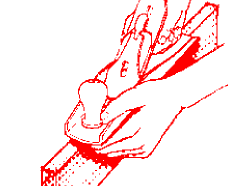
>Holding the plane correctly was the most important thing for me. This image from Jeff Gorman's site that you linked to is the one that helped me the most


img

Re: Planing a square edge (long).

#6

Re: Planing a square edge (long).

Ed Mulligan, Cape Cod

>Paul -

On Bailey-type planes I used to grip the knob 'thumb-up'. I changed this to 'palm-down' (don't recall the motivation) and it greatly improved my ability to plane an edge square. It may work for you.

Ed

Re: Planing a square edge (long).

#7

Ditto

Frank D. in Montreal

>I use Jeff Gorman's technique and it works for me. The key for me is the thumb pressing down over the edge, and using my finger underneath as a fence to control the lateral position of the plane over the edge of the board. I don't have a machine jointer and do all my jointing with my #8. I do take stopped shavings to take out any convex bow and have no problems truing up the surface afterward; any steps come out as full shavings and the lower sections don't give me shavings at all: a few passes or so and I'm back to full-length shavings and a flat surface.

As to correcting angle of the edge, I have an ever-so-slightly convex blade (I haven't measured but maybe a thou over the width of the blade) so I take partial-width shavings (a quarter to a half the width of the edge) over high sides (I steer the plane accordingly, using the middle of the plane for surfaces that are flat, changing sides if the left and right edges are high at opposite ends), and repeat gradually widening the shavings. This leaves a slightly cupped edge which I flatten out by taking a few final passes near the center of the edge with the middle of the plane. The thumb pressure on top and the finger fence under the sole are the keys to control, as well as reading the shavings.

FWIW,

Frank

Re: Planing a square edge (long).

#8

Re: Planing a square edge (long).

joel

>As you plane partially the shaving widens to a single shaving. It's exactly the same method Charlesworth uses - except with a cambered blade the effect is more pronounced.

I learned about it from an old book by Ellis - not sure which one. (c. 1900)

you are right about his double square idea.

Re: Planing a square edge (long).

#9

Re: Planing a square edge (long).

Dean J in MN

> 5) Use Jeff Gorman's method of a convex blade:

http://www.amgron.clara.net/planingpoints/edgeplaning/squareedgeindex.htm

Now this one intrigues me, but I have reservations. For one, I am not so sure that the absolute plane control required can be had anytime soon (looks like a *lot* of experience required). Secondly, I normally do glue joints using the two boards face-to-face method, which works extremely well and I am loath to risk by having a convex blade. Maybe I could do it on my Jack plane and use it to "true" the edge and then finish with a square bladed jointer. I ain't buying another #8 anytime soon so I have have both available...


Well, FWIW --

As I see it you are talking about two different operations, 1) making an edge square to a reference face, and 2) making a glue joint.

I use the cambered irons on all planes that are used for stock prep. From the scrub all the way to the smoother. So you can guess which method I use to square an edge. Actually, it is not that difficult to do. So in use, my #8 with a cambered iron is more or less a try plane. (And you don't need to buy another #8, but perhaps a second blade would be in order).

All the planes I have that are used to cut/trim joints have square irons. The two operations are not the same, so it stands to reason you have two methods. When you are making a glue joint, you don't care if the edges are 90 square to the face, it makes no difference. (As you found using the face-to-face method.) In this case, your iron will be square. Nothing a second iron for your #8 won't solve. (And here, the #8 with a square blade becomes a jointer plane.)

Cheers!!

-Dean

Re: Planing a square edge (long).

#10

Darrell in Oakville

Re: but for long stock...

Darrell in Oakville

>But for long stock, like the 12 foot long white pine boards I was jointing up at the cottage a couple summers ago, I find that this hurts too much. The friction between my fingertips and the wood was enough to generate a lot of heat. I got to the end of the board and started that burnt finger dance - Oooo! Oooo! Owwww!

And then there was the beech I was edge jointing. I had face jointed one side, and then doing the first edge whilst the back face was still rough. On the second plank I neglected to put the smooth face out and promptly got a half dozen slivers in my fingertips. Dang, that smarts!

So now I try not to drag my fingertips along the wood whilst jointing.

Darrell

Wood Hoarder, Blade Sharpener, and Occasional Tool User

Re: Planing a square edge (long).

#11

Re: Planing a square edge (long).

Bill Houghton, Sebastopol, CA

>1. Practice, practice, practice.

2. The longer the plane, the easier.

3. Get the height of the stock correct - you want neither to be bending over too much nor up on your tiptoes.

4. Check with your square frequently until you're good at it. I'm still waiting for that day to arrive.

Re: Planing a square edge (long).

#12

Hey Darrell

Frank D. in Montreal

>Ever tried one of these? Great for tender fingers ;)

Re: Planing a square edge (long).

#14

Re: Planing a square edge (long).

paul womack

>As you plane partially the shaving widens to a single shaving.

But surely at the intermediate stages you have a "double faceted" edge

BugBear (easily confused)

Re: Planing a square edge (long).

#15

Other options...

Mark Harrison -- in Sydney, Australia

>I didn't see this offered as an option by others here but there are precedents to the tool offered by Lee Valley. Stanley had the 386 jointer fence and Miller-Falls had one as well. I have the MF and I highly recommend this route.

The MF is slightly less expensive in the wild but is functionally equivalent.

The bonus is that you can do more than just square edges.

Re: Planing a square edge (long).

#16

LOL!

Don Thompson - Cutler Ridge, Florida

>You almost caused coffee to enter my laptop!

(I was expecting some sort of glove)

Re: Planing a square edge (long).

#17

Re: Planing a square edge (even longer).

joel

>no

let me try to explain better.

(essentially this is exactly what charlesworth says in his book without the cambered blade - I just find it easier with a straight blade - a cambered blade can work faster but requires slightly more paying attention)

supposing the edge is high on the left side of the board. let's make it easy - consistently a 1/32 out of square, all along the left edge. IT happened because I was planing with the plane held out of square to the work, the bench, and the floor.

so the first thing is to learn to hold the plane square. Larry williams explained this best to me. Like a class of water we instinctively try to hold things in our hands square. With wooden planes the high center of gravity and the light weight make this trivial to feel. With Stanley designs, with a low center of gravity, it's a little harder. worth the practice to get the feel of this.

ok - back to the wood.

so holding the plane square (we hope)and using my finger as a fence I will plane with the plane maybe a 1/4" off the left edge of the board. HOWEVER if I do this right, and the plane is quare in fact what I will do is plane a very narrow shaving along the left edge. On the next pass it will be slightly wider, and wider and wider - and so on.

the sqaure flat will be wider and wider. And I can check it with a square easily.

IF I am wrong and still holding the plane out of square it's no big deal because im only planing material that needs to be removed anyway (because the right side of the board is still low) and I have planing of time to correct the problem before the cut is so wide I am back where I started ( except with a differet out of sqaure condition).

As I plane correctly I move the plane over to the center to take wider and wider square cuts using the now widening square top edge of the board as a reference.

It's easier than it sounds and squaring boards used to be a major hassle for me - now it's a trivial exercise - with practice and paying attention I plane out of sqaure a lot less and if I do need a correction it's usually pretty small.

Re: Planing a square edge (long).

#18

Re: Planing a square edge (even longer).

paul womack

>so the first thing is to learn to hold the plane square.

Ah! Now I understand what you're talking about.

Essentially this is exactly what charlesworth says in his book...

Oh. I'd have to check that.

Because:

My understanding of the classic cambered blade, tapered shaving approach is that the plane is always registered firmly on the worksurface, which is why a tapered shaving is essential.

That certainly works for me, which is not to say other techniques don't work, of course.

BugBear

Re: Planing a square edge (long).

#19

re: other options

glh

>St. James Bay Tool Company makes a reproduction of the 386. I have one and it works great. It's easy to square the fence with the plane's sole because the fence is adjustable.

Re: Planing a square edge (long).

#20

Re: Planing a square edge (even longer).

Alice Frampton, UK

>My understanding of the classic cambered blade, tapered shaving approach is that the plane is always registered firmly on the worksurface, which is why a tapered shaving is essential.

That's my understanding too, and with David's hand planing DVD fresh in my memory I'd say it was his as well. The essential problem with using the square blade technique would seem to be the whole "holding the plane square" issue. Unless you're a real klutz in getting near enough, the cambered blade largely does away with this problem. Doesn't it? Must do, otherwise I wouldn't be able to get it to work for me...

Cheers, Alf

P.S. Any clue as to the double square tip? Or am I going to have to go through my entire F&C back catalogue? Not that it isn't a pleasure, but I may get side-tracked and forget what I started to look for in the first place.

Re: Planing a square edge (long).

#21

david charlesworth

david charlesworth

>The cambered blade technique is surprisingly easy to learn.

If any of you have my second book there is a good description on pages 77 & 78. It includes the small set square wheeze.

I say a "good" description because the graphic artist, Simon Rodway, did a great job with the diagrams.

best wishes,

David

Re: Planing a square edge (long).

#22

Re: Planing a square edge (even longer).

joel

>if you hold the plane square and you are using a cambered blade, and you are trying to correct an out of square condition you also plane with the plane not centered on the wood. What happens is the resulting surface is planed with a tilt in the opposite direction of the main error. As you continue planing you center the plane on the wood, evening out the camber, and you end up with a hollow (because of the camber in the iron) in the center of your edge.

In addition because of the camber you don't need to hold the plane as perfectly square (but it must be centered)

With a very small amount of camber the differences are very minor and it's mainly 6 of one 1/2 dozen of the other.

I don't like a camber because if you edge join the wood and then have to face plane to remove thickness the space left by the camber will leave a more visible glue line. We are talking small amounts but in my view if I do it right the glue line should be invisible. Typcially I do most of my thicknessing after on face is planed smoothed, the other face is cleaned up just a little, so there is an excellent chance I may be doing serious amounts of thicknessing AFTER I glue up.

Now I know it's a little easier with a cambered blade, but once I got the hang of doing it with a straight blade it wasn't an issue.

Re: Planing a square edge (long).

#23

Re: Planing a square edge (long).

Paul Kierstead

>Wow, I got so many great responses I cannot respond to them all! Many, many thanks. I address some of them:

I have tried the holding-the-plane square deal, and I just can't get it to work for me; I just am not very good at balancing the plane on a very narrow strip of wood, such as the case when the board is out-of-square. I don't have that good of plane control; perhaps someday (my hand-eye dexterity is fundamentally good, just needs work for this skill).

I should clarify why I don't like the cambered blade: I love my #8; I mean, I truly enjoy using it. It glides over wood and cuts like butter, leaving a perfect surface. Jointing an edge with it is a pleasure. As mention, I like doing glue joints both boards at a time, and I do it with the #8. Now, I could get an extra blade and camber that one, but realistically I hate changing blades I only really enjoy planes when they can be reached for and used; I don't want to fart around changing blades all the time. I don't want to but any new planes (well, this month anyway). So, I don't like cambering my #8. Perhaps I shall try it on my #7, which is quite well fettled and works, just no the same wonderous joy (perhaps something to do with the #7 being a Record and the #8 being a L-N)

Many thanks for the encouragement and guidance. I will try what has been suggested here.

Re: Planing a square edge (long).

#24

Re: Planing a square edge (even longer).

Alan Hamilton

>Joel,

For what it's worth, I'm with you.

The iron on my jointer is straight across, and I plane all my edges at 90� to the face. I have a Bailey-style jointer, but I don't find it all that hard to plane things square. Working that way sure takes all the anxiety out of glue-ups.

Alan

Re: Planing a square edge (long).

#25

Re: Planing a square edge (even longer).

William Duffield, on the Cohansey

>Me too.

In my case, I find it easier to find a plane that I can hold level than one that I can consistently laterally adjust the edge, or even judge how much camber I've put in it. Getting the camber out of the blade is relatively easy, since no matter how deep it is set to cut, the finger tips are really accurate in feeling whether it is cutting a flat shaving. I then know when I'm done, because a full width shaving is coming out of the plane, and it sounds right, too. I don't have to worry about keeping the blade centered on the edge of the work. I don't have to worry about taking off wood where I don't need to take off wood (on the low side). I don't have to worry about the plane pulling towards the thick side, thus throwing off my sense of level, and I don't have to check my results with the square until all other indications tell me that I think it's right.

And, if you can saw a fairly perpendicular cut, you shouldn't have to take enough off to make the wedge shaped plane cut significantly more efficient :^)

👍 This page answered my questions

Your vote helps other woodworkers quickly find the answers and techniques that actually work in the shop.