WoodCentral Forums

Est. 1998 — 27 years of woodworking knowledge

Dovetail cut out saw balde

Posts

Dovetail cut out saw balde

#1

Dovetail cut out saw balde

Rick W.

>Does anyone know where to get a dovetail cutout sawblade?

I first heard about this unusual sawblade in an article on Frank Klausz in FWW #18.It was described as a bowsaw blade that makes a 90 degree bend over its length, used for cutting out the waste between the pins and tails in dovetailing.

I've since seen a reference to it, and to a keyhole saw version, in Salaman's "Dictionary of Woodworking Tools", but I've never seen one for sale anywhere.

If anyone knows where to get one, please let me know.

Rick W.

Re: Dovetail cut out saw balde

#2

Re: Dovetail cut out saw balde

Ernie Miller Topeka

>Is he talking about a coping saw blade? is is a sharp turn or is ine end 90� to the other? if it is the later just turn your ends after the blade is inserted into the frame then tighten if the blades have a sharp 90� at bothe ends use a couple pairs of nedle nose pliers and roll your own. Can't help you with a maker

Re: Dovetail cut out saw balde

#3

St. Roy

Dave (Arlington, VA)

>Hi Rick -

I saw St. Roy demo one at our local Woodcraft a year or so ago. Pretty cool. However, his was a coping saw. He would cut down one side of the dovetail with the verticle half of the blade. Then he's cut down the other side of the dovetail using the same half of the blade, and when he got to the bottom of the dovetail, he gave the blade a firm pull which brought the horizontal portion of the blade into play and he continued to cut along the bottom of the dovetail until it popped out. Sharp turn at the corner. Almost no waste. Very fast. Amazing.

He was asked about the blade, and he said it was a stock coping saw blade, but that he had drawn the temper from the center (only) of the blade and then bent it himself (I assume with a hammer on an anvil - but I didn't ask). On examination, I could tell that his blade was about to break - not surprising given he'd drawn the temper and the forces on the blade. But he made is sound easy :-) Never tried it myself -- yet.

Doesn't answer your question. Sorry, but I thought you might find it interesting anyway. Haven't seen any for sale (doesn't mean they're not out there).

Regards -

Dave

Re: Dovetail cut out saw balde

#4

Re: Dovetail cut out saw balde

Adam Cherubini, NJ

>Here's what Rick is talking about.

Frank Klaus twisted his frame saw blade 90 degrees from one end to the other. He sawed the dovetail down using the front few inches of the blade since it was vertical or nearly so, then pulled saw out and used the twisted center and back of the saw to turn the corner to remove the waste.

With the greatest of respect to Frank Klaus, this is a parlor trick. I'm fairly certain he doesn't take it seriously. No special blade is required. I'd skip it altogether, unless you have a shop full of bored woodworkers you wish to entertain.

Adam

Re: Dovetail cut out saw balde

#5

I agree with Adam

Rick Hoppe (Los Angeles)

>

Re: Dovetail cut out saw balde

#6

Re: Dovetail cut out saw balde

William Duffield, on the Cohansey

>I agree, it must be a parlor trick, unless you sharpen the vertical part of the blade rip and the horizontal part crosscut :^), and then reharden the blade.

St. Roy did it with a bowsaw, IIRC, in the "Building the Library of Congress" Woodwright's Shop episode.

I assume the best way to bend the blade would be in the jaws of a machinist's vise, with a torch. You have to bend it at a very low angle, at least 7:1, or the stresses encountered trying to straighten out the dogleg by tensioning it in the bowsaw will surely cause the early demise of the blade.

Re: Dovetail cut out saw balde

#7

Re: Dovetail cut out saw blade

John Aniano in NJ...

>Adam, et al.,

I have seen Frank K. do this and the blade really does make a 90 degree turn roughly 1/2-way in it's length. As I heard it, he bought the blade at one of the tailgate sessions at the CRAFTS auction many years ago. The saw blade really does exist. In one of Roy Underhill's books, he explains how to make the blade and use it, just as Dave described it.

In use, one half of the blade is used to rip down the pin (tail). At the bottom of the cut, the blade center is brought into play and it begins to cut the waste out in a cross-cut fashion. Several sort of stabbing cuts are made in the central region of the blade as the 90 degree transition is done. This forms the corner and after is is fully formed, the other half of the blade is used to cut the waste free. The saw handle is not rotated during the process, the blade simply changes direction.

I think it is a very clever solution to an age-old problem and I would suggest that it is not a parlor trick. Frank K. did say that this blade and method was used for kitchen cabinet carcass dovetails, the ones that were not to be seen, but needed strength none-the-less. For dovetails that were to be seen he used the conventional dovetail saw and chopping method.

Thus I ask, why disregard a clever but albeit "coarse" tool or method? It's not suitable for all instances or for every woodworker's taste, but it is one of the methods for sawing out the waste when doing dovetails. Best to know as many of the "tools" possible in my opinion.

Way back when, in the deep recesses of my mind, I can recall a very early Fine Woodworking article where this blade is fully detailed. Perhaps someone can do a search...

There, I've gotten off my soap-box,

John
Re: Dovetail cut out saw balde

#8

Re: St. Roy

Alan Hamilton

>Dave and Rick,

Saint Roy also has a bow-saw sized bow saw (huh?) with the same kind of twist in the middle. He made that one the same way: he drew the temper from a bit near the center and bent it hot. They have one in the Cabinet shop at Colonial Williamsburg too. IIRC it's called a "turning saw" and is used just like St. Roy's coping saw--but on larger features than a dovetail.

Alan

Re: Dovetail cut out saw balde

#9

Re: Dovetail cut out saw blade

Wolfgang Jordan, Munich (Germany)

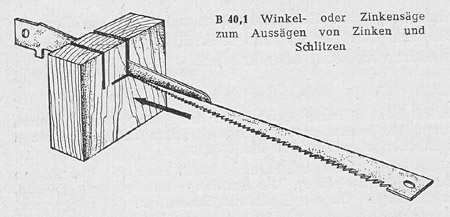
>It seems that the dovetail blade is a European thing. You can find it in old German catalogs and books, but it's form is different from the one Frank Klausz uses. The vertical cut has to be done with a regular bowsaw blade. Then the 'Zinkens�ge' is brought into the cut and the horizontal cut made. This is not a tool for fine woodworking, but, as John already said, for coarse work. The article about Frank Klausz was in the October issue 1979 ("Methods of an Old World Cabinetmaker", also on the CD).

Wolfgang


img

Re: Dovetail cut out saw balde

#10

Re: Dovetail cut out saw blade

Mike Swindell

>I have the FWW, I'll to look for it, but I was issue 18. According to Klauz these blades are common in Hungary. He used in the article to make rough dovetails for shipping crates. I'll look for the issue and post a scan.

Happy Thanksgiving

Mike

Re: Dovetail cut out saw balde

#11

Saw PIC 

Mike Swindell

>


img

Re: Dovetail cut out saw balde

#12

Mike - any chance you could make the pic larger?

Dave (Arlington, VA)

>If not, that's okay, but it's a bit hard to see - and read... and I'm kinda curious about this.

Dave

Re: Dovetail cut out saw balde

#13

Re: Mike - any chance you could make the pic large

Mike Swindell

>Well I can't make it any bigger due to posting restrictions. Any ideas ? I can send you the PDF file if you'd like ? Send me an email and I'll reply back

Mike

Re: Dovetail cut out saw balde

#14

Mike, send me

Dan Donaldson

>Send me a big one and I will get it put up for you. You can send it to the e-mail in this post or to dan@woodcentral.com

Re: Dovetail cut out saw balde

#15

Here it is 

Dan Donaldson

>


img

Re: Dovetail cut out saw balde

#16

Re: Dovetail cut out saw blade

Rick W

>Thanks to everyone who responded.Even though I didn't locate a source for these sawblades, I got a lot of useful information.

Someone mentioned that Roy Underhill had described making a similar blade in one of his books. I have all his books, but it's been a while since I looked at them. Guess I'll go through them again.

Thanks again!

Rick W.

👍 This page answered my questions

Your vote helps other woodworkers quickly find the answers and techniques that actually work in the shop.