Interesting YouTube video
John Pappas
https://www.youtube.com/watch?v=m7HxBa9WVis&t=40s
Rob Cosman has a follow up video on the subject. Might be of interest.
Est. 1998 — 27 years of woodworking knowledge
Interesting YouTube video
John Pappas
https://www.youtube.com/watch?v=m7HxBa9WVis&t=40s
Rob Cosman has a follow up video on the subject. Might be of interest.
Better end grain videos?
Derek Cohen (in Perth, Australia)
There have been so many misinterpretations of the video on forums. This may be a better video…
https://m.youtube.com/watch?v=AEj404EhW9U
https://m.youtube.com/watch?v=ER1k4Pcyn0M
For end grain glue ups, I always size the joints. Sizing (for those unfamiliar with this technique) involves first applying a thin layer of glue, for the purpose of filling the end grain straws. Let the glue almost dry, and then add another layer of glue. This last layer is "glued layer".
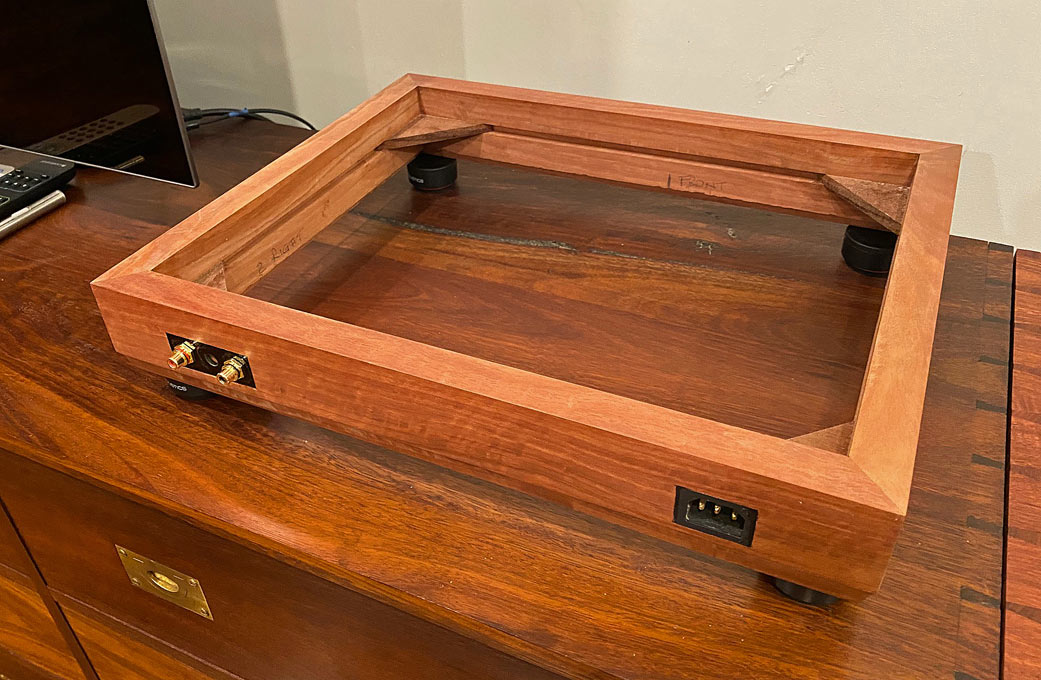
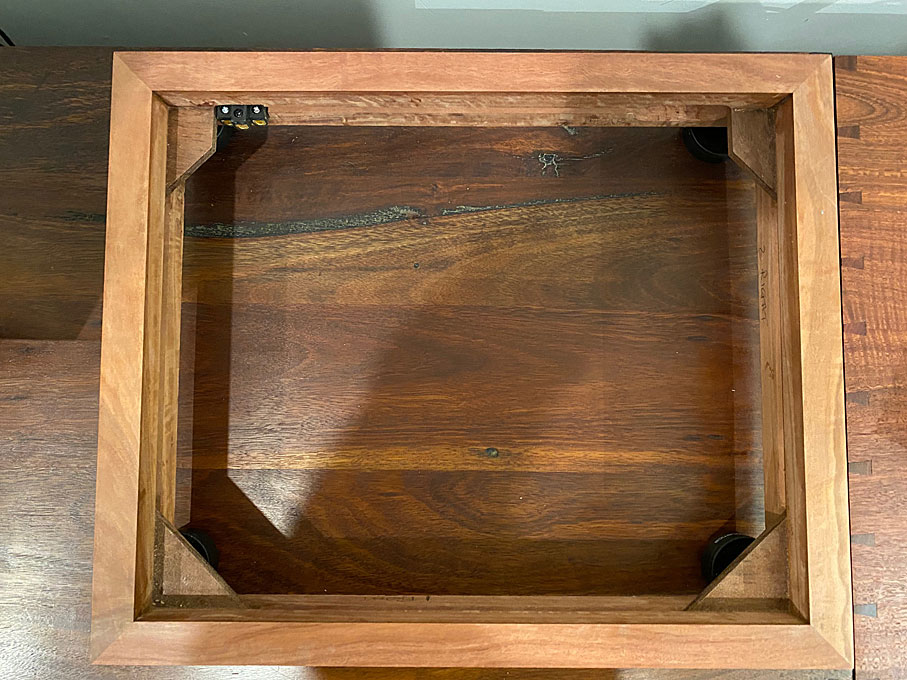
While mitre joints are not pure end grain, this is what I do with frames, and in the example below, a recently built turntable plinth. Internally, there are splines to deal with wood moving ...
Regards from Perth
Derek
Re: Better end grain holding
H Bruce McCrory
I am more inclined to trust the Patrick Sullivan experiment. It isolated more potential conditions and variables. It utilized better equipment, even comparable to materials in unbiased scientific analysis. Mr. Broun starts his experiment heavily biased to his 50-year-old conclusions.
A few other considerations: Franklin sells glue, not scientific results. It will accommodate preconceived notions rather than crush them. In my experience, it's No. III is not waterproof.
The best adage is tell people something enough times, and they will believe it. As we have found already, half the people need no proof.
On the other hand, Broun makes a point for shrinkage. However, that is a physical property of wood impacting joint release. A spline on a miter will pop as well if the wood is shrinking to stability.
Personally, anecdotal (empirical?) observations suggest to me that more surface area will improve holding strength. I'm not ready for butt joints, even with peddlers selling me all sorts of tools to cut various other joints.
Re: Interesting YouTube video
TomD
I have mentioned the strength of endgrain joints here often. But I didn't realize that an end butt is stronger than a side butt. I guess it is obvious because the failure in end to side is in the side, that is how we knew it was worth gluing the endgrain. So end to end ought to be stronger. Just aren't many uses.
In the real world of carpentry, the real issue is you get 100% continuity with sidegrain joints, but not with endgrain joints, unless you scarf them. It has always been about how easy it is to break sidegrain versus endgrain.
But gluing endgrain has it's structural uses in highly stressed applications like aircraft and boats that rely on core materials, and there even balsa wood is capable of superb core function based on endgrain joints.
I watched some of Cosman, and hitting things with hammers has nothing to do with failure modes in furniture. Well I hope not...
Re: Better end grain videos?
TomD
"While mitre joints are not pure end grain"
I may be reading into your comment... But I think this is interesting relative to miters and scarf joints. If you take a full strength end to end 1/8 scarf joint. I figured a lot of the strength came from it becoming more like a side to side joint, even though if it was fully side to side it would be weak. It may be that along with the increased glue area, the reason we get such good results is because it is end to end gluing. Because what the tests say is that is stronger. If somehow miter joints were pure endgrain they would be stronger.
Seems like there are 4 factors: End to end gluing, side to side gluing, larger surface area, and better supported/better leverage. And probably some other stuff. At this stage I think we can dismiss the side to side gluing, though... The test did not try angled joints out, there could be some magic relative to what happened there, though probably not as we know what happens at both ends of the continuum.
Finger joints?
Henry (Raleigh NC)
Finger joints are arguably a longer scarf joint, folded up.... although they clearly do not have the same properties of a long scarf joint.
My experience reported here is not a scientific study, just observational. Commercial finger jointed trim pieces are easily available, and easily breakable. When I forget that is what I have and I toss or drop a longer piece, it will break at the finger joint (if it breaks). There can be a multitude of forces in the fall: twist, compression on one side and tension on the other, point impact if there is a protrusion it is dropped onto, etc. Inevitably the break happens at the finger joint (and rarely in the wood itself; mostly a fairly clean break at the joint.
That is not a comparison of types of joints, but is a recognition that the joint is a weak point compared to the wood itself (and possibly an indictment of the gluing process).
I try to remember when I have finger jointed stock and to handle it gingerly.
I still prefer 'real wood' trim, even finger jointed, over re-constituted wood (MDF) or foam stuff....
Henry