What is this wood
Bill Tindall, E.Tn.
Est. 1998 — 27 years of woodworking knowledge
What is this wood
Bill Tindall, E.Tn.
Bocote?
Re: What is this wood
David Weaver
bocote or louro preto.
If you can plane the surface, I can give you a better idea, as I've got a bunch of the latter, and only a little of the former.
Never saw louro preto with any regularity before the last couple of years, but it appears to be getting imported.
Grain looks more like louro preto, but louro preto generally also has very prominent flecking that you should be able to bring out of it planing a quartered face.
Zebrawood
Re: Zebrawood
Bill Tindall, E.Tn.
looked at pictures of the two and it is dull looking like the Zebrawood pictures and not lustrous like Bocote pictures.
Re: What is this wood
Sgian Dubh
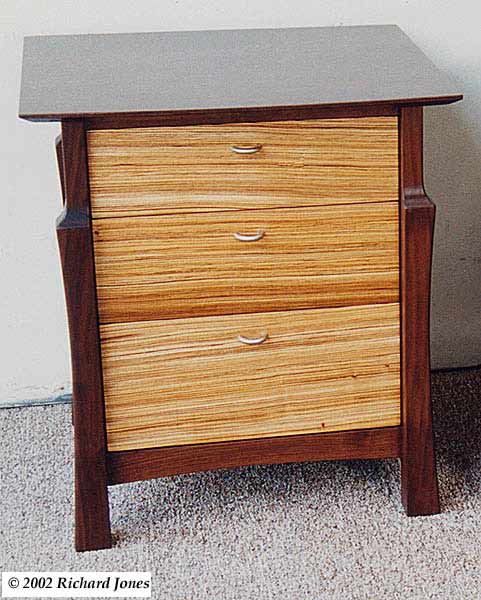
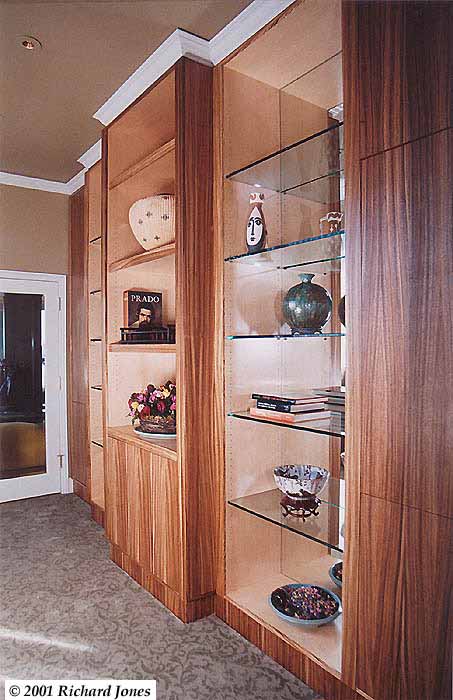
It looks like zebrano to me, which is what the drawer fronts of this one of a pair of cabinets is made of. Unfinished zebrano is quite often uninspiring, but a polish really brings out the colourful character. Also the large built in unit is fronted with zebrano veneer and solid parts, but the final colour in this case is browner and less yellow than the drawer fronts.
But it could be what others have suggested, i.e., louro preto or bocote (aka cordia, light American), although I think those two are less likely candidates. Slainte.
Wood ID: Examination vs guessing
John K Jordan
Except in special cases it can be very difficult to correctly identify wood from photos of the side of a board. Even the lighting can throw off the color for distinctively colored woods. Unless the color/grain/ring structure wood is unusually distinctive you might get a variety of guesses - remember that ALL of them will be wrong except for one, if you are lucky.
For some idea of the wide variation within any species look at some of the pictures on these pages: http://hobbithouseinc.com/personal/woodpics/
This article on the Wood Database tells how to examine wood and get started on identification. The most important thing and the thing to do first is to look at the end grain, section 7:
https://www.wood-database.com/wood-articles/wood-identification-guide/
I use a good stereo low-power microscope but a small hand lens will do the job. This lighted loupe is inexpensive and very good: https://www.amazon.com/gp/product/B01AD5O4GW
They used to be $13, the last few I bought were $16, now I see they are $20. Think fast.
Some things:
- END GRAIN STRUCTURE The Wood Database article tells how to prepare the end grain of a small sample for visual examination. This is the most useful tool for general wood ID. Use a 10x magnifier to examine pore distribution, parenchyma, ray size, ring visibility/distribution, etc. First thing with hardwoods is to try to put it into one of these three categories: diffuse porous, ring porous, or semi-ring/semi-diffuse porous. The Wood Database has a good photo of the end grain for each wood listed. Note that some, especially some exotics, can be very difficult to differentiate from similar species.
- DENSITY Measure, weigh, and calculate density. Look up the density of candidate species in the Wood Database, consider moisture weight. This can eliminate a lot of candidates. Remember that density can vary so you won't have and exact number but close can help.
- ODOR Some species have very distinctive smells. Until you have experience with them it helps to get a local experienced person to help.
- FLUORESCENCE Some species have a distinctive fluorescence under UV light. I use a good 365nm UV light but they can be expensive. This one is inexpensive and not bad: https://www.amazon.com/gp/product/B07SWW5FHB
Once you have some candidate guesses, look up each in the Wood Database and see if any are a good fit. The Hobbithouseinc web site is also a powerful resource.
The bottom of the Wood Database ID page under "Still Stumped?" tells how to send off a small sample for a free analysis.
For anyone interested in identifying wood this book is the best way I know to get started: Identifying Wood by R. Bruce Hoadley: https://www.amazon.com/Identifying-Wood-Accurate-Results-Simple/dp/0942391047
I've used mine so much half of the pages are falling out. I just ordered a spare. I've been meaning to do that for a long time.
BTW, I got interested in wood ID long ago at a turning club meeting when someone passed around a Show-and-Tell piece marked Cherry on the bottom. It was clearly ring porous! If marking a piece with a guess at least pick one that's believable based on pore size and distribution.
JKJ
Re: Zebrawood
Larry Edinger
Zebrawood
Re: Zebrawood
C John Hebert
yep...zebrawood for sure
Sniff test
Steve jenkins
Cut a small piece off the end and smell it. All zebra wood I’ve used has a very distinctive “wet horse” smell. Sure looks like zebra wood.
Re: Sniff test
John K Jordan
Compare to pictures of zebrawood here:
http://hobbithouseinc.com/personal/woodpics/zebrawood.htm
All my zebra wood looks different than Bill's board but as mentioned, there is much variation.
The page above also shows some end grain pictures. As always, the end grain can be a big key to ID. Shave off any saw and sanding marks on a small section of end grain using a single-edged razor blade or razor sharp knife. The very large and evenly distributed pores in zebrawood are fairly distinctive. From the entry, zebrawood has "Diffuse porous with large, sparse pores that have thick lozenge shaped (and occasionally wing shaped) aliform parenchyma", the wing shaped parenchyma is easily visible with a hand lens.
JKJ
density test...
David Weaver
well, I thought I'd look up density and find that bocote is more dense than louro preto and more than zebrawood, but none are that far apart.
It doesn't have the same color to me as bocote (bocote isn't something I've bought a lot of).
Louro Preto is less stringy and more "expensive" feeling than zebra wood. Zebrawood is a bit soft between the rings from what I recall of it. And the samples I've had aren't much more dense than hard maple.
The pictures of louro preto aren't that helpful. But what I do get from them is that the ones on wood database aren't that characteristic of the 10 or so billets that I've gotten except for parts of them. They have more distinctive lines, but also have a unique sort of rose-woody but also perfumey smell. And they are very dusty (even if you're hand planing them, your hands will get filthy).

What does it look like....
Ellis Walentine
.... planed smooth and oiled?
The grain looks like zebrawood, but the color of the weathered sample you posted doesn't help identify it. Yellowish tan with brownish black streaks would pretty much clinch it for me. Bocote tends to have more clustered grain lines. Ziricote grain looks similar, although it's gray and black, often with a landscape figure similar to Brazilian rosewood, and with very wide and light sapwood. I can't vouch for louro preto, at least by that name.
Ellis
Re: Sniff test
William Duffield
We had a customer who would not recommend the sniff test. She took some zebrawood boards back to her shop, started working them, and had an allergic reaction. Her face swelled up so much she couldn't even open her eyes for a couple days. Different people have different reactions to different woods.
options dropping...louro preto
David Weaver
I have a bunch of pics of louro preto - I was going to post them. And then I realized that while some actually look like the wood in your picture (others don't, but louro preto can look like three or four different woods in the same billet, varying from light color to grayish to deep browns)....
When I opened your initial image in a separate window, I don't think any of the samples that I have show pores in the earlywood like yours do. I'll post the pics of louro preto, anyway, but we'll see how my luck is - the images often don't get attached properly when I use my phone:


Re: options dropping...louro preto
Sgian Dubh
David, without you specifically identifying those images as louro preto thus taking out the guesswork, I have to admit my superficial visual impression would have led me to speculate those samples might be one of the rosewoods, possibly Honduras rosewood. If you tried to tie me down to an identification based just on those photographs I'd say to you that my suggestion 'was just a guess', and I'd refuse to be at all positive. As others have said, sometimes a positive wood identification needs close examination of actual samples.
I very rarely offer a suggestion for a wood species that's been photographed and put up on a forum with a request by the poster asking, "Can anyone tell me what this is, please?" It's all too easy to be wrong, so I generally don't get involved.
However, in Bill's case it seemed quite likely what he's got was zebrano, so I said so. I've used the stuff quite often and his image was very like unworked zebrano I've used. Of course, I could easily still be wrong, and Bill's sample really is something else, ha, ha. Slainte.
Re: options dropping...louro preto
David Weaver
I don't recall if we've heard of the smell. I don't break down the louro preto blanks before using them, so I can't smell all of the ones I've showed. The ones I have broken down that display more certain visual characteristics of louro preto (some greyness and lots of flecking that you don't normally see in most rosewoods) have a very distinct smell. It has a little bit of the peppery smell of rosewood, but a very unique perfumey smell that goes with it.
So even as I've bought them from the same place that sold me other billets that are definitely louro preto, they look different enough that I'm waiting on the smell test for them.
Louro preto also doesn't seem to have quite the uniformity grain wise that most rosewoods do (it's more stringy, or directional).
The wood bill has is probably zebra wood, but it's less crisp than zebrawood that I've had (I don't remember the smell and it's long gone now). I'd side with your guess of that if I had to bet on it.
I don't remember sniffing zebrawood, as I wasn't as far along now and hadn't really thought I should sniff everything to remember the smell as well as the look. Louro preto was a long time confusion for me because I got a huge wide billet from rockler when they used to sell off bits for cheap (They do no such thing for now). I split it and it split not like a rosewood, but more stringy, and it got lighter in weight than most of the indian rosewood that I had and considered throwing it out. It wasn't until earlier this year that I figured out what it was.
https://i.imgur.com/ttx7Gjw.jpg
The flat face of the wood shows no flecking, and the lighter colors and graying in it looks like spalt sometimes.
I've seen a hundredth of the wood you have, so even identifying what something like this is a big thrill for me.
Re: zebrano smell.
Sgian Dubh
Assuming I've understood you correctly, David, those chisel handles, or whatever they might be, are louro preto. Visually, they don't strike me as being rosewood like. In comparison to the images of the unworked louro preto you put in an earlier post which, if you recall, I'd said I might have suggested could be rosewood, those handles seem to have characteristics brought out with a finish that unfinished samples don't have.
It's been quite a while since I worked zebrano, or zebrawood if you prefer, but I was always struck by its unpleasant smell whilst being worked. I've always described it as stinking like sh*t, but that's not right at all really. If I was pushed to find an accurate description of its smell I'd probably have to go down the angle of describing it as something unpleasantly musty or of decay about it rather than faecal.
I can't recall what any of the rosewoods I've worked smelt like now; it's been a long time since I messed about with any of those, but I do recall most of them were kind of whiffy, sometimes not overly pleasant. Slainte.
I'll scuff some of those other ones...
David Weaver
...yes on the louro preto - the known stuff doesn't look like rosewood, and it's not a type of rosewood...
....except that some of it looks like rosewood if it doesn't have flecking and it's the brown part. I intentionally chose wood to maximize flecking, but not all of the handles have it and then the ones that don't look more like rosewood.
It could always be that more than one wood is sold as louro preto - and I didn't lok up the other trade names, but only a small part of the smell reminds of indian rosewood, brazilian (vivid "peppery" smell), cocobolo, bois de rose - those all have sort of a common element to the smell. I've seen it described as peppery and I understand why it would be described as that, but it's not a smell like pepper - it's rosewood - not a smell that causes you to recoil but it's a punchy sharp-ish smell.
So, I'll scuff a couple of the other blanks and see what they smell like.
I like the flecking - and my handles are ferruled with pretty substantial brass, so the fact that it doesn't "stay together" as well as rosewood does isn't a big deal. I bought a lunk of it figuring that it would be nice to have for handles down the road as I have seen little of it here....and it strikes me that things are sometimes affordable and then quickly not. Cocobolo and african blackwood come to mind - the latter is now moon price here. and Cocobolo is 2 or 3 times what it used to be while indian rosewood in plantation form seems to be coming in in piles.
I haven't smelled the louro preto smell anywhere else, and it's excessively dusty (fine dust, even when turning it) instead of being a little smooth to oily like rosewood)
Definitely doesn't match your account of zebrawood - the louro preto is kind of :pleasant and then sneeze;
(other rosewoods don't make me sneezy).
Re: zebrano smell.
David Weaver
The various pictures I showed, despite different color and look, are all the same wood. Same smell, etc. Same dusty whatever coming out of it even after planing mirror shavings off of the edges.
The "browner" and less grayish toned wood is closer to the center of a tree, or a small tree, and the others further from the heart or from a larger tree.
Makes it difficult to identify stuff when the same wood doesn't even really have the same look.
It needs to be from a bit wider of an area to not have small diameter rings and really have a lot of that flecking.
The first piece looked like this turned over (the flecking), so I didn't bother planing it:
Three together - I have two more, but they are less "not the same" looking.
Similar density to rosewood, but I've not seen silica in any of it yet (the plantation indian rosewood is loaded with it).
Simple finish planing of this with a low-tech 1084 steel plane iron, india stone and buffer:
(reflectivity isn't quite as good with dark woods, especially if they have rosewood like pores like this does. The pores don't seem to be as prominent on the quartered face - don't know why - maybe they're not round. )
about the same density as zebra wood and not hard to work for its hardness - just releases a sneezy dust even when planing it this cleanly (which as I type this, I think I said above before gathering pictures).
All the same smell (all of my pieces - not mine smells like zebrano - mine is pleasant smelling before the nasal itch).
If bill would sand his a little and let us know if it smells like the backside of a horse, we'd move back to the back part of our seat.
Bill, end grain?
John K Jordan
Bill did you look at the end grain yet? Best to shave with a razor blade, maybe plane gently, but some sand with very fine paper.
Zebrawood has pores like this:


The pores can vary considerably in density but the distribution should be even.

All these stolen, er, borrowed from Hobbithouseinc,
http://hobbithouseinc.com/personal/woodpics/zebrawood.htm
The wood is zebrawood.
Re: zebrano smell.
Sgian Dubh
Bill seems to have concluded his sample is zebrano. He doesn't say if he worked it a bit to do a sniff test to determine olfactory unpleasantness, ha, ha.
As to louro preto, I think there are perhaps three species within the genus Nectandra given that trade name. I can't say if trees from another genus or species have been described as louro preto. I don't think I've ever had cause to work with the stuff, and if I have it was a long time ago and I've forgotten.
'Exotics' have pretty much completely disappeared from my woodworking life. I think the last one I worked would have been Santos rosewood some twenty plus years ago; it was in the form of boards that became a table top. As to its smell, I remember it had one, but I can't recall well enough to describe it. Slainte.
things other than furniture...
David Weaver
I use them (Exotics) for tools and instruments (and hopefully in the not so distant future, a nice chess set). There's definitely a common smell in rosewoods (but santos rosewood isn't one of the commonly seen types here like it is in England, so I haven't seen it).
Cocobolo was at one point relatively reasonable (no longer) and indian rosewood goes up and down depending on what's coming in, and right now, one called gombeira is inexpensive - but super dense and heavy (and not a rosewood and seemingly not an ebony - just a very hard wood that gets very dark without much porousness). Like indian rosewood, if you can afford 500 pieces of something (be it turning blanks or 500bf of wood), it gets to be a fraction of the typical market price. I can't store that much and wait to figure out where to use it, but it's a decent time to buy exotics as long as you're willing to buy the ones that are being dumped or farmed second growth plantation type.
But, I think the talk of hand planing exotics and using them, etc, isn't matched by realistic use - it's something beginners dabble in and only stay in if they make tools or instruments.
Exotics: things other than furniture...
John K Jordan
>>>But, I think the talk of hand planing exotics and using them, etc, isn't matched by realistic use - it's something beginners dabble in and only stay in if they make tools or instruments.
I don't know about hand planing exotics for furniture and such but a huge amount is used by woodturners for decorative and functional pieces. I can certify that after 20 years of woodturning I still use a LOT of exotics. The harder and heavier the better (for woodturning).
Turning small, detailed things instead of big bowls and forms greatly expands availability and affordability of exotic woods.
Favorites are olive wood, african blackwood and ebony (and my favorite, B&W ebony), lignum vitae, various well-known rosewoods including brazilian tulipwood and cocobolo, pau marfim, bloodwood, bubinga, mahogany and the substitutes, zebrano, lyptus, pink ivory, kingwood (when I can get it), zirocote, leopardwood & lacewood, mopani, dalmata, etc., and I really love turning goncolo alves.
These three shelve units are mostly exotic turning stock (with many more mixed with domestics elsewhere in the shop):
Some exotics I'll turn only under duress include padauk and bocote.
Wood I refuse to ever touch again: I'll give away or burn before turning what wenge I have left. And I rather work wet poison ivy with my bare hands than borneo rosewood.
On the other hand, I'd trade my kingdom for a supply of kingwood - what a wonderful rosewood! Janka hardness well over 3000.
Or more pink flamewood. A photo of a few small things I made from this are at the bottom of the pink flamewood page on HobbithouseInc:
http://hobbithouseinc.com/personal/woodpics/pink%20flamewood.htm
I got a big block of it from the late Jim King in a WoodCentral benefit auction years ago.
BTW, Santos Rosewood may look like rosewood but is not a Dalbergia, according to the Wood Database:
https://www.wood-database.com/pau-ferro/
JKJ