WoodCentral Forums

Est. 1998 — 27 years of woodworking knowledge

Scandinavian shoulder vice

Posts

Scandinavian shoulder vice

#1

Scandinavian shoulder vice

eliot

My first real woodworking project (many year ago) was a standard woodworking bench. The plans for it I know came from what I think I remember was a Woodsmith publication of some sort. It has what I'm sure visitors to this site know as the standard vice-- the one on the front-- the end vice is different. Recently, I have been visiting Rob Cosman's site, and I see what I believe is a Scandinavian shoulder vice. He uses it constantly often to hand cut dovetails. My question here is what's the story on getting one and installing it on my current bench. Is it a big deal to do so? Do you suggest something different? I plan to start doing more hand tool work.

Re: Scandinavian shoulder vice

#2

Re: Scandinavian shoulder vice

AZ in Colorado Springs

I don't know about "Scandinavian," but a shoulder vise might be tough to secure well "after the fact."

When I built my Roubo bench, at the appropriate corner I put some t nuts (5/16") about six inches in from the outside of the bench. There are 3/8" holes in the outer layers leading to the t nuts with about 2" of clearance behind the t nuts for threaded rod to pass through.

I have not yet installed a shoulder vise because it'll make for a hazard in my shop. Just not enough room for it. (When I cut dovetails I use the leg vise and it works great. I may never get around to installing the shoulder vise.)

I'd think it'll be difficult to properly secure the shoulder vise if there weren't provisions made for it during the construction of the bench. Gluing or screwing to the edge of the bench likely won't be very strong.

But good luck as you proceed.

Re: Scandinavian shoulder vice

#3

Re: Scandinavian shoulder vice

Brian retired gunsmith from Colorado

take a look at this page. It is a shoulder vise screw. A shoulder vise is shown in one of the small inset diagrams.

Is that the type of vise you have seen?

https://www.leevalley.com/en-us/shop/tools/workshop/workbenches/vises/31134-shoulder-vise-screw?item=70G0151

Other types of vises can be seen on www.benchcrafted.com

they have leg and tail vise.

Lie-nielsen has a bench and hardware offerings with tail vise and what they call a twin screw shoulder vise

https://www.lie-nielsen.com/products/lie-nielsen-workbench?path=workbenches&node=4113

But so far non of those items are what I have heard called a scandanavian bench. There was a Fine Wood Working mag issue 53 July August 1985 It is the bench of Frank Klausz. That bench has a proper scananavian should vise and a tail vise.

Hope this helps.

Please keep us posted on your progress.

Re: Scandinavian shoulder vice

#4

Re: Should be simple enough.

TomD

It shouldn't be difficult to secure to an existing bench. The initial attachment when you make a bench is you cut a tenon on the end of the bench, and that is easily done with a circular saw, and a guide. Though commonly it exists on many benches anyway. You could also use a fly cutter in a router to make a slot, then use a plywood floating tenon. Then you attach the end piece to the bench with some bolts that go into captured nuts. A better, usually easier, arrangement can be to hardware bond threaded rod in place of captured nuts. I have done it both ways, and prefer the epoxy bonded approach. Basically you are making a breadboard joint at scale.

Your end piece comes out to the front, where you dovetail on the crosspiece. It is a large dovetail and can be cut on a bandsaw. Obviously all the joints can be cut with hand tools just as easily. There is a re-enforcing block and a threaded rod. There are good instructions in FK's work, and in Tage Frid's book. I made Tage's bench.

I don't really see why there should be a problem with retro fitting one. The one thing that would be an issue is that the vise side leg extends out to support the vise hardware But there are all sorts of ways around that. You could simply have a leg. You could epoxy hardware bond an extension on to the existing leg. Make a new leg. You could put a timber frame like bracket there. You can also make the vise removable with two nuts, and so when you aren't using it, you can remove it so support is not needed.

Making these vises is a project under any circumstance, and one often sees small mistakes when people make them from scratch, like the threaded rod runs through a dog hole. There are some planing issues, and if you retrofit, there might be some other issues. All in a day's work.

I normally think of these vises for dovetails, though they are also ideal for securing long boards to the front of the bench.

They are great vises for dovetails, but here are 3 things you may not have come across:

1) They stick out quite far, and people have run into them, or found they took up too much shop space I don't mind that myself. There is a more complex variant where the L moves in and out that would solve the problem of space.

2) Similar issue is that they come out too far, so while it may not be obvious, the hardware that is usually for sale is normally modified. So they come out really far, and that adds to cost, and structural needs. What most of us do is cut the screw short, and make a new end on it so that it fits again into the pressure foot. But while you could probably neaten up the end on a wood lathe, a metal lathe is better. I think Rob just made his double threaded screw short from the get-go. I don't think the expense or lack of a quick release is a big deal.

I have several quick release vises and rarely use the feature, it tends to get stiff with sawdust, and I don't normally move from 8 inches to 1 inch and back again, to make it worth messing with.

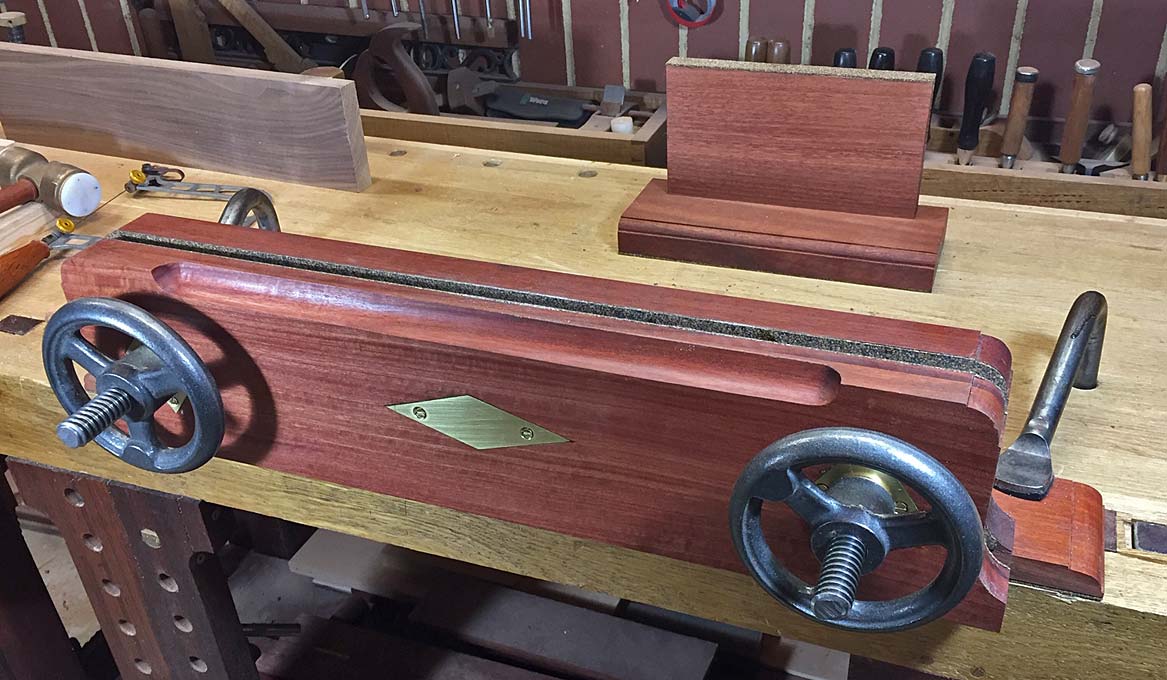
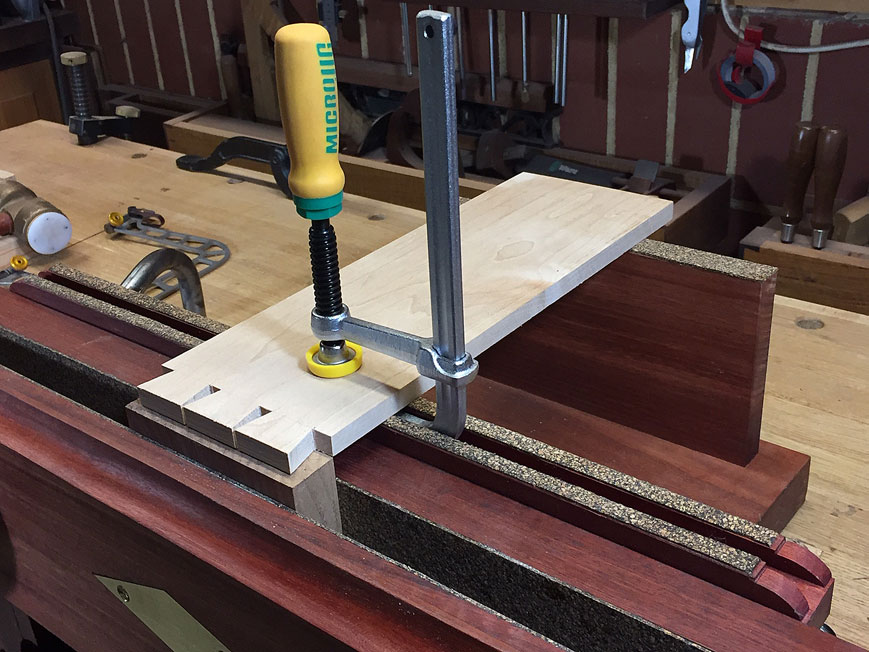
3) I actually like my dovetail vise higher than my bench top, particularly after about 50 years of age. And something like a Moxon Vise, though I have my own variant that I prefer, solves a lot of problems. My current set-up is an attachable "Moxon" vise and my bench face vise is a Tucker Vise, and easily the most used thing in my shop. Often used in the horizontal position. I still have the Frid bench, though it is currently in my leather shop. If I had more space, I would have it in my woodworking shop.
Re: Scandinavian shoulder vice

#5

Don’t do it for dovetailing.

Derek Cohen (in Perth, Australia)

Eliot, I would not recommend using a face vise like Rob Cosman’s for dovetailing. Yes, he thrives on it, but he has had that bench since day dot, and his attachment to it overrides ergonomics. Watch how he has to reach over the vise, as well as reach down, and you tell me if this is the most comfortable position to work.

I completed my current bench nearly a decade ago. It is a Roubo with a leg vice. One of the reasons I went with this design was the emerging recognition, driven by Christopher Schwarz, that sawing for dovetails was better done higher than a European bench top, by using a dedicated Moxon vise.

The downside of a Moxon is that it needs to be attached and removed. Some have built a dedicated sawing station around one to avoid this. I do a fair amount of dovetailing, and do not mind ... because the vise is such a pleasure to use. It offers better visibility, better sawing ergonomics, and more secure clamping than a European face vise.

My current Moxon, built two years ago, features the best ideas from my years of using one ..

http://www.inthewoodshop.com/ShopMadeTools/TheLastMoxon.html


It enables the Tail Board to be clamped to the Pin Board for transfering marks ...


A Moxon bise does not have to be this fancy, but I liked the concept so much .. :)

Regards from Perth

Derek

Re: Scandinavian shoulder vice

#6

Re: Don’t do it for dovetailing.

eliot

Derek, I have to say that I just can't get over your work! What an inspiration! I am currently in the state of Connecticut away from my shop. When I get back to Maryland, I plan to study what you and Tom D and others posted and get to work. I see you use a leg vice and that incredible Moxon. I assume , since you prefer to not bend over much ( me too-- I'm 82) that you prefer the Moxon for dovetail cutting. But I know that craftsmen also use a leg vice for dovetails and that there is new hardware, like scissors, so one doesn't have to bend over to adjust the peg board at the bottom. ( And there's that fellow who kicks a wedge on the floor to adjust it.) So how about a leg vice? (Now that I think about it more, why not both? )Would like to hear your thoughts.

Re: Scandinavian shoulder vice

#7

Re: Don’t do it for dovetailing.

Derek Cohen (in Perth, Australia)

But I know that craftsmen also use a leg vice for dovetails and that there is new hardware, like scissors, so one doesn't have to bend over to adjust the peg board at the bottom. ( And there's that fellow who kicks a wedge on the floor to adjust it.) So how about a leg vice? (Now that I think about it more, why not both? )Would like to hear your thoughts.

Hi Eliot

I use a leg vise primarily for holding long boards for edge jointing. When boards are longer than 3 feet, this would be in conjunction with a sliding deadman. The downside of a leg vise is the position of the screw. Mine limits the depth of a board to 12”, if it is held at the centre. A Moxon vise, as a double screw, does not have any such limitation.

Ironically, the case I am just about to dovetail is 450mm (just under 18”) between the screws, and my Moxon will only go to 400mm. As a result, I will need to use the leg vise/sliding deadman. This is definitely not as stable nor comfortable as a Moxon vise - partly because I have to lean over.

Build a Moxon vise for dovetailing. You will not regret it. Ask Bill. :)

Regards from Perth

Derek

Re: Scandinavian shoulder vice

#8

Re: Don’t do it for dovetailing.

AZ in Colorado Springs

Not arguing against the moxon vise, but I eliminate the width & depth problems by putting longer boards (my bench is 36" tall, so 40-42" is the practical limit for length) by putting the board beside the vise screw. I'm left handed so my leg vise is on the right hand leg. I secure the left side of the board with a long squeeze clamp (long enough to go to the back side of the bench top -- my squeeze clamp is 36" long).

I reduce the stooping to adjust the parallel bar on the leg vise by using shims instead of the pin. Most of my work is with 3/4" stock so the 15/16" shim is usually down there. I have a couple of others to make a variety of thicknesses. The shims have a 5/8" slot on the bottom so they easily slip over the 1/2" parallel guide.

👍 This page answered my questions

Your vote helps other woodworkers quickly find the answers and techniques that actually work in the shop.