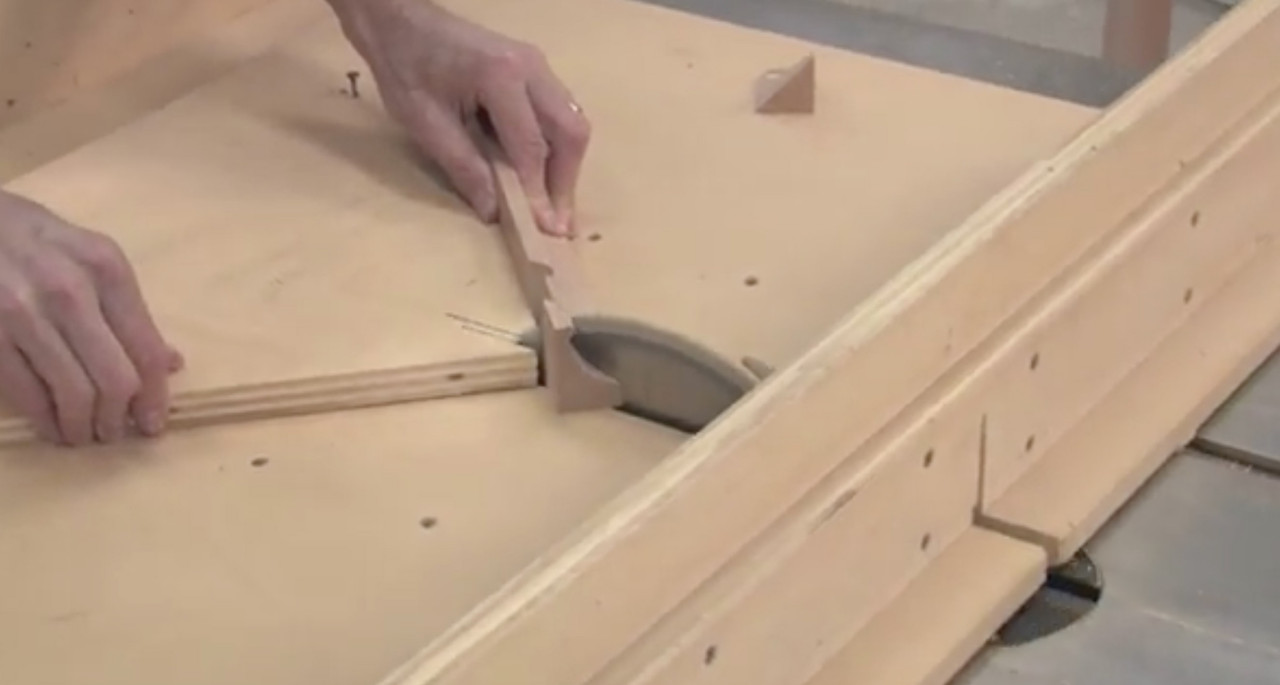
This question is NOT about cutting the cove itself. It is about cutting the edges. I am trying to cut the edges of some custom cove I have cut and I have not found a good way to cut both edges safely. One edge can easily be cut on the table saw with the cover flat. The opposing edge 'could' be cut by tipping the cove up so that its face is against the fence. This gets me the required 90 degree opposing edges.
However, the second edge is not a safe cut and both times I've tried it on practice pieces, I've had kick back. Once was the offcut and the other was the molding itself. Another method is needed I think.
When I make crown, I use a molding head with flat blades on the TS. If the angle is 45º the arbor is tilted, and all cuts can be run flat on the saw top. If you choose something different like 35º / 55º, then one will need to be against the fence without changing the tilt of the arbor. For a cove, I might cut the angled edges before cutting the cove, but that may not be required.
Cutting the shallow bevel before the cove could work, but if you have already cut the cove, another option is needed. If you used a dado blade, the shallow bevel could be cut with the workpiece flat to the table, though it would likely take a couple of setups.
Suppose the bevels are 30 degrees and 60 degrees. Both 15 degrees off 45.
Make a simple sled: stick of 2x which is at least the length and width of workpiece. Rip a 15 degree bevel along the length and across the width of the sled. Tack the work down onto the sled.
Set blade tilt to 45. Set fence to make the 60 degree bevel first. Run sled thru saw. Then turn the sled end for end, reset fence to make the long 30-degree bevel, and run sled thru saw again.
Caveat: I haven’t done this, and am not sure the width of the mold, so there may be a safety issue simply because of the narrow base of the mold—not much distance between blade and fence. So this is offered only as the germ of an idea for you to consider. Its main advantage is that the sled is sitting flat down on the saw table, so there is no angle that has to be handheld thru the length of the cut.