In the most recent issue of Fine Woodworking there is an excellent article on making drawer pulls. I am working on two oak dressers and I want to make the pulls from the same boards as the drawers. Here's the question: should I buy threaded inserts rather than just screwing the handles to the drawer fronts? That seems like a good idea - preferable to screwing into end grain. What do you think?
Be careful installing threaded inserts. The risk of splitting is high.
General question. How do wood pulls hold up on a dresser where the handle will be used daily. Seems the finish would get worn off or softened by body oils and look ugly after a few years....yes, no?
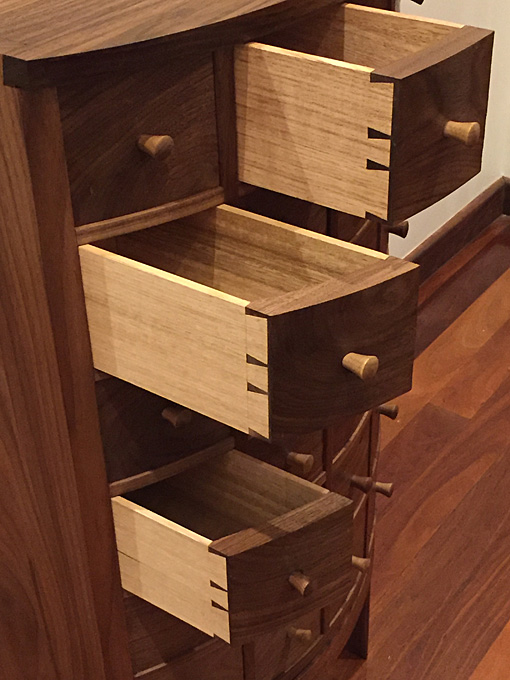
Mostly, I make my own handles. These are attached either with a wedged through mortice-and-tenon. The tenon is turned as part if the knob. The mortice is simply drilled. The wedge is tapped in from inside the drawer ...
... which is a strong joint, and important if the drawers are used frequently and to carry heavier loads.
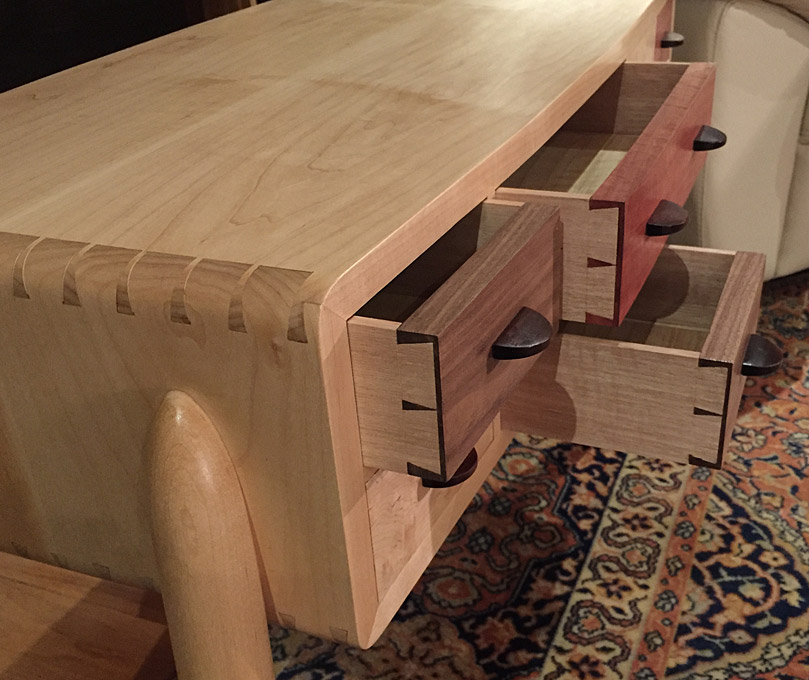
Or the attachment is a mortice-and-tenon, which is fine for lighter drawers ...
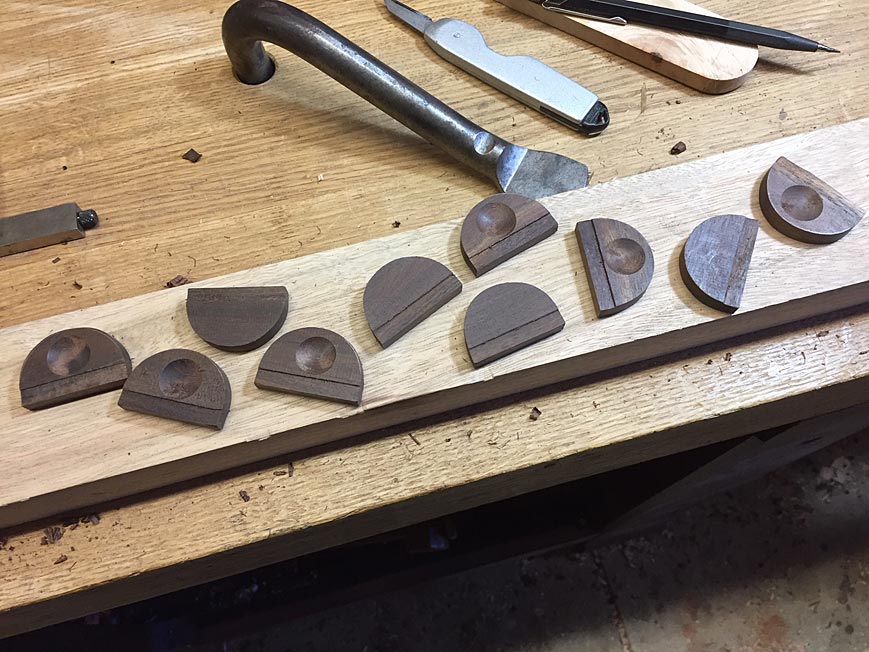
Here the tenon can be seen (taken during the shaping process) ...
Screws and bolts into thin handles seem to add vulnerability as the sidewalls into the handle are thin.
But I think a (always home-made looking) wooden pull never enhances the design of a piece of furniture like a metal pull, be it oxidized wrought iron or bright brass or something else, that goes with the style of the piece. Wood looks faddish.
I have made dozens if not a hundred wooden pulls. Some with inserts and some not.
On the larger ones I was surprised at them not splitting and have been very happy with them. Generally, I drill the hole for the insert slightly larger than recommended, screw them in, remove them, coat the hole with epoxy and reinsert them.
I like the inserts. They make it so you can install and remove/replace the pulls as many times as you want. I try to space them at some reasonably standard spacing so that if someone wants to they can replace them with metal pulls. I have been somewhat surprised at how many "standard" spacings there are.
Part of this is I have sticker shock at the cost of nice pulls. Sometimes it amounts to more money than I have in the piece up to that point all together.
My son doesn't like the wood on wood on wood look and asks that I leave the pulls off and he will find something he likes later. I install little tape tabs on the bottoms of the drawers to act as temporary pulls. It's good to know that tape will hold up for years. He is still using them.
I can only speak for traditional cherry Shaker-style pulls but those on my chest of drawers, one of the first pieces I ever made, are holding up fine after 20-or-so years. Same for those on a nightstand I made for my mother and on my own stand. My hall table also has Shaker pulls but in walnut. All of these were and simply their turned tenons glued in place. The non-drawer pull on my little computer desk is rectangular and is made of wenge and is in impeccable shape. No detectable deterioration in any of them.
I've used most of my screw inserts in, of all things, refrigerator magnets where I place the insert to enable the iron cup to be screwed into place. The 3/4" rare-earth magnets just seemed to be unsafe with just being glued into place since they are both slippery and powerful. I've had both superglue and epoxy fail in the application.
Thanks, Barry. Since red oak is sometimes prone to splitting, I think I will use inserts and epoxy them in place. The lower drawers on these dressers could be rather heavy, so making the pulls that way should ensure that they last. So 18 drawer pulls in all.
If it's convenient you might clamp them in a vice to help resist splitting. Or put a clamp on the critical area. I rigged up a driver mounted in my drill or impact driver and drove them into the over sized hole, backed them out, slathered in the epoxy with a q-tip or small stick and screwed the insert back in. I wanted the insert to have some grip on the wood. Goes quickly once you are set up. Just be sure you don't put so much epoxy that it gushes up into the insert. If you can, drill the holes deep enough that there is a reservoir for any excess. If you are nervous have the screws handy, oil the tips and screw them into the insert to keep it clear.
All that may sound a little nutty but it's a real PITA if the epoxy floods the threads and sets before you know it. It probably means making a new pull and using new inserts. DAMHIKT
Some time back, somebody (maybe Bill Tindall?) posted pictures of dovetailed drawer pools that were really nice. I can't find the original, but maybe Bill (or whoever) could re-post the pics.
Johanna, I haven't seen the article you mentioned nor have I seen your design idea, but I personally don't like the idea of threaded inserts in pulls, for several reasons. First, unless you get really tiny ones, their outside diameter will dictate a rather large minimum diameter for the shaft of the pull. That may or may not be an issue here. Inserts also have a rather extreme wedging effect and will be worse in hardwoods. I tend to use them in softer woods where there is sufficient material around the hole to diffuse the wedging effect.
Also, inserts are particularly useful when you will need to take the joint apart frequently (or even occasionally), which is not normally an issue with drawer pulls.
From a strict engineering perspective, there are a couple important considerations: The pull needs a flat or a shoulder to keep it from racking. Likewise, a tenon -- either a through tenon or a stub tenon -- will keep the pull straight.
The attachment force required is probably less than you think. A threaded insert may offer hundreds of pounds of pull-out resistance, which is a lot more than is necessary to keep the pull's shoulder tight to the drawer face.
By far the easiest and strongest method I've used is to turn a tenon that goes all the way through the drawer front. Just this, with some glue, is all you need to keep that pull in place forever; you don't even need to wedge it on the inside.
If you want to keep the pulls removable, a good technique is to make a fixture for your lathe (assuming turned pulls) that has a sheet-metal type screw thread to anchor the blank for turning. After turning, just unscrew the finished pull and install it with an identical screw from the inside of the drawer. I've done entire kitchens this way and never split a pull or had one fail. I've also drilled and tapped exotic wood (dense) for machine screws.
If your design doesn't lend itself to these suggestions, maybe you can be more specific about your intention.
I was thinking of handle type pulls, each with two screws.
In my mind, single pulls are knobs. I generally attach them with a single screw with no Insert or Turn a shaft on them as others have suggested and glue them in.
So these are U-shaped handles that can have fairly thick legs. With the comments that have come up so far, I am now thinking I don't need inserts because the handles will be permanent. If I use adequately long screws and pre-drill, that should be fine. A little epoxy at the bottom of the hole might be added insurance.