WoodCentral Forums

Est. 1998 — 27 years of woodworking knowledge

Tite Bond Liquid Hide Glue

Posts

Tite Bond Liquid Hide Glue

#1

Tite Bond Liquid Hide Glue

Barry W. Larson

Hi All:

I'm about to begin assembly on a pair of small side tables. I'm am trying several new (well new to me anyway) things and one of the things I am considering is using liquid hide glue for the first time to glue up the numerous mortise and tenon joints. I have used it to repair splinters and cracks in white oak in the past mostly because its a bit more finish friendly than PVA. I'm considering the hide glue because of the longer working time for assembly - the tables have a number of spindles to glue up when assembling the sides. Any tips, tricks or thoughts on the Tite Bond product. I will be buying fresh glue (well the freshest date I can find here in the Great White North anyway) to be on the safe side. Any and all advice is appreciated. Thank you.

Cheers. Be safe and stay well.

Barry W. Larson

Calgary, Alberta, Canada eh!

Re: Tite Bond Liquid Hide Glue

#2

Re: Tite Bond Liquid Hide Glue

David Yoho

Probably the best way to insure a successful glue up such as yours is do a complete dry fit. Do everything as if the parts were already glued making sure you have all the necessary clamps and such at hand for when you do the real thing. The liquid hide glue is good stuff. Also, in case you haven't experienced it before, it makes snug fitting joinery like mortice and tenon slide together like they've been greased.

Re: Tite Bond Liquid Hide Glue

#3

Jack Guzman from Maine

Re: Tite Bond Liquid Hide Glue

Jack Guzman from Maine

That stuff is pretty foolproof. If it is cold in your shop and the glue is thick you can thin it by putting the container in hot water. After glue up,I remove squeeze-out with a toothbrush dipped in hot water,then follow with a dry rag.

Re: Tite Bond Liquid Hide Glue

#4

Re: Tite Bond Liquid Hide Glue

J Barrett Irby Jr

I agree with David and Jack, go for it. Warm up the glue. Get the shop to or above room temp and for a while to let the project warm up. Do a practice dry run. Good stuff.

To test the glue you can put a drop on your thumb and touch it with your forefinger, over and over and it should become tacky fairly quickly.

Re: Tite Bond Liquid Hide Glue

#5

Re: Tite Bond Liquid Hide Glue

Derek Cohen (in Perth, Australia)

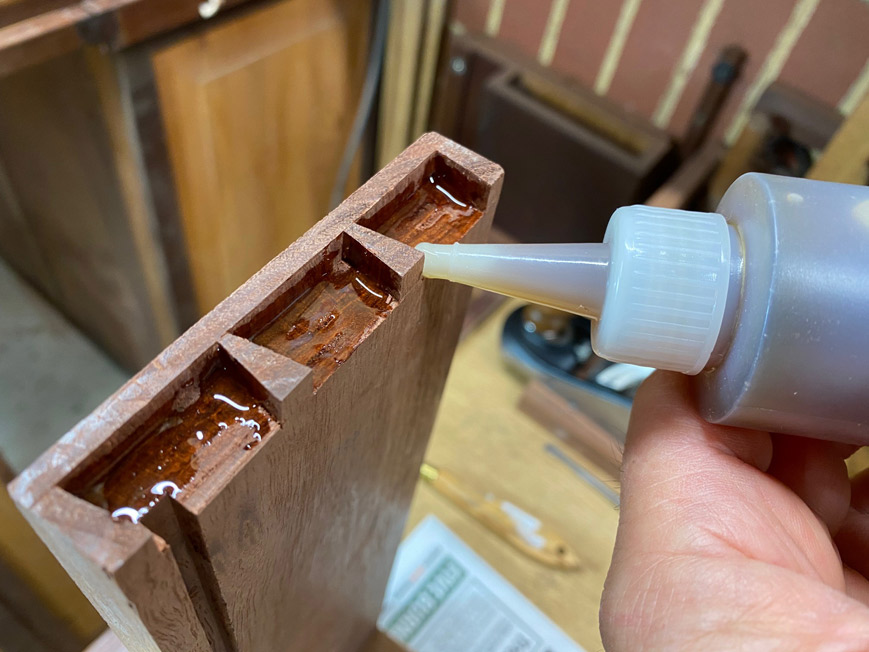
Barry, I decant all my glues into these small plastic squeeze bottles. The spout allows me to accurately place the glue where I want it to go. I use a thin steel spatula to spread in inside mortices.


Regards from Perth

Derek

Re: Tite Bond Liquid Hide Glue

#6

Re: Tite Bond Liquid Hide Glue

Barry W. Larson

Thanks. I've done both sides of one of the tables (with multiple spindles) - trying to break the glue-up into more manageable bits. One further question. On mortise and tenon joints with hide glue how much squeeze out do you try for. I tried to have a bit but this was based on my experience with PVA glues which I try to minimize to avoid cleanup issues and finish problems. The hide glue cleans up very easily - thanks Jack for the toothbrush and warm water tip, so I could deal with more squeezeout to avoid starving the joint (assuming this is an issue with M&T).

Cheers. Be safe and stay well.

Barry W. Larson

Calgary, Alberta, Canada eh!
Re: Tite Bond Liquid Hide Glue

#7

No squeeze out on a M&T.

Bill Tindall, E.Tn.

Why would you get any? Slather on each cheek of the mortise and a very thin layer on the tenon. Slide together. How can there be squeeze out?

This stuff has enough assembly time that you should be able to do any sort of table. I have done large case pieces with dozens of joints. Doing in portions asks for trouble squaring the total assembly.

If you can't push joints together by hand they are cut too tight.

If a joint hangs, remember, all adhesives have little shear strength until fully cured. Modest clamp pressure will snug a joint many minutes after assembly. Conversely, it is a property of polymers that that the joint will have colossal impact strength. A joint that slides together easily with clamp pressure may resist abusive bashing with a mallet and still not seat.

Re: Tite Bond Liquid Hide Glue

#8

PS

Bill Tindall, E.Tn.

Titebond is liquified with something different from urea. Urea decomposes to ammonia and ammonia destroys the adhesive. Old Brown is formulated with urea.

Tech service person at Frankin told me he had kept Liquid Hide for 10 years in frig and it was still fine.

Re: Tite Bond Liquid Hide Glue

#9

Re: PS

Barry W. Larson

Thanks Bill. Funny you should mention the 10 year life for the Tite Bond product. As I mentioned earlier here in the "great white north" you often settle for whats available especially with rare commodities like liquid hide glue. When I went to find fresher glue I found that most on the shelf was from the same lot as I had or was even more ancient having the earlier date code on the bottles I settled for a marginally better date by nearly 6 months by rooting towards the back of the display. I'll check with my charming wife to see if I can store it in the spare fridge when I'm not using it, thereby, hopefully, enhancing the longevity. On to complete the glue-up!

Cheers. Be safe and stay well.

Barry W. Larson

Calgary, Alberta, Canada eh!

Re: Tite Bond Liquid Hide Glue

#10

Re: No squeeze out on a M&T. correct

Barry Irby

Conversely, it is a property of polymers that that the joint will have colossal impact strength. A joint that slides together easily with clamp pressure may resist abusive bashing with a mallet and still not seat.

Bill is right on this. I have pulled recalcitrant joints together with one of those little Quick Grip Clamps. Or a bar clamp. Takes a stunningly small amount of pressure. Sort of confusing after whacking something with a mallet to watch it just slide gently into place with a clamp. (Not that I have ever hit anything other than my thumb with a mallet.)

I can't think of a glue where this does not work. Works even when you you have one of those Oh CRAP I didn't see that moments a few minutes later.

Re: Tite Bond Liquid Hide Glue

#11

Why it works

Bill Tindall, E.Tn.

All of these curing adhesives are polymers when cured. At the molecular level the partially cured polymer is like a heap of molecular springs. Bash on a heap of springs with a quick force and the springs absorb the shock, then spring back when the impulse is done. The joint does not move.

Conversely, push on this heap of molecular springs with steady force and they have time to move position to relieve the force. As the springs move to relax the force, the pieces of the joint can move.

Re: Tite Bond Liquid Hide Glue

#12

Re: Why it works

J Barrett Irby Jr

Related to Thixotropy?

When I was in college I learned about them driving piles for a power plant they wanted to build on a mud flat. The welded piles together to get one 400 feet long. Stood it up and it settled about half way under it's own weight. Hit it three times with a pile driver and it was at ground level. waited about a month and they could not drive it further or withdraw it. The whole plant was built on a grid of such piles.

This could be wrong, I only paid about $10,000 for the whole education.

Re: Tite Bond Liquid Hide Glue

#13

no

Bill Tindall, E.Tn.

What you are describing is called shear thinning. It is a property of certain kinds of suspensions and I don't know fundamentally much about it. What I described is called "creep", flow under stress, due to actual movement of molecules.

👍 This page answered my questions

Your vote helps other woodworkers quickly find the answers and techniques that actually work in the shop.