Underbench cabinet: 11. Progress report
Derek Cohen (in Perth, Australia)
I am pleased to get to this stage, with everything still square ....
... 24 sliding dovetails done.
Only a dry fit - now to glue it together ..
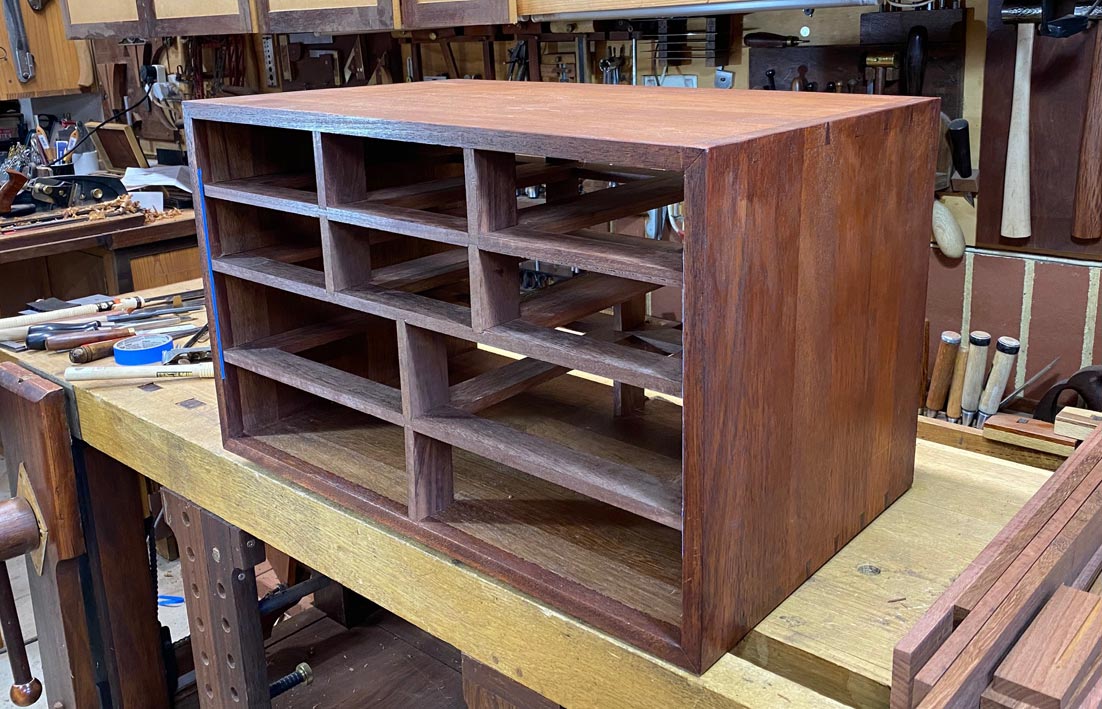
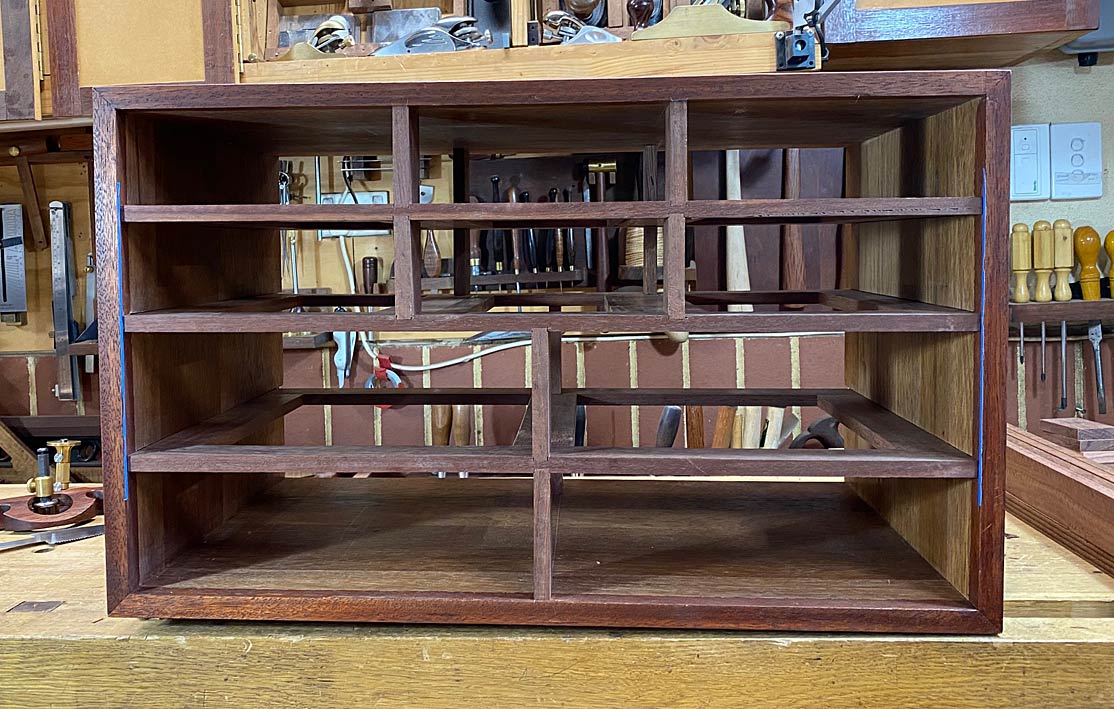
Regards from Perth
Derek
Est. 1998 — 28 years of woodworking knowledge
Underbench cabinet: 11. Progress report
Derek Cohen (in Perth, Australia)
I am pleased to get to this stage, with everything still square ....
... 24 sliding dovetails done.
Only a dry fit - now to glue it together ..
Regards from Perth
Derek
engineering question
Bill Tindall, E.Tn.
I have struggled on how to ask so you understand what I am asking.....Lets try a comparison route.....
The basic engineering need- hold case sides together and support drawers.
In my case pieces the sides are held together by dividers that will also support the drawers. Runners fit loose between front and back dividers even to the point of leaving a gap (seen in picture) so the sides can come and go independent of these runners. The runners have no structural function other than holding up the drawer.
Your case sides are held together by the top and bottom of the case. So the essential function of the dividers and runners is just to support the drawers. It seems you have chosen a complicated route to accomplish this need. (Probably I don't understand something, hence the questions)
Your runners seem to be integrated into the case sides with a dado and fastened to the dividers, why? Your runners seem to be integrated into a frame. Is this frame glued to become a rigid unit? Again why make a frame to accomplish the function of holding the case sides together and supporting the drawers while allowing for case side expansion? How does this construction accommodate case side expansion?
Re: engineering question
Derek Cohen (in Perth, Australia)
Your runners seem to be integrated into the case sides with a dado and fastened to the dividers, why? Your runners seem to be integrated into a frame. Is this frame glued to become a rigid unit? Again why make a frame to accomplish the function of holding the case sides together and supporting the drawers while allowing for case side expansion? How does this construction accommodate case side expansion?
Bill, the seeming complexity comes from my cabinet having multiple drawers and, as a result, multiple drawer dividers.
The dividers connect the case sides, and make the structure more rigid and less likely to move. The drawer cases then also remain straight and parallel.
Does one have to do this? I have built a number if cabinets/chests this way, but also done so with basic dados. The latter seem to do okay. Here, I believed it was the best construction. Perhaps a little overkill .. but every time I stand at the bench and reach for a tool, I want to feel that I did not wimp out when building the cabinet.
Regards from Perth
Derek
Re: engineering question
Bill Tindall, E.Tn.
You didn't answer any of the questions, which involved runners, not dividers. If you look at the large multi drawer cases I have built my top, bottom and divider construction is essentially identical to your case. Horizontal dividers are dovetailed into sides, vertical dovetailed into horizontal, for all the reasons you enumerate.
Where we differ substantially is how we engineered the runners to serve their dual function of supporting the drawer and not constraining the case side. I am trying to understand why you chose the route you chose for engineering the runners.
Re: engineering question
Derek Cohen (in Perth, Australia)
Bill, my apology ... writing late at night with tired eyes and an even more tired brain ....
I set the runners in dados, rather than sliding dovetails, simply because this is on the short side of the case. The runners cross the grain on the short sides/ends of the case. Wood movement is across the grain. Therefore, the dados are not going to move position in the vertical axis.
What is more important is that allowance is made for front-to-back expansion and contraction, since the runners and the case grain oppose each other. Hence, the runners are glued in the first 1/4 - 1/3, which. mentioned in an earlier post.
Regards from Perth
Derek
Re: engineering question
Curt Putnam
Does some of the question resolution lie in the difference between frame & panel cases vs dovetailed solid cases? Does more lie in the single case wwidth drawer per level vs multiple drawers per level?
Apologies for butting in ....
Re: engineering question
Bill Tindall, E.Tn.
Why are the runners attached to the case side? They seem to be M&T into the dividers so they are held in place as needed.
Re: engineering question
Derek Cohen (in Perth, Australia)
Why are the runners attached to the case side? They seem to be M&T into the dividers so they are held in place as needed.
Hi Bill
In a solid case, a dado helps position the runners. That is a pretty common method of fitting a frame. Recall I used templates at the start to position the dados.
In a frame-and-panel case, I would fit front-and-rear blades into a housing, and then join them with runners into a M&T joint ....


Regards from Perth
Derek
Re: engineering question
Derek Cohen (in Perth, Australia) Apologies for butting in ....
Does some of the question resolution lie in the difference between frame & panel cases vs dovetailed solid cases? Does more lie in the single case wwidth drawer per level vs multiple drawers per level?
Absolutely no apology needed, Curt. I wish more here would ask questions or offer their thoughts.
Your thoughts are in the same direction as mine.
I doubt that there is one "right" or even "best" way to fit drawer frames. Bill Hylton wrote "The Drawer Book", demonstrating a multitude of methods.
Regards from Perth
Derek
no and no
Bill Tindall, E.Tn.
Does some of the question resolution lie in the difference between frame & panel cases vs dovetailed solid cases? Does more lie in the single case width drawer per level vs multiple drawers per level?
no and no See separate post on runners coming soon.
Considering only American Period furniture construction.....
A frame and panel case side obviously precludes plowing a dado across the case side. The fact that one can't plow a dado across a case side shows that this dado in not necessary to runner installation. In fact, in Period furniture the times when such a dado is encountered it is there as a result of divider installation, not runner. But given that the dado is there in these cases a runner is simply nailed into it.
The redundance of a runner installed in a dado and M&T into the divider is unnecessary to fulfill the engineering requirements of the runner. There is never any significant load on a runner, even for a large drawer. The redundance of alignment is also unnecessary and in fact leads to unnecessary complexity in Period furniture construction.