WoodCentral Forums

Est. 1998 — 27 years of woodworking knowledge

Underbench cabinet: 8. Drawer Dividers (part 1)

Posts

Underbench cabinet: 8. Drawer Dividers (part 1)

#1

Underbench cabinet: 8. Drawer Dividers (part 1)

Derek Cohen (in Perth, Australia)

After making dados, and drawer blades, and then fitting them, comes the vertical drawer dividers. I consider that these are the make-and-break of a chest of drawers. It is tough to get a case square. It is tough to get the the dados positioned correctly. The drawer blades are simple. But then comes the dividers ...

Drawer dividers are needed when there are more than a single drawer in each row. In this cabinet, there are two rows of three drawers and two rows of two drawers. Care in aligning the dividers at the front and rear is necessary to ensure the drawer case is parallel and square if the drawers are to run smoothly.

It is easy enough to attach the dividers with dados. However, this is a less-strong design than attaching them with sliding dovetails. Building sliding dovetails is more complex, but the advantage here is that they tie the drawer blades to the case, making the case more rigid. That is a good thing, especially for a tool cabinet.

This article is about the preparations for the dividers, and the next article will be making them - there are too many photos for a single article.

Issue: drawer blades flex and bow. Accurate marking out needs a stable foundation.

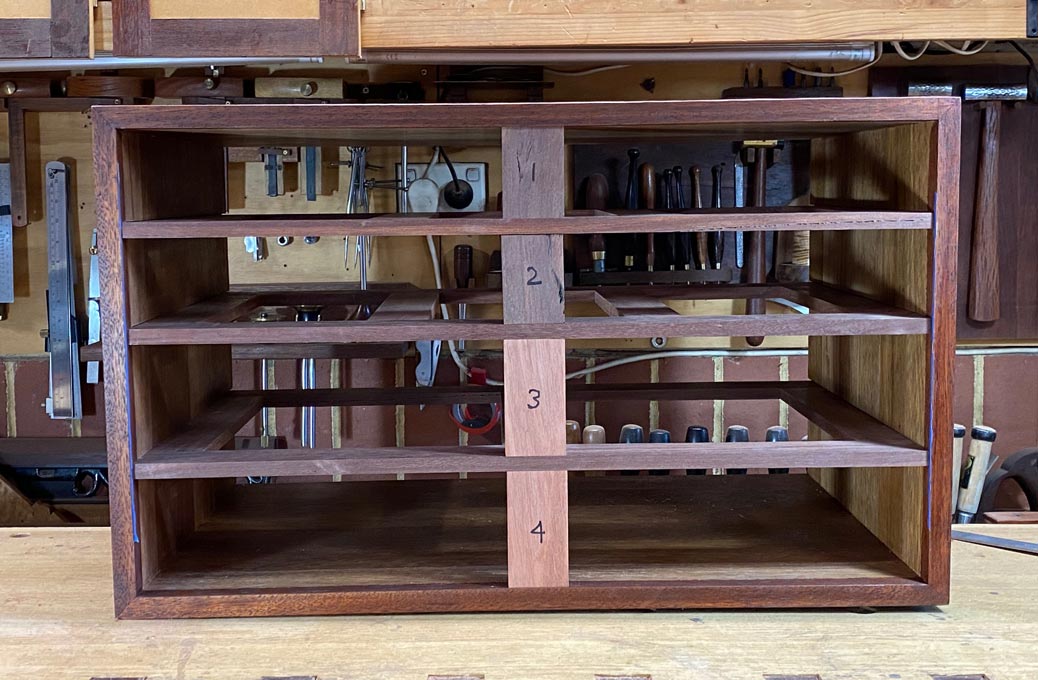
The first step is to make spacers to keep the height even. Start with the ends ...
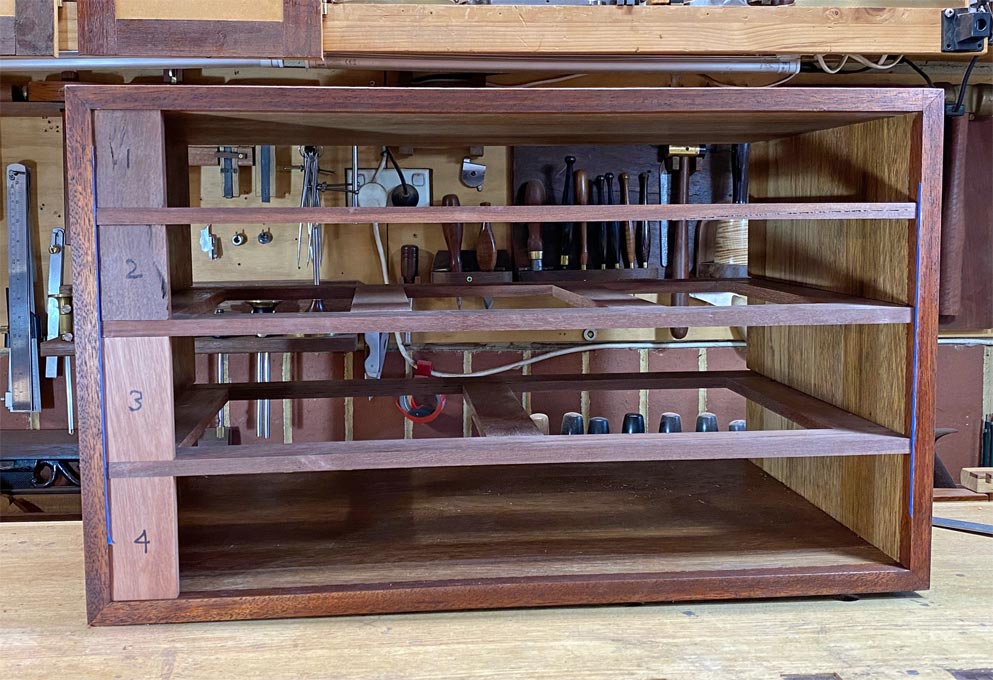

.. and then move them into the centre ...

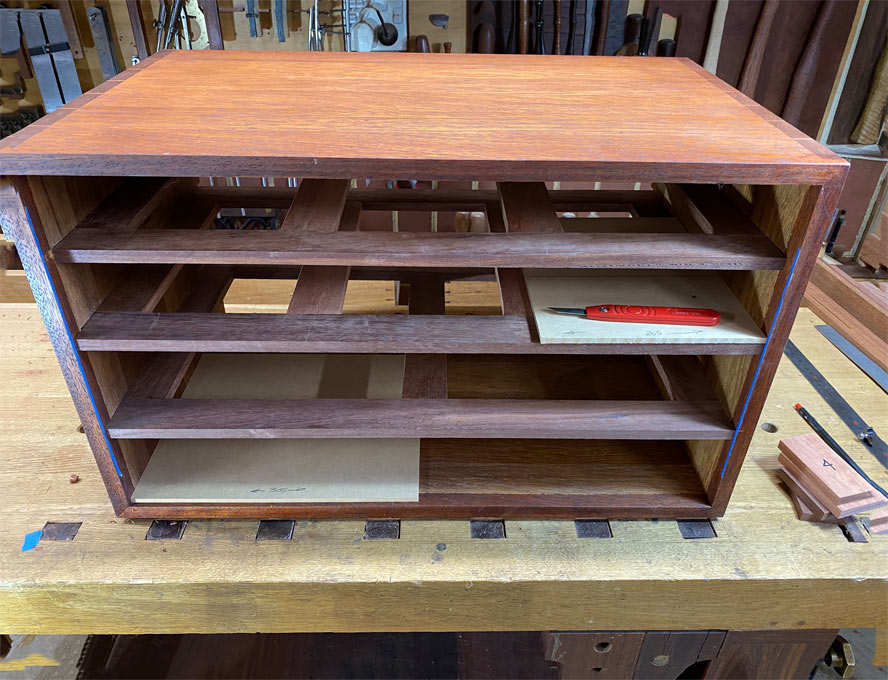
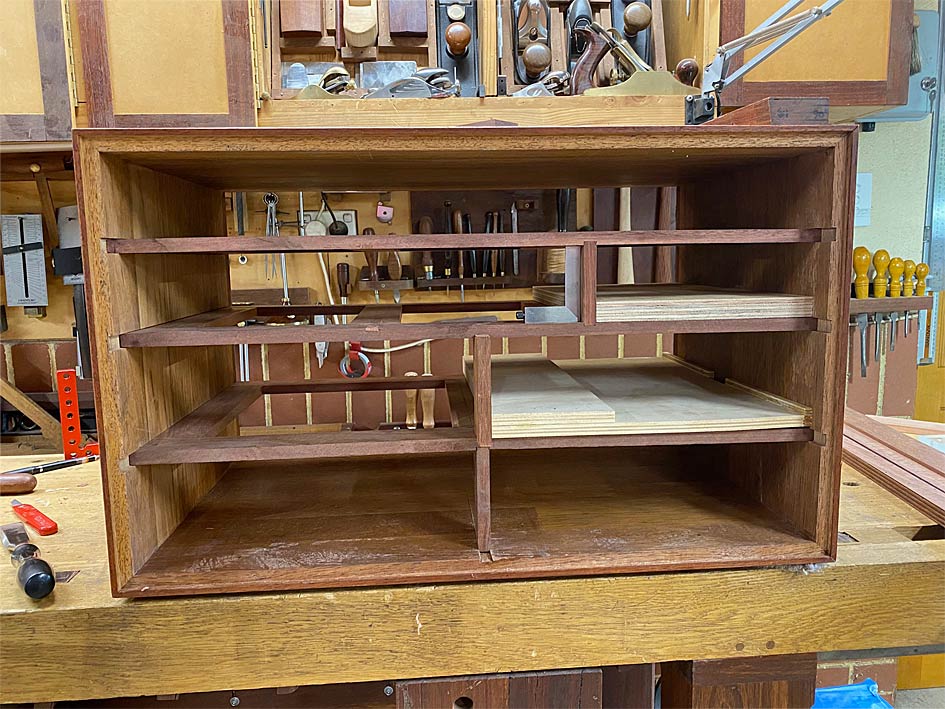
The second task is to make templates for spacing out the drawer dividers, similar to the heights for the dados ...

Later, I made these thicker so that they could also aid in ensuring that the dividers were plumb when marking out.

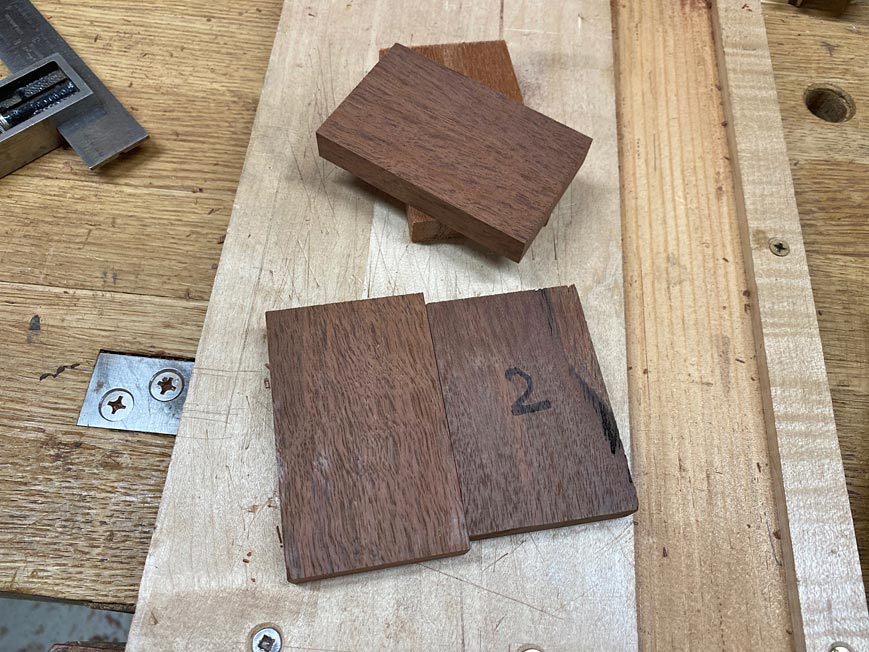
Lastly, for now, the drawer dividers were cut ...
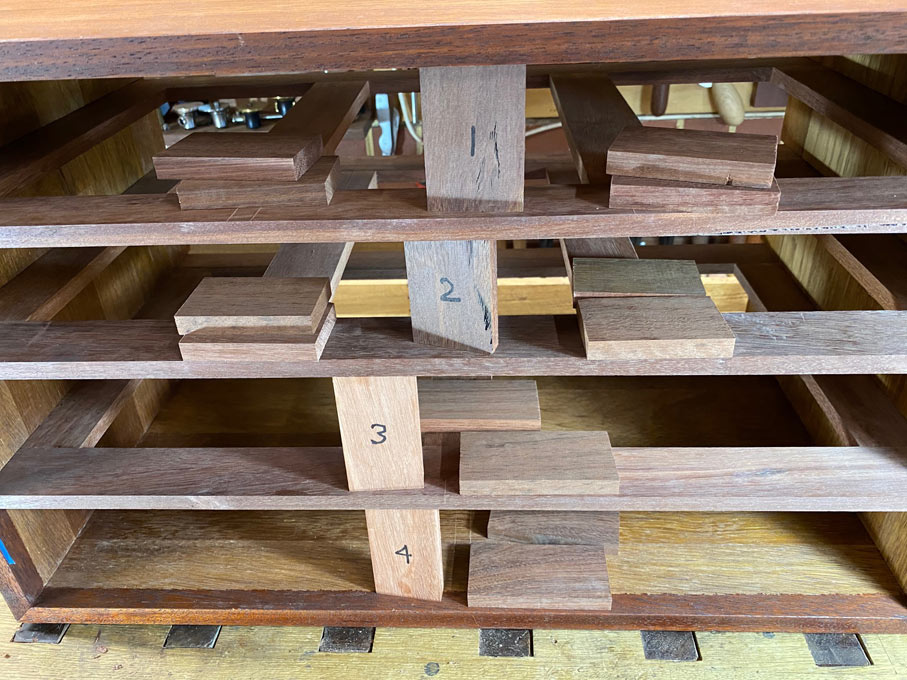

The dovetails will be 3mm deep at each end ...


Onward to the dovetailing .... :)

Regards from Perth

Derek

Re: Underbench cabinet: 8. Drawer Dividers (part 1)

#2

comment

Bill Tindall, E.Tn.

I do like procedures that remove any chance of error and the one you have for layout meets this requirement. I would not discourage anyone from using it.

If bold however, the process can be shortened. I just stack the blades, indexing the ends in alignment, and mark across all of them the position of the "dividers" (English for vertical dividers). Ditto for the case sides to mark the blade positions ( English for horizontal divider). As a personal preference I don't like repetitive dry fit assembly of case to enable marking drawers from the assembled case.

Re: Underbench cabinet: 8. Drawer Dividers (part 1)

#3

Re: comment

Derek Cohen (in Perth, Australia)

Bill, I get what you write. As I understand what you are suggesting, this works if all parts (namely, the dovetails) are machine-made and identical. Where there is variation, even slight, owing to hand cut joinery, it will ultimately throw off the accuracy of the drawer case.

I have a reasonable method for making the dovetails, and we will hopefully discuss this - advantages and disadvantages - when I post it next.

Regards from Perth

Derek

Re: Underbench cabinet: 8. Drawer Dividers (part 1)

#4

Re: comment

Bill Tindall, E.Tn.

It often works out that subtle details drive us to do what we do, rendering what we do inappropriate/inconvenient/ etc. for someone whose details differ. Makes discussions interesting.

Lonnie Byrd teaches what you do for marking.

I do have a question though. The distance between the dovetail shoulders of your blades must be identical no matter how you cut the dovetails. If these are aligned a scribe mark across all the involved blades will fix the divider (vertical) location as accurate as any method. ?correct?

Re: Underbench cabinet: 8. Drawer Dividers (part 1)

#5

Re: comment

Derek Cohen (in Perth, Australia)

It often works out that subtle details drive us to do what we do, rendering what we do inappropriate/inconvenient/ etc. for someone whose details differ. Makes discussions interesting.

Lonnie Byrd teaches what you do for marking.

I do have a question though. The distance between the dovetail shoulders of your blades must be identical no matter how you cut the dovetails. If these are aligned a scribe mark across all the involved blades will fix the divider (vertical) location as accurate as any method. ?correct?

Thanks Bill

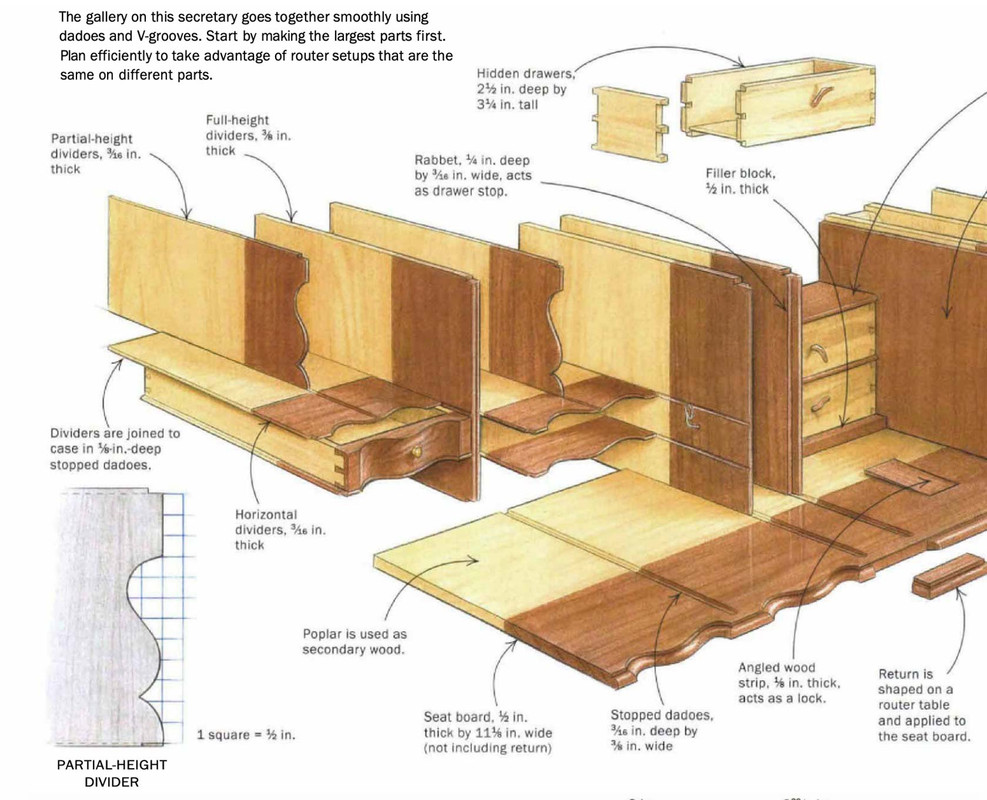
I looked up Lonnie Bird (he writes for FWW) and found a Desk Gallery he had built ..


There is a relevant difference in this example. Lonnie is building with solid wood panels, into which he creates the stopped dado. I have done this many times. It is intuitively easier than working with frames.

The present build requires a couple of stopped sliding dovetails. I have done this before, and it is always a challenge - not in creating the joint, but in being precisely accurate (coplanar and square).

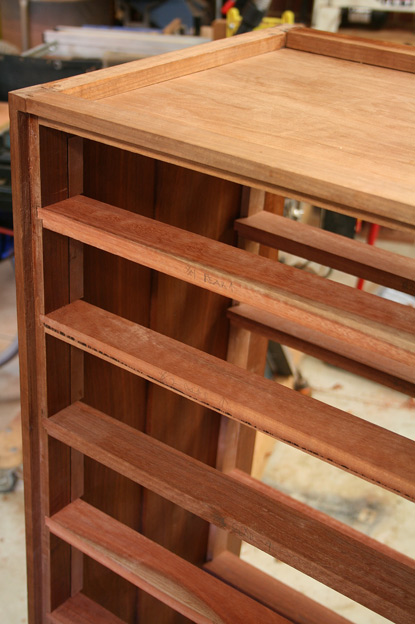
The drawer blades for the Lingerie Chest, several years ago, rested on sliding dovetail, with the front sections being stopped ...


As you noted, the shoulders for the dividers (in the current build) are all the same. It is the slight variations in the dovetail that makes it tricky to fit. The Lingerie Chest had the advantage of single drawers in a row. Adjusting for height is more forgiving than adjusting for width.

Let me know your thoughts after I post the next part, which is about the sliding dovetails at the rear of the chest.

Regards from Perth

Derek

Re: Underbench cabinet: 8. Drawer Dividers (part 1)

#6

Re: comment

Bill Tindall, E.Tn.

Lonnie is just down the road a bit from where I live. A friend has taken classes with him involving case work. I took one and it was useless to me; but that is another story. He teaches laying out blades and dividers in cases just as you have described. Friend (Mayberry see Gallery desk) employed it on a chest of drawers. Decided too fiddly and went back to marking more or less as I have described, and many use.

The box you are building is functionally no different than the box for a tall chest of drawers where the drawers might be in ranks of 3/2/1/1/1.

Re: Underbench cabinet: 8. Drawer Dividers (part 1)

#7

Re: comment

Derek Cohen (in Perth, Australia)

Bill, I think you have a point. What you suggest is essentially what I did with the Lingerie Chest - create front and rear sockets together, then separate them. I shall do this next time.

Regards from Perth

Derek

Re: Underbench cabinet: 8. Drawer Dividers (part 1)

#8

Re: comment

Bud

Derek and Bill,

I've spent a weekend in a class and didn't get as much info as reading all of your posts.

Re: Underbench cabinet: 8. Drawer Dividers (part 1)

#9

Second the notion

Jim Matthews

Organized classes always descend to the lowest skill level.

When that was mine, it was fine.

Afterwards, it was an expensive drag.

Derek's website is invaluable to me.

👍 This page answered my questions

Your vote helps other woodworkers quickly find the answers and techniques that actually work in the shop.