WoodCentral Forums

Est. 1998 — 27 years of woodworking knowledge

applying glue to sliding joints

Posts

applying glue to sliding joints

#1

applying glue to sliding joints

Bill Tindall, E.Tn.

Glue application to dovetails, and related other slid together joints, came up in a conversation below. I would like to continue it separately.

I think of three goals for applying the glue to a dovetail or mortise and tenon joint- (1)if liquid hide glue, to lubricate the joint, (2) achieve wetting of both surfaces, (3)prevent glue from squeezing out where it would cause a problem in finishing. In the discussion below it became clear that subtle details affect one’s preference for how the glue is applied.


I use the equipment shown. I can pick up a drop of glue with the flat end of the spatula and rapidly wipe a thin film on the long grain of a dovetail or pin. Because I am only applying a thin film there is little excess glue to squeeze out. Any that squeezes out is forced to the outside of the joint where it will be removed during finishing or in the case of a drawer, fitting. If I was not able to rapidly apply a thin film my application details would be different.

A joint will only bond where the glue has wet both mating surfaces. If glue is applied to only one surface, one must rely on excess glue from the applied surface wiping off on the “dry” surface. If the mechanics of sliding a joint together are considered, excess glue is forced to the outside. As the joint is slid ever more together there is less glue available to transfer. It would seem likely that with a tight joint there would be no transfer after even a partial engagement of the parts.

End grain to long grain joints are weak. Personally, I see no point in applying glue to the end grain of a dovetail joint. I would especially avoid the bottom where any excess will squeeze out into the interior of the joint where it is hard to remove. Because I often stain wood I am paranoid about avoiding squeeze out to areas that will get stained.
Re: applying glue to sliding joints

#2

Lab training carries over?

Henry (Raleigh NC)

Great advice Bill, but how many of us have a leftover lab spatula to use as a glue spreader?

Your chemist roots and training show up here in picture form - love it.

Henry

Re: applying glue to sliding joints

#3

Re: applying glue to sliding joints

Don Stephan

Years ago I purchased a spatula from a local store that sells oil and water color paints and supplies to artists. Not the same spatula, but works well for spreading glue in dovetail joints.

Re: applying glue to sliding joints

#4

and not any old spatula

Bill Tindall, E.Tn.

It has to be one of the square ended ones not a rounded or pointed ended one. I have no idea where to get one other than having it escape from the lab. Ebay?

Re: applying glue to sliding joints

#6

Re: and not any old spatula

ryan

A good place to look for different shaped implements is a pottery supply. Potters use some wierd shaped tools, some of which I find quite useful for woodwork. Seattle Pottery Supply is a good place to see what's available. (no relationship, they just have a good selection)

Re: applying glue to sliding joints

#7

Re: and not any old spatula

William Duffield

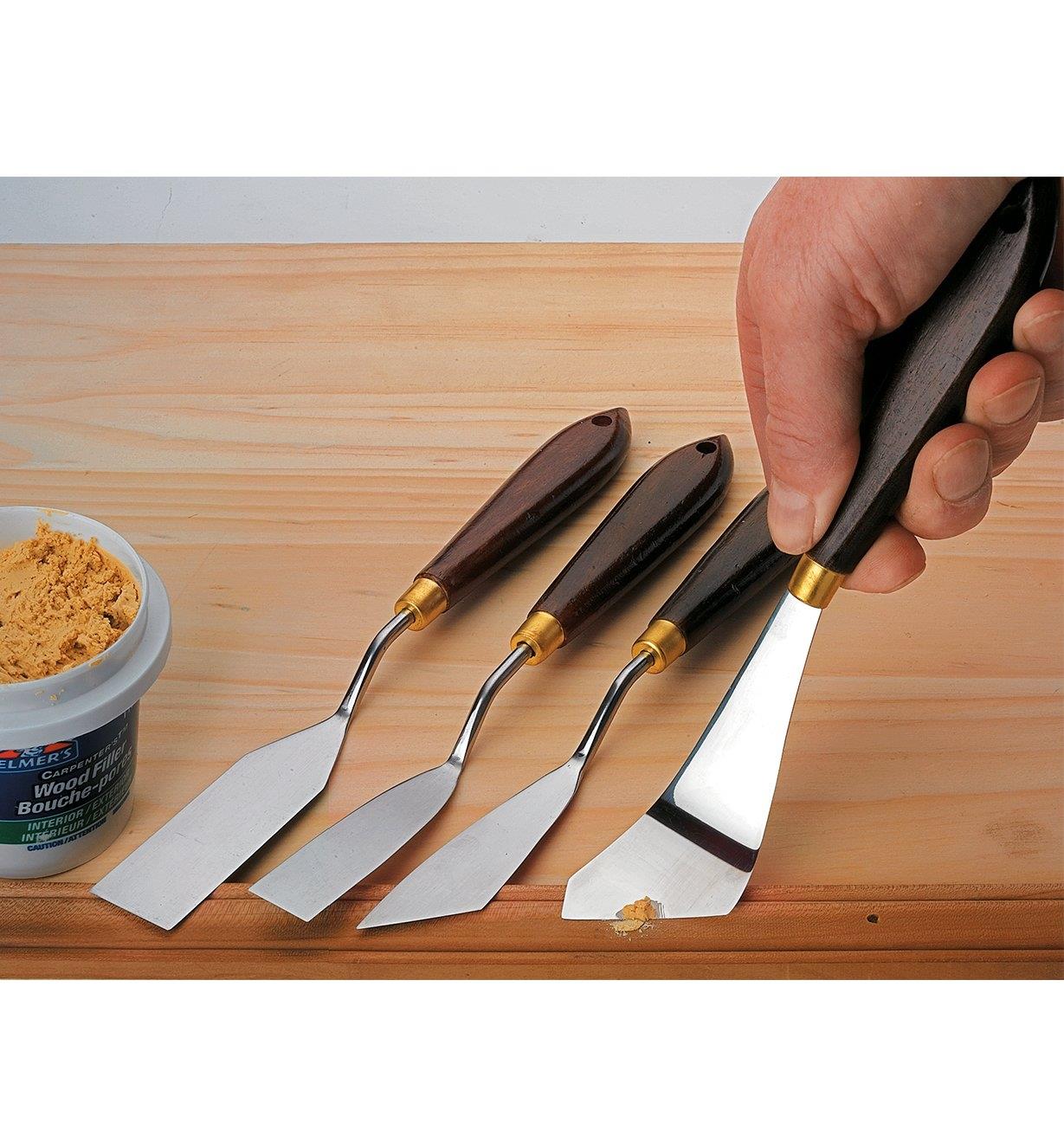
If your search for "spatula" is not finding what you want, try a search for "palette knife".

I use these stainless steel palette knives from Lee Valley. The business ends are very thin, and therefore flexible. Somem may find this an advantage; others, a disadvantage. They are definitely too flexible to be used to scrape off hardened glue drips. For that, I prefer a crank back firmer chisel or a card scraper.

https://www.leevalley.com/en-us/shop/tools/hand-tools/knives/60274-palette-knives-for-woodworkers?item=35K0901


Re: applying glue to sliding joints

#8

Re: and not any old spatula

TomD

Tandy sells a tool like that for applying dye to the edge of leather, in which use one uses the flat surface of the tool, sideways.

A very useful thing to have around the shop is feeler gauge stock. It comes in a variety of forms, I prefer 1/2" by 12". It comes in 1 thou increments of thickness. Useful for lock picks, small saw blades, and all sorts of tools. It is spring hardened. You can make a handle out of shrink tubing, or lace that has been epoxied.

The Dollarama sells artist's spatulas, and they are about 1.50. Not as nice for art work, unless you regrind them, but they are uniformly stiff, which would be good for this kind of device.

👍 This page answered my questions

Your vote helps other woodworkers quickly find the answers and techniques that actually work in the shop.