WoodCentral Forums

Est. 1998 — 27 years of woodworking knowledge

hinge mortise - single or double?

Posts

hinge mortise - single or double?

#1

hinge mortise - single or double?

DizD

I've seen references to mortising both hinge leaves into one side and surface mounting other leaf on door. Carlyle Lynch has this technique in one of his plans where he suggests flattening the hinge in a vise first. Are there pitfalls to be aware of with a single mortise?

Re: hinge mortise - single or double?

#2

Re: hinge mortise - single or double?

Virgil Johnson

I built a huntboard from Lynch's plan and used that technique but had forgotten about it until I read your post. In 22 years of using the piece no one has commented on the hinges and the doors are sound. No issues in my sample of 1.

Re: hinge mortise - single or double?

#3

Re: hinge mortise - single or double?

William Duffield

Yes, there are pitfalls. The screws are there mostly to make sure the hinge cheeks don't slip past the hinge mortise. The majority of the strength of the hinge connection is in the interface between the sides of the mortise and the edges of the hinge. That cheap trick limits the support on the door side to only the threads of the screws into the door.

Re: hinge mortise - single or double?

#4

Re: hinge mortise - single or double?

Ralph Lipeles

Would a strip of 2 sided tape, under the hinge on the door side, help?

Re: hinge mortise - single or double?

#5

Re: hinge mortise - single or double?

Dick Coers

There are always short cuts. I don't make furniture for the short term, I make it for generations. In 50 years, I don't want my grandson to see I took short cuts and the door is loose and the screw holes have gone oversized since there is no mortise to carry the load. Is the vise trick to modify the swaging, or put some swaging into the leaf?

Re: hinge mortise - single or double?

#6

a flawed technique

Bill Tindall, E.Tn.

I have never seen a single mortise on a piece of fine furniture or a house door. Why even consider it? The mortise supports the hinge. The screws just hold the hinge in the mortise.

Re: hinge mortise - single or double?

#7

Re: hinge mortise - single or double?

Sgian Dubh

With a socket cut into both the stile of the door and into the furniture carcase you fit one leaf of the hinges into, for example, the door first, and then place the matching leaves into the hinge socket of the carcase and screw through at least one hole to start with, just to get the door at least partially installed. Then check the door swings okay, adjust sockets if required, and complete the installation. The sockets cut for each hinge act as a positive location for each leaf. So, with one leaf of each hinge fitted into the door stile, which can be done with the door away from the carcase, holding the door in place by inserting the other leaf (or leaves) into the carcase hinge sockets helps considerably, especially if working alone, in holding the door in the right position as the first screw for each hinge leaf is driven into the carcase side.

Without the hinge socket in both the door stile and the carcase side (i.e., double leaf thickness sinking into one or the other of the stile or carcase side) means more of a juggling act to correctly locate the second leaf into its correct position on a flat surface with nothing to register against.

And, as others have mentioned, the bottom edge of the socket for each hinge leaf provides additional positive resistance to downward sinking of the door in use over time.

I've never been a fan of double leaf thickness sinking of a hinge into either one or the other of the door stile or the carcase side, and perhaps I'm especially not fond of the technique when fitting a heavy architectural door to its door lining. Slainte.

Re: hinge mortise - single or double?

#8

In defense of Mr Lynch's method.

Virgil Johnson

The article in question (I'm pretty sure although the OP does not mention it by name) mentions this technique for a cock beaded light door on a huntboard. The goal is to keep from cutting a hinge mortise into the cock bead. The hinge is offset into the leg of the huntboard and does not overlap the cock bead. I too build for generations but do not hesitate to follow the advice of a furniture maker I respect. I would not use this method with a heavy door.

Re: hinge mortise - single or double?

#9

Re: In defense of Mr Lynch's method.

Sgian Dubh

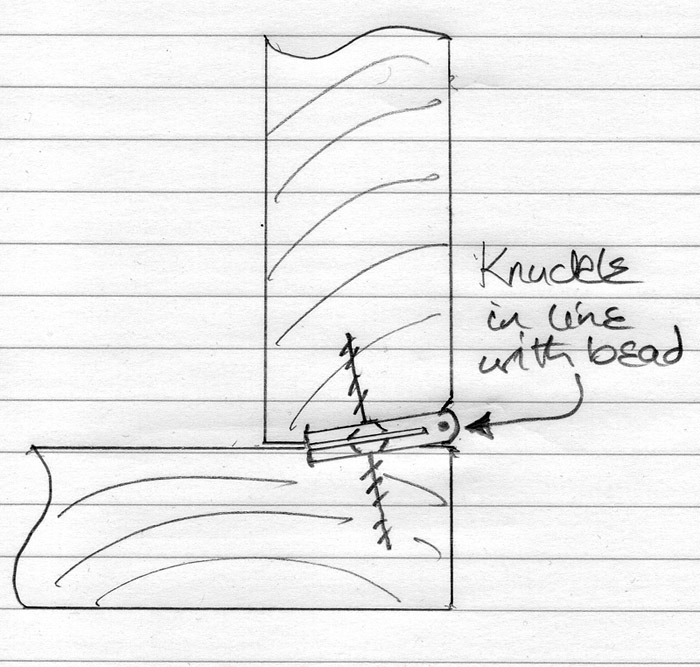
Virgil, I don't know the article to which you refer, but now you've mentioned cockbeading being a reason for the technique, it brings to mind the alternative solution to that conundrum. Assuming we're talking of extruded butt hinges, the alternative is to make the cockbead with a diameter and resultant arc that largely matches the hinge knuckle, and then cut the hinge recess so that the knuckle lines up with the bead. This can result in double depth sinking of the hinge into whichever part has the cockbeading, so still presents the same alignment challenge at installation of the door that the sinking of a leaf into each part helps make easier.

Who is to say which technique is correct? Not me, ha, ha. Slainte.

Re: hinge mortise - single or double?

#10

Re: hinge mortise - single or double?

DizD

Just curious. Did you place the flattened leaf of the hinge at the bottom of the mortise? Does this offset the hinge barrel away from the cockbead? I can see this working well considering the size of the hinges relative to the size of the door.

Re: hinge mortise - single or double?

#11

Re: hinge mortise - single or double?

DizD

Thanks all - In agreement with comments on double mortise for doors. I think the rule is Gravity wins every time. For a chest lid, however, it would seem not be an issue except for the alignment process.

Re: hinge mortise - single or double?

#12

Re: hinge mortise - single or double?

William Duffield

Can you predict that normal gravitational forces are the only ones that will affect your chest? Over the years, chests have been used for protecting their contents while being moved. What if the chest fell of the back of a wagon or forklift or off a hand truck and down a set of stairs? If you know how to build the joinery correctly, why use a cheap trick instead?

Re: hinge mortise - single or double?

#13

Turning this request around.....

Bill Tindall, E.Tn.

What reason would anyone have for doing a single side mortise? If you can make one, why the reticence to do a double?

One, they are trivial to do. And if they are not regarded trivial then some training and a small amount of practice will make them so.

Two. Given that they are trivial to make, the ease of accurately locating the lid or door to the case when using a double mortise would make it by far the preferred technique unless there was a compelling reason not to.

Re: hinge mortise - single or double?

#14

Re: hinge mortise - single or double? *LINK*

Virgil Johnson


Here is a pic of the hinge that I squeezed in the Kurt mill vice back in 1999. Seems I strayed a bit from Mr Lynchs design intent. The barrel of the hinge stayed centered on the door gap so that one half of the hinge is set into the leg and the other fits into the gap between the door and leg. If you wanted the hinge offset I think you would have to squeeze it then bend the barrel off center. The doors on this huntboard are very light (10” x 13”) are only opened a few times a year. They were opened more in the last 2 days than in the last 2 years. I don’t recall alignment of the doors being a problem. The glue up of the carcass was much more difficult.


http://www.woodcentral.com/shots/shot71.shtml

Re: hinge mortise - single or double?

#15

Re: hinge mortise - single or double?

Sgian Dubh

It had slipped my mind regarding this question, but I remembered it just now so thought I'd mention it here. There's also the technique of angling the hinge at the intersection of the door and frame or carcase side so that the knuckle falls in line with the bead, whichever part the bead sits on, i.e., door or carcase.

The advantage here is that there is a recess or shallow angled mortice cut in both the parts so at least there's a recess to help with locating the hinge in each part when fitting the door(s), and the bottom edge of each recess supports the bottom edge of each hinge leaf thus reducing the likelihood of gravity causing the door to slide downwards.

The disadvantage is that setting out and executing the recesses is somewhat more challenging than normal. Slainte.


👍 This page answered my questions

Your vote helps other woodworkers quickly find the answers and techniques that actually work in the shop.