Nearly 100 Exotic Wood Species, Direct-Imported Since 1972. Shop Slabs & Turning Stock.

WoodCentral Forums

Est. 1998 — 28 years of woodworking knowledge

Desk Design issue.

Posts

Desk Design issue.

#1

Alan Young

Desk Design issue.

Alan Young

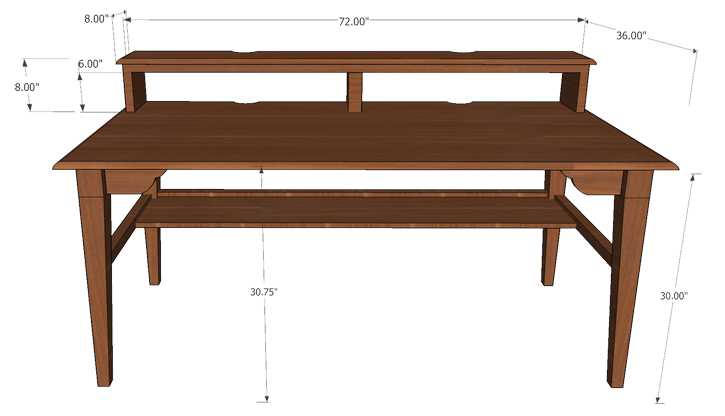
Looks like I might be taking on a project. A neighbor needs a desk. We are close to finalizing the details. One aspect to settle/confirm is that he wants the space between the floor and the bottom of the desk to be 30" with the top at .75" thick so the top would be 30.75" from the floor-


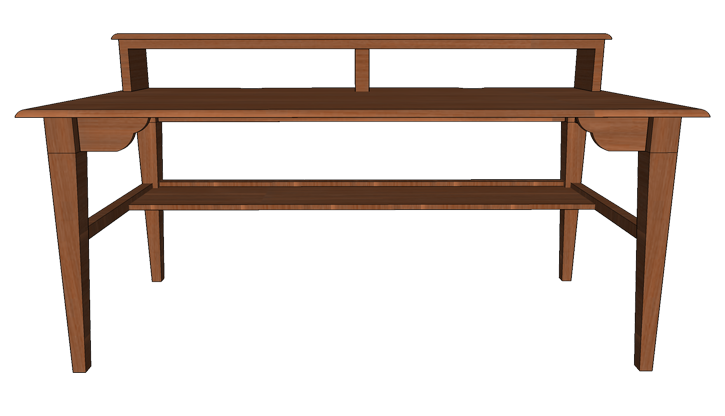
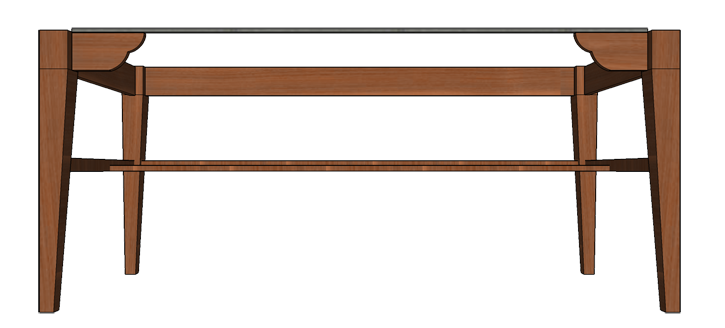
The tricky detail is that he doesn't want an apron of any sort for the majority of the length of the desk-ie the side where he will sit. We are looking at the idea of a stub apron from each end @6" or so with a steel bar connecting the sub aprons on top. The bar would be 3/8" thick i.e. high and 3/4" thick-same as the stub apron.


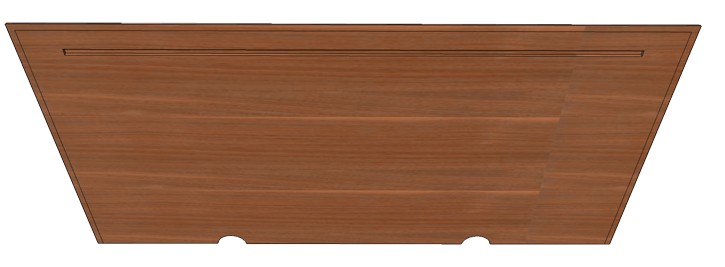
There would be a groove routed into the underside of the desk allowing the steel bar to fit flush with the underside of the desk.


Client is wondering about "deflection" of the top with the bar at 3/8" thick....My thoughts are that the wood-walnut---should be sufficient to spread any deflection force and that the main job of the bar is to tie the stub aprons/end sections together.

Any thoughts one way or the other as to this design detail? I looked up a "deflection" formula on wikipedia and was unable to figure out what would be accurate numbers to plug into the formula....

Re: Desk Design issue.

#2

Re: Desk Design issue.

Henry (Raleigh NC)

But Alan, that 3/8" piece is part of a larger whole, not isolated. The entire 3/4" top around that will 'stiffen' the entire piece. Deflection will not be an issue - in my estimation.

What is the purpose of the iron substitute of the apron? A 3/4 wood top should not deflect (much?) over a 36" span. Try to find 'the sagulator' to determine how much.

Your reinforcement should work well I think... but I'm not certain it is needed.

Henry

Re: Desk Design issue.

#3

agree...forget the steel

Bill Tindall, E.Tn.

Mock it up and test. Heck, a 6" board 3' long won't deflect under the weight of a pencil, or elbow, etc. Would you hesitate making a book shelf 3' unsupported?

Re: Desk Design issue.

#4

Re: Desk Design issue.

Brian gunsmith From colorado

If deflection is the main concern what about using a thicker top. If you went to 1.25 inch and had a taper on the front edge, the user would hardly be able to notice it. And it would be stronger. And if you were still concerned a thicker top could easily hide a steel rod.

Re: Desk Design issue.

#5

Alan Young

Re: agree...forget the steel

Alan Young

I do not worry about the sag factor-and I conveyed those opinions to my client. My concern is more for a lateral force that could push the front legs outward--It is not uncommon to swing away from a seated position and clunk into legs..I see the bar as keeping the legs from spreading in a situation where the user knocks the legs...

I would attached the top via clips that allow the top to move with seasonal changes in humidly--probably also drive some shorter screws through the metal bar and into the recessed underside of the desk top....


Re: Desk Design issue.

#6

Re: agree...forget the steel

Dick Coers

Glue and screw the front stub aprons to the top and let all the movement go out the back. Personally, that height would be too high for a writing surface for me. Absolutely too high for working on a computer. My dining room table is 29 1/2" tall. My desk keyboard tray is at 26" off the floor.

Re: Desk Design issue.

#7

How 'bout

David Yoho

I see the bar as keeping the legs from spreading in a situation where the user knocks the legs...

I would attached the top via clips that allow the top to move with seasonal changes in humidly

Since the top will move most in width (front to back), you could delete the bar and attach the stub aprons, which will be attached to the legs, straight into the top using pocket holes and screws. Then use the clips for the rest of your attachment points. This allows for movement of the top but keeps the legs from spreading if bumped hard.

Re: Desk Design issue.

#8

Re: Desk Design issue.

Lee Schierer in McKean, PA

I made a desk with no horizontal support across the front out of hickory, a but stiffer than black walnut. The top is attached to the base with figure 8 fasteners. I get no deflection whatsoever on the desk top even if I lean heavily upon it. The open span is 4 feet 6" and the top is only 3/4" thick.


Two figure 8 fasteners on each end rail and one near the end of the front stub rails should hold everything in place.

Lee

Re: Desk Design issue.

#10

Re: Desk Design issue.

Barry Irby

I agree with most of the above.

I might make the top an 1" thick but mock it up at 3/4" and that should work. 72" is pretty wide.

Securely attach the stub aprons to the top and legs and let the movement occur at the rear.

Unless your client is tall enough to be a pro basketball player, I have to agree with Dick, 30"+ is too tall for a keyboard. I am 5' 8" and mine is about 26" off the floor and if I had my druthers I would lower it an inch. (Mine is on a shelf that hangs below a top that is 30" off the floor. I am about to make a new desk for myself, thanks for the opportunity to think about it.)

Re: Desk Design issue.

#11

Re: This will blow your mind...

TomD

There are design options that will add to the stiffness of the top. I don't understand enough what is really being done here to know whether there is a problem. For instance how long is the unsupported span, and does he expect to sit on it. I made this low coffee trestle table with a tempered glass top. Looked good to me. And every kid in the neighbourhood had a go at sitting on it while the kids were young. That was not part of my brief.

So off the bat I would want to know whether the design issue is stiffness, or tensile strength, or both.

If you go with the metal bar part, I would use a strap, like 1/8x3/4 and make a 3/4" wide groove. You set it in with a few blocks to support it, you should be able to get a half inch of arc in it. The whole thing gets hardware bonded with epoxy. So what you get are 1) a much wide support for the load, in stiffness you want the supporting dimension to be out there as far as possible, circular section are great for being the best in all directions, but you only care about one direction in this case, so align your material with that; 2) you want the maximum offset in the metal, like diamond wires on a mast; 3) You want the whole thing bonded in so the load is transferred to the whole bar. A bar of metal is not that stiff in these sections, but if you bond the whole thing in, you create a composite truss. Another material that might work pretty well in this application is one of those pieces of pultruded glass fiber they sell in the fencing section of hardware stores, they bond well.

Simplest method is to make your top 1 inch thick, and taper the visible edge. That way you would pick up nearly twice the stiffness, and almost twice the strength, depending on how abrupt the taper is.

Complicated method, that would make sense if the design is really pushing the envelop, is to Vac bag veneer over carbon cloth. That would be very stiff. Seems unlikely to be needed in this case. But if the desk had only a support at one end, and was bolted to the floor, and people would stand on it to change light bulbs...

If you put say a wire,or cable in a groove and tension it, that can really increase the stiffness and strength, even with a slight offset.

One technique that is used in bows is to, in this case, make you outer board of the top 2 x 3/8" thick pieces that are natively curved their length, then laminate them in a mold, such that the 2 Cs nest, but they are flexed past straight to the point that when they come out of the mold and spring back, they are straight. Very difficult to one-off. But it will be very stiff in one direction...

-------------

So a few examples of the above are examples of pre-stressed structures. Did you know that the bicycle wheel is a pre-stressed structure, and that the loaded axle does not hang from the spoke above, but stands on the spoke below it? Yes, you are supported by the column under the wheel, not hanging from the wire above. Apparently you can prove this to yourself by plucking the musical notes of a bicycle wheel (a guitar tuner may help), or using a spoke tension tool to read the tension. If you were hanging from the spoke you would hear a higher pitch above the axle, but what you hear is that the only pitch that changes is the spoke(s) below. That becomes lower in pitch. Or so the story goes.

Mind blown? If nothing else it is a great way to start an argument with cyclists.

Re: Desk Design issue.

#12

Re: Desk Design issue.

Jason Roehl

Not that they apply here, but ADA regs spec knee clearance of 27” at a desk/table, and a working surface height of 28” to 34”. 30” is pretty normal.

Jason

Re: Desk Design issue.

#13

Alan Young

As Usual- Lots of great comments

Alan Young

Client and I have both been convinced the steel bar is unnecessary. He is also re-thinking the height he wants...

Thanks for all the suggestions. Top will probably be fastened securely to the stub aprons and the movement will float front to back via clips or fig 8 attachments..

I'll post pics as the project gets underway.

-Alan

Re: Desk Design issue.

#14

Bracket Foot

Bill Tindall, E.Tn.

The choice you describe is a variant of what is called a "bracket foot" in Period furniture.

There are various means of fastening a bracket foot to a case bottom. What follows is perhaps the most robust means.

I don't have a picture but will try to describe........The three constituent pieces are milled in such a way that when they are assembled there is a rabbett (sp?) around the inside edge of the assembly. Into this rabbett is fitted and screwed a 3/4" thick triangular piece of wood, which in turn is screwed to the case bottom (in your case the table top). This triangular piece strengthens the joint and provides a large attachment surface to the case bottom. Its grain runs the same way as the case bottom so there is no differential expansion/contraction between the foot assembly and the case bottom(in your case the desk top).

This assembly can last centuries.

Re: Desk Design issue.

#15

Alan Young

So something like this?

Alan Young

A front stub apron and full side apron glued into leg. A three part structure all glued together and glued to stub apron,leg and side apron. The desk top can then be screwed from the underside of the three part piece. Glued also if the top is to never come off. The rest of the top attached via standard methods of clips/fig8 hardware etc to allow the wood movement to move from stationary in the front to wards the back.


Re: Desk Design issue.

#16

Wish I had seen this before

Henry (Raleigh NC)

Alan - About 6 months ago I was making a Covid desk, needed for working from home; I had similar concerns/issues.

I opted for a wide but shallow pencil drawer with a full front cross beam - thinking similar to yours about support of legs splaying out. I likely would have used what you have drawn there in place of my solution, but I guess the next piece will have to incorporate my learning.

Thanks (all) for this thread.

Henry

👍 This page answered my questions