WoodCentral Forums

Est. 1998 — 27 years of woodworking knowledge

In/Outfeed on Combo Jointer/Planer

Posts

In/Outfeed on Combo Jointer/Planer

#1

In/Outfeed on Combo Jointer/Planer

Don Stephan

Today I was describing for a friend the relative merits of a combination jointer/planer that may offer a very wide bed, and I wondered how the machines handle long heavy boards. Does one make ball bearing or roller stands on the infeed and outfeed sides?

Re: In/Outfeed on Combo Jointer/Planer

#2

Re: In/Outfeed on Combo Jointer/Planer *LINK*

Sgian Dubh

Do you mean machines like the minimax fs 41es below, Don? These machines have a combined infeed/outfeed surfacing table roughly 86" long by 16" wide, with a matching thicknessing width (16") capacity. Coincidentally, I recently had a job where I used this model of machine, and of all the planer/thicknessers I've used intermittently over many years this has to be the best in terms of capacity and swift swapping from one function to the other, plus ease and speed of adjusting thicknesser bed height. There may be better planer/thicknessers of similar or greater capacity out there, but if there are, I've no experience of them.

However, this machine, in common with all surface planers (US jointers) can be used with supplementary freestanding adjustable rollers, which I sometimes had to do when working with the machine below - the stuff I was working on the machine below was sometimes up to around 14+ feet long. If working with material heavy enough and long enough to cause a single operator to struggle with holding the wood down on the tables at either the beginning or end of the cut then supplementary rollers, available from a variety of suppliers such as the US based Rockler version below, can certainly make life easier. Much much better really than a roller is to have a capable helper to support the pieces at the beginning and end of the cut, which is less hassle altogether, or at least that's my experience, ha, ha.

Personally, I can't see a good reason to make a supplementary roller support stand when ready made ones are are already available at what seem to be reasonable prices, but others may see things differently, e.g., cost and capability of the ready made ones. Slainte.
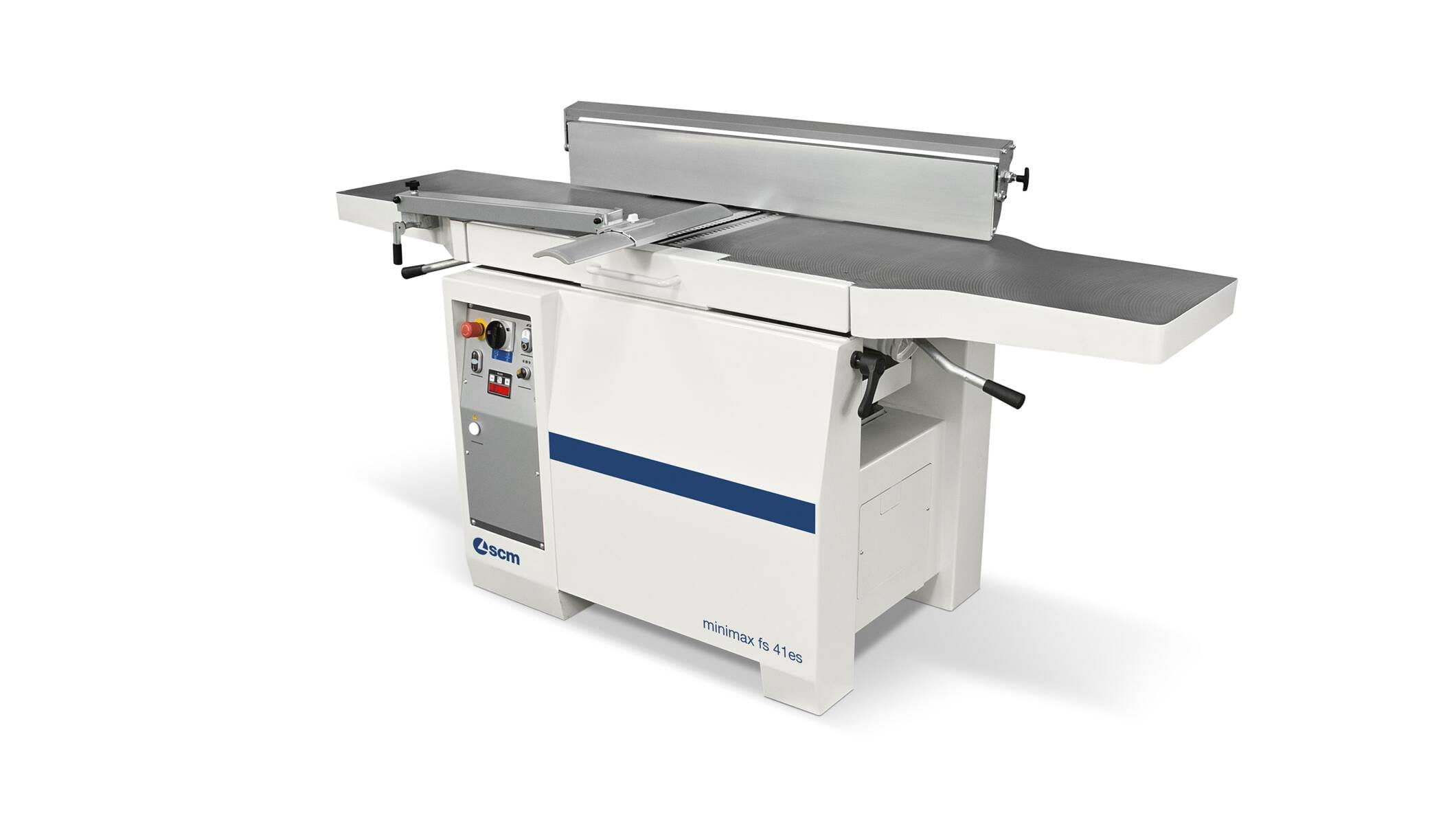
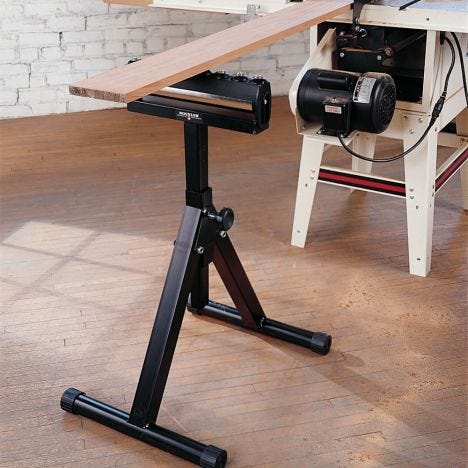


minimax fs 41es

Re: In/Outfeed on Combo Jointer/Planer

#3

Ellis Walentine

Re: In/Outfeed on Combo Jointer/Planer

Ellis Walentine

I've had two Inca jointer planers, and on the first one, I made a removable, 4'-long outfeed table that worked great. I routinely planed 12' boards dead flat. Roller stands are fine if you can line them up well and space them such that they don't bump the work. This is more of an issue on a jointer than on a tablesaw.

Ellis

Re: In/Outfeed on Combo Jointer/Planer

#4

Re: In/Outfeed on Combo Jointer/Planer

Hank Knight

I have a Hammer A3 31 jointer/planer. Hammer makes table extensions in several lengths that are easily attached and removed from the jointer table and/or the planer bed. I rarely joint or plane anything longer than about six feet, but I have one of these extensions that I attach to the outfeed side of the jointer or planer to assist with longer stock. They work fine. I've never found the need for additional support like roller stand.

Re: In/Outfeed on Combo Jointer/Planer

#5

Ditto ...

Derek Cohen (in Perth, Australia)

I have extensions for the bed of the jointer, and they can also be fitted to the thicknesser/planer. See below (on the outfeed side) ....


However, I may have used them just once or twice in several years. It is not my style to joint over-long boards. I cut them to the approximate length and width to be used. Jointing and thicknessing longer boards is poorer technique (wasteful of thickness).

Regards from Perth

Derek

Re: In/Outfeed on Combo Jointer/Planer

#6

Re: Ditto ...

Sgian Dubh

"It is not my style to joint over-long boards. I cut them to the approximate length and width to be used. Jointing and thicknessing longer boards is poorer technique (wasteful of thickness)."

In general that's sound advice, Derek. But sometimes there is no choice but to process long material, usually in my experience when working on some large items involved with architectural joinery, or similar, rather than on smaller parts for furniture. Having said that, there have been numerous furniture parts I've had to machine over the years that were longer than the surface planer (and I, on my own) could handle, e.g., boards for long table tops.

However, even on pieces that really need to be longer than the operator can handle with ease, particularly during the initial surfacing and edging, most workers will cut the wood, if possible to shorter lengths and widths for the reasons you mention. And if there's no skilled workmate or even a lesser skilled helper around to assist with the initial machining (the skilled workmate assistant being the best solution in my experience) then you simply have to resort to some kind of additional roller support, frequently at both the infeed and outfeed end. Those roller stands can be a pain to set up just right I grant, but needs must every now and then, ha ha. Slainte.

Re: In/Outfeed on Combo Jointer/Planer

#7

Lengths and clearances

Jim Matthews

In every home, the possible entrances have clearance limitations.

If you're working in a large bay, that may not be a significant restriction.

In my house, it's pieces no longer than 50".

Re: In/Outfeed on Combo Jointer/Planer

#8

my skilled workmate assistant

Bill Tindall, E.Tn.

Surprisingly most wives don't seem to help in the shop. I am lucky that mine is that skilled workmate assistant for handling lumber and gluing. She has been on the other end of tens of thousand bdft of lumber that has gone through our planer. We once had an order for a 2 x 10 x 16' long oak hand rail for a building. We prepared it on a 6" jointer. Both my daughters were also that skilled workmate assistant but then the left home >(

Re: In/Outfeed on Combo Jointer/Planer

#9

Re: In/Outfeed on Combo Jointer/Planer

John McGaw

I have a Robland X-31 which is the low priced spread of combination machines. The jointer function is pretty decent and the tables haven't needed supplementation. I have fed really heavy 6-foot pieces over the blades (the halves of my bench) with no problem.

The planer has virtually no surface -- almost like a lunchbox planer and for heavy stuff I've had to improvise infeed and outfeed supports. Luckily I don't do a lot of jobs that require that. Also the feed mechanism is a real brute and mashes the board down to the table quite effectively so if I remember to keep the table waxed even medium-big pieces feed pretty well and don't need added support as long as I support one end level while starting the feed and then run around to the other side to catch it as it comes out.

Re: In/Outfeed on Combo Jointer/Planer

#10

Roller stands on Combos

Derek Cohen (in Perth, Australia)

A roller stand is easy to set up for a jointer since the top of the bed is stationary. However, the bed of a thicknesser/planer (on a combo) moves up-and-down to set the chosen thickness. It is impractical to keep resetting the height of stands. If you need to have extra support, either build this onto the bed of the planer, or use an extra set of hands.

Regards from Perth

Derek

Re: In/Outfeed on Combo Jointer/Planer

#11

Re: my skilled workmate assistant

Sgian Dubh

It seems like you've landed on your feet there, Bill. What you say may be correct in that not too many partners (male or female) of woodworkers make good helpers. I guess there would need to be a fairly detailed survey to ascertain if that's the case, or not. Slainte.

Re: In/Outfeed on Combo Jointer/Planer

#12

Re: Roller stands on Combos

Sgian Dubh

I agree entirely, Derek. Adjustable roller stands are seldom of assistance whilst thicknessing material using a planer/thicknesser, they're only useful for facing and edging on the surfacing (planing) tables: I'm not sure I made that point absolutely clear in a previous post on this subject.

I suppose if you were/are processing dozens or maybe multiple scores of stuff all to the same thickness then the bother of setting up an adjustable stand for each change in bed height might be worth it; I've never done so because it would involve constant time consuming fiddling. Whenever I've had a very large volume of stuff to thickness, and I'm alone, I've just had to run around the machine to catch the piece on the way out - not especially efficient, but this just has to be the process sometimes. Better, obviously, is to have a helper to work at what's always euphemistically been known as the 'dumb end' to catch and stack the emerging boards.

Home made or manufacture supplied extensions to thicknessing tables might help, but if you're working alone, you have to go round to the outfeed table to catch the pieces anyway, at which point you can supply additional support if required for long stuff. Slainte.

Re: In/Outfeed on Combo Jointer/Planer

#13

Re: my skilled workmate assistant

Bruce, a MN Galoot

My wife is very good at these things. It took a while to get in sync but that was time well spent.

Re: In/Outfeed on Combo Jointer/Planer

#14

Re: In/Outfeed on Combo Jointer/Planer

TomD

Not that anyone said it, but jointer table length is not relevant to accuracy. It is relevant to how long a board you can keep in contact with the surface as it levers off the table. It is also relevant to dialing in spring, or lack thereof. I can't see aligning a roller stand to support the cut, but I could see it being there to catch the board as it nearly pops you through the ceiling coming off the table. :)

👍 This page answered my questions

Your vote helps other woodworkers quickly find the answers and techniques that actually work in the shop.