I recently picked up an old 37-220 jointer (FC series, circa 1972 I believe) and the rear table appears to be stuck. The mechanism underneath that normally moves left/right when the table is adjusted is stuck. I'm not super mechanical so I'm dreading trying to open this thing up, and I'm really hoping I didn't buy a 300lb paperweight. Any ideas/thoughts?
Looks like the dust hasn't been disturbed - it's clean and dry looking, so I'm guessing you haven't yet tried a good skoosh of WD40 on various moving parts (threads, ways, etc), perhaps followed up after 30 minutes or so with a generous application of something like 3 in 1 oil, because if you had that dust would have been turned dark by the fluid. I also assume (could be wrong, of course) there's some sort of locking device to hold the table at whatever height the operator sets it to, e.g., a lever, or knob or similar, and that you've unlocked this device to allow vertical movement of the table? Slainte.
I have that very jointer I bought new in about 1972, Installed a spiral head a few years ago.
I agree with Dick and Mark. If you have compressed air, blow away the dust and clean the area. Apply something like 3 in 1 oil or if necessary PB Blast penetrating oil. Oil the slides or gibbs.
And loosen the locking knobs (Mark sent you the picture). On mine, there is a knob on the infeed table and square headed set screw on the outfeed table. I would be inclined to remove both, put in a little oil and reinstall. Loosely. With the locking knobs/set screws loose, give it a try. I had forgotten the set screw until I installed the head. My unit was stiff to the point of a fault, so I never needed to lock the tables. After I cleaned it up it's much smoother and easier to adjust.
When I had the regular knives I would install a sharp set and then adjust the out feed table to the height of the knives. I found changing the knives to be a giant PITA and am really happy with the segmented head. Now I have the outfeed essentially locked in place.
The jointer is much more versatile than just straightening edges. I taper table legs and a number of other things on mine.
If you can't tell I think you have a good machine. I may still have the blade gibbs for my old head, if you are interested I will scratch around and see what I have and send them to you. Seems to me I already gave away my knives.
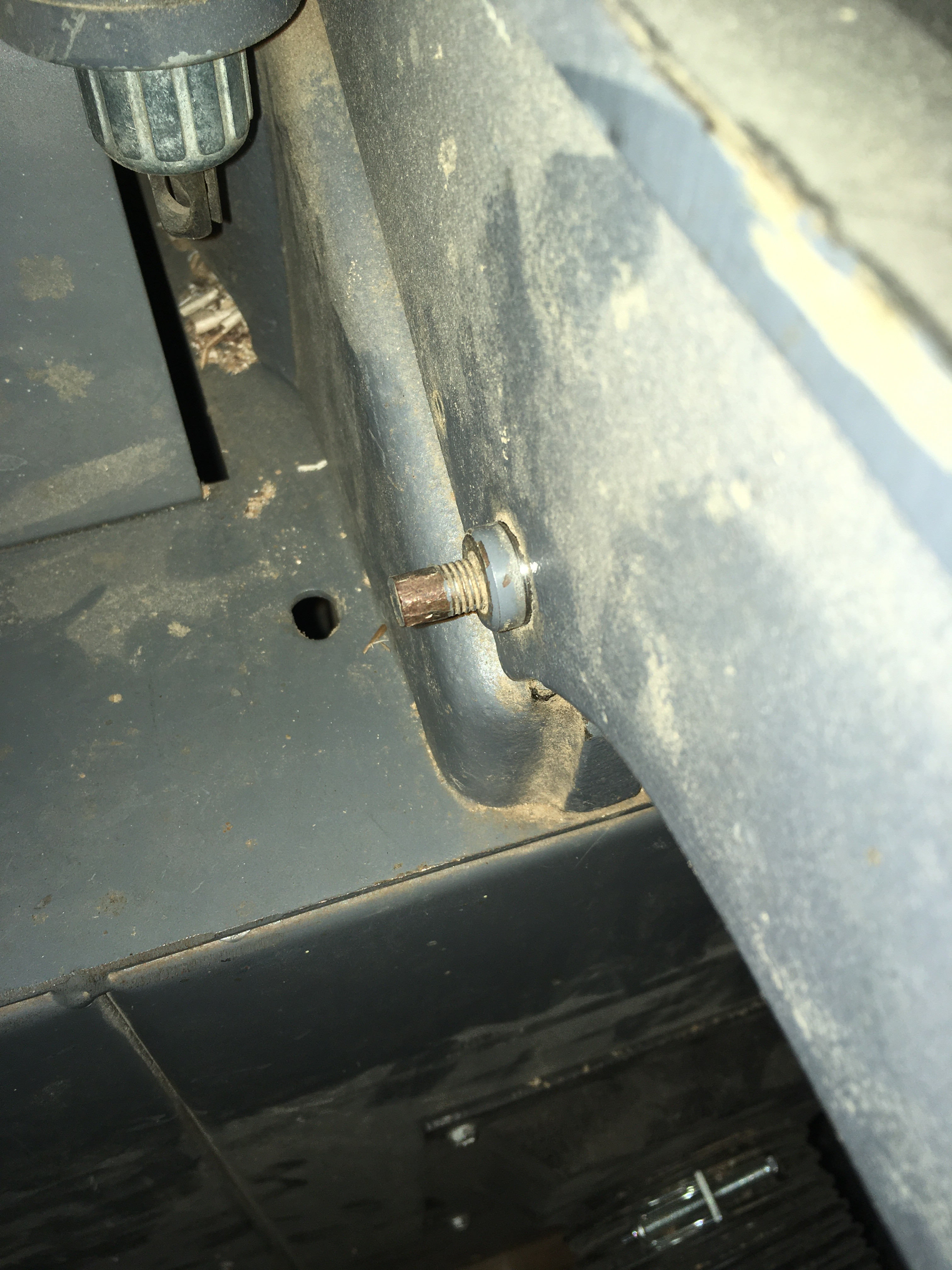
I found the same manual online but the photo doesn't show enough detail for me to tell if mine is missing something or is just rusted solid. The end of the (once?) square head is definitely mangled with a vise grips. Is it normal for the whole cylinder the square head is housed in to rotate when the adjustment wheel is turned? And you're saying the square head should come out somehow, just like the knob does on the back of the infeed?
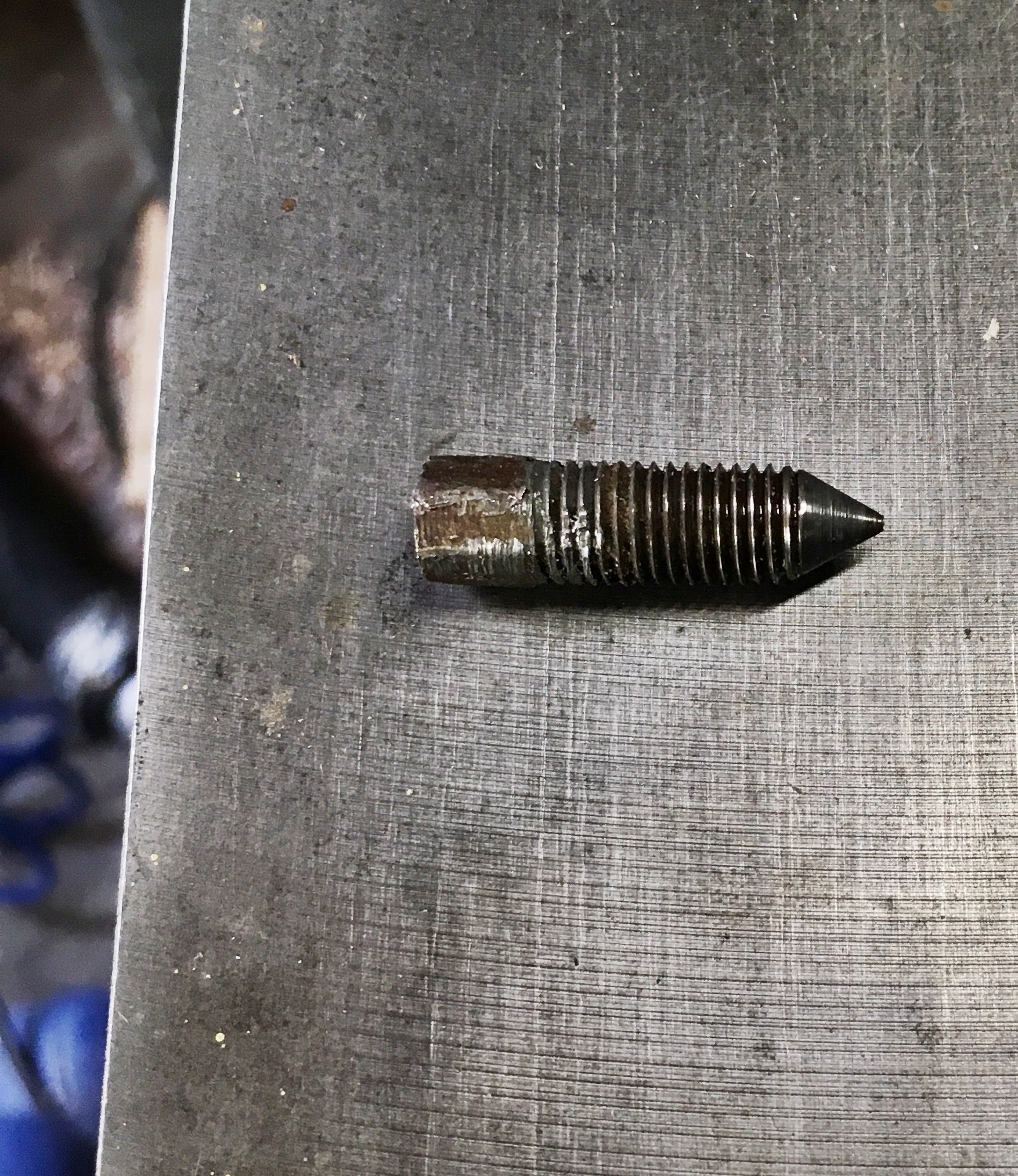
That used to be a square headed set screw and as you say someone has chewed the head up with Vicegrips or similar. I would soak that with penetrating oil/PB Blast/similar and let if soak. Then use my own Vicegrips to loosen it. I am certain it's got what used to be standard SAE threads and I would probably replace it, But that's just a matter of taste.
I never tighten mine enough to need vicegrips.
I think they used a set screw to save a nickel on the knob.
Just looked at mine a few minutes ago and it was only finger tight, but maybe a little tighter would be better. Not sure, but I think the mechanical advantage the hand wheel has is so great the tables tend to stay put.
If you wanted to you could go to e-Replacement parts and buy a second knob for that side. Fastenal or McMaster Carr may have a suitable one. Since I very seldom move outfeed table I would be happy with another set screw.
Problem solved! Nothing a little compressed air and PB Blaster can’t solve, apparently! Thank you all so much for you help and ideas!
The once-square peg is indeed almost completely round, so I will probably look around for a replacement. Thanks for the suggestion of getting a knob like the infeed side has. The square bolt was probably to discourage people from adjusting that side but I'm the only one using my shop.
Now that I can get a board across it, now I have to tune it up so it’s actually true. I’ve read a few posts referencing a VHS tape by John White called “Tuning Up A Jointer”, any other resources you’d recommend?
I think you are correct about the set screw. Not only did they save a little money, they discouraged anyone form adjusting the outfeed table without thinking about what they were doing. As I mentioned, the jointer is far more versatile than it appears. But, the only reason I can think of to adjust the outfeed table is to cut a base for something like a chest. Lower both tables, say 1/4", set a board on the jointer four inches past the cutter head, slide the piece forward, stopping four inches from the cutter head and you have a raised base. I've never done it. And the piece could not be long enough to fall off the end of the outfeed table.
The fence on my machine is not perfectly flat. It's very slightly "winded" or twisted. Does not interfere with me getting good glue joints enough to take it and have it machined flat. But, When gluing a panel, I mark the edges with chalk, I & O for In and Out and run the edges with the I against the fence and the O out. This cancels any angle problem with the fence. It's good practice anyway but I don't know if that helps with the less than perfectly flat fence.
Polish the table and fence and wax them with paste wax.
Fiddle with the height of the outfeed table until the board will slide onto it nicely and you do not get any snipe.
Haha, I have a VCR in the attic that I've justified holding on to for 20 years for that one scenario where something wasn't available on digital, but hopefully YouTube and my 14-day free trial of Fine Woodworking will be enough video resources to get the jointer tuned up. If not, might have to break out the VHS!
There is another use for the outfeed table height adjustment: putting a spring joint in a panel (e.g. table top) assembly. However, I never got my head around the geometric principle involved in using a power jointer to do this. Also, the amount of adjustment needed is related to the length of the board, and you have to remember to set the table back to zero when you are done. Instead, I always found it easier to match plane both boards at once with a #7 jointer plane in a shoulder vise on my bench, with the help of a board jack. A lot of woodworkers don't seem to understand the utility of a spring joint, but I have no trouble getting my head around that concept.