WoodCentral Forums

Est. 1998 — 27 years of woodworking knowledge

Fettling Hand plane question

Posts

Fettling Hand plane question

#1

Fettling Hand plane question

Barry Irby

A friend gave me a Craftsman hand plane. I appears that it may have never been used or very lightly used. The blade is 2" wide and the sole about 9" long. I flattened the back of the blade and polished it. I sharpened bevel side.

Then I set out to flatten the sole. I got it flat except for leading into the mouth there is a very slight slope about an 1/8" wide and maybe a 1/1000" or two roll up toward the blade.

At first you are removing maybe 50% of the area and as you progress it begins to approach 100%. So the final tiny area takes the longest to remove. Is it worth continuing to grind/polish the sole to eliminate this tiny amount?

I plan to use this plane rather than use it as a collector model.

Re: Fettling Hand plane question

#2

Re: Fettling Hand plane question

Mark Nowicki

Did you try it before you started messing with it?

Re: Fettling Hand plane question

#3

No....

Barry Irby

The blade was slightly rusty as was the sole. There were minor chips in the blade and it obviously needed sharpening. So I sharpened it.

I reviewed a number of YouTube videos on setting up and restoring planes. What I don't know is how important some of the finer details are.

For example, how polished does the sole need to be? And how flat? Seems to me it would be acceptable to have a slight hollow in the sole, but perhaps the area right at the mouth is important.

Re: Fettling Hand plane question

#4

Just in front of the mouth...

Jim Matthews

Just in front of the mouth, the sole is above the wood a few thousandths?

That might explain why it wasn't used.

Getting a shaving would be impossible until the blade takes a huge shaving.

Get it flat on a granite plate, glass base and it will be more predictable.

Re: Fettling Hand plane question

#5

Re: Fettling Hand plane question

Wiley Horne

Hi Barry,

Dropped in from HandTools. That plane will not work right until the leading edge of the mouth is sitting right down on the work. Hard to predict exactly what trouble it will give if the mouth is in the air, but usually it’s erratic. Like it may be hard to keep it in the cut—run the blade out enough to pick up a shaving, and it will first dig in, and then lose its bite and jump out of the cut. Or it may plane a hump in the middle of the stick, by getting a bite only at the ends of the stick.

Long coarse file used lengthwise or on a long diagonal (alternating direction) is a fast way to remove metal. It’s miserable work. Then refine with sandpaper on a granite plate or on thick glass. Did I mention it’s miserable? But the plane will sing once the mouth is hard down on the work.

Wiley

Re: Fettling Hand plane question

#6

Thanks Jim and Wiley.....& another question

Barry Irby

The more I thought about it the more I realized the sole right at the mouth was probably the most critical place on the sole.

When I got tot he point I was at, I reassembled the plane and tried it. I managed to take a fairly course shaving on some straight grained poplar, but was in a bit of a hurry and left before trying for a really fine one.

It had to be in that spot.

When I flattened the back of the iron I had a small hollow centered on the cutting edge. It took about ten minutes to get to that point and then about and hour to get the rest of it.

You are correct, miserable work.

As an extra question....I see several YouTubers using a Trend diamond plate. Well over a hundred bucks. There are many cheaper ones on Amazon. Is it worth the difference? What would you recommend?

Re: Fettling Hand plane question

#7

Re: Thanks Jim and Wiley.....& another question

Wiley Horne

Hi Barry,

Couple questions before answering...

1. Are you looking at the diamond plate to flatten things on, like this Craftsman plane sole and plane blade back? Or to sharpen?

2. Do you hollow grind plane blades and chisels? If not, we should ask Bill Tindall to give a quick seminar on it, so you can pick it up.

I definitely think there are better diamond plate options than Trend, like Atoma. But there may well be better and cheaper options than diamond plates, depending on the answers to the questions.

Wiley

Re: Fettling Hand plane question

#8

Re: Thanks Jim and Wiley.....& another question

Jim Matthews

I've got an Atoma 400 that works as a grinding plate.

I also use it to flatten my sharpening stones.

3x8 inches for about $80 and it should last forever.

Re: Fettling Hand plane question

#9

Trend diamond plate

Winston

> As an extra question....I see several YouTubers using a Trend diamond plate. Well over a hundred bucks. There are many cheaper ones on Amazon. Is it worth the difference? What would you recommend?

I have a Trend diamond plate. It looks suspiciously similar to generic ones (there's not even any branding on it!), but costs 3-4 times as much.

The one thing that's good about the Trend is that they have some sort of guarantee about flatness. The one that I bought originally didn't meet the standard. I think it was convex .002"-.003" on one side, concave the same amount on the other. I got Trend to replace it, but it did involve mailing it to them, which of course requires more time and money.

I doubt the generic ones provide any sort of guarantee about flatness.

Relatedly, the people at my local Woodcraft store said that if I bought a diamond plate from them (I think they had both DMT and Trend), they'd be happy to let me check it for flatness first.

Re: Fettling Hand plane question

#10

Re: Thanks Jim and Wiley.....& another question

Barry Irby

I saw Rob Cosman using the Trend diamond plate. Also James Hamilton, AKA Stumpy Nubs. Cosman's latest thing is to use the 1000 grit side on a slightly dull blade (touch up) for a few seconds and then jump to a 8000 grit stone to create a micro bevel If I recall correctly. He sometimes uses the 300 side to flatten the 8000 grit stone.

I am stumbling around in the great morass of half truths and sponsored misdirection trying to find the Holey Grail of quick and easy sharpening. There seems to be a subculture of sharpening with no real end in sight.

I would hollow grind if that were a good thing to do. I have a 6" Rockwell grinder with an attachment made for the purpose. I have finagled a way to sharpen planer knives on it.

What I really want to do is get my planes and chisels in fundamentally good condition and then use them, occasionally touching up the edges. Trying to sort out where 1/1000" actually matters.

Re: Fettling Hand plane question

#12

Re: Thanks Jim and Wiley.....& another question

Wiley Horne

Barry,

It’s true that on sharpening, there are a million voices in the crowd competing for attention and for your money. I don’t post much over here, so don’t want to overdo it myself.

I would just like to commend to you that hollow grinding is a way to faster, easier, and positive results, for both plane blades and chisels. It reduces the amount of metal you need to hone to get to sharp, and avoids everyone’s tendency on full flat-bevel honing, to start chasing the edge and increasing the cutting angle.

Once you have hollow ground a blade or iron, there are numerous honing methods and they all work. You might start with what you have already!

I hope Bill T. and Derek, and others will provide thoughts on hollow grinding, and related.

Wiley

Re: Fettling Hand plane question

#13

Re: Thanks Jim and Wiley.....& another question

Barry Irby

I have watched some of those and the ones I missed, I just watched them.

Thank you.

I have managed to overwhelm myself with information.

Re: Fettling Hand plane question

#14

Wiley....

Barry Irby

A week or two ago I drawn into the discussion on the Quiet Side about Unicorn Edges. I came in very late and could not bring myself to read enough to understand the term. Was the term unicorn meant to be the elusive edge no one had ever really seen or perhaps a convex edge like a horn?

The problem is I am basically a power tool guy burning electrons and the hand tool concepts though admired only pass through my head occasionally. I have accumulated a few planes and it occurred to me I might use them more and enjoy them if they were perfectly turned and sharpened to abut 50,000 grit. Perhaps the magic reveals itself at near perfection levels.

I made a large oval QSWO pub table for my son from a tree that fell on a house I own and he helped me put the roof on. I have a coffin plan I have had for over fifty years as a wall hanger but never used. I sharpened it an put a lot of camber on the blade and planed the top with it. You can feel the ripples. Nice effect. I may have overdone it a bit.

Re: Fettling Hand plane question

#15

Re: Wiley....

Wiley Horne

“ I might use them more and enjoy them if they were perfectly turned and sharpened to abut 50,000 grit. Perhaps the magic reveals itself at near perfection levels.”

Hi Barry,

That’s a great story about the pub table and the coffin plane! Am sure you could have done without the tree falling on the house.

We have a good many 50,000g discussions on the other side. Which usually is about taking a perfectly practical idea and seeing how fine we can grind it. The tiny little buffed edge (Unicorn, pat. pending) turns out to be very practical, at the basic level shown in Winston’s video.

Getting back to planes, near-perfection is the enemy of the good. You got that coffin smoother working, and you can get this Craftsman one going too. To begin, say the first goal is to take a 3-foot straight stick of something, put it edge-up on your bench and get a full length shaving with the Craftsman. Like if you were straightening a stile. That’s the ‘good’. The plane will do that if the front of mouth sits flat down on the stick, and the blade is sharp. That’s it. It will feel better if you keep a candle on your bench and wax the sole.

Try it. Will it do it? If it won’t, we’re into diagnostics—what does it do? Will it start a shaving but not finish it? Will it stay in the cut, or no? We go from there.

Once you get Goal 1 down, Goal 2 is to get the plane where it will sing a nice song for you. That involves a very sharp blade and we get into hollow grinding the iron, which Bill T. will explain. If you will do the hollow grind, I expect you can hone using the stones or whatever you used on the coffin smoother.

Wiley.....talking too much

Re: Fettling Hand plane question

#16

All you ever wanted to know ...

Derek Cohen (in Perth, Australia)

Barry, as Wiley and others have mentioned, there are about as many sharpening methods as there are woodworkers, and on fori it appears that everyone wants to tell you their version! :O YouTube is the worst offender, since many there are seeking their 15 minutes of fame.

It gets confusing and overwhelming after a short while, but this diminishes after 20 years or so.

I will try and keep this simple, with someone starting out with hand planes in mind.

1. The plane needs a coplanar sole (toe-mouth-heel). The area around the mouth must be evenly smoothed down. Start with 120 grit sandpaper and work to 240 grit. After this grade, once using the plane, the wood itself will polish the sole.

Use sandpaper glued to a flat substrate, such as glass ..
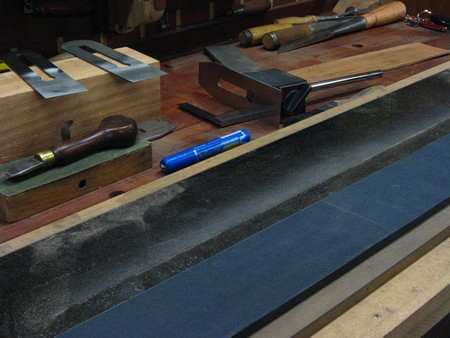

As you have found out, the more iron you remove, the greater the surface area remaining, and the harder it becomes to do more. Hang in there - it is tempting to stop just when you are nearing the end.

2. The blade: The bevel has two sides - front and back, and both must be hone. The back must be perfectly flat otherwise it is difficult to achieve a sharp edge. Essentially the same deal as the plane.

Lapping the back in pictures: http://www.inthewoodshop.com/WoodworkTechniques/Lapping%20the%20Backs%20of%20Blades.html

3. Sharpening media: With thin blades, it is possible to work with sandpaper, which is great because it is an inexpensive way to get going.

Get the feel for what you need to do by using a cheap Eclipse-type honing guide. Begin with grinding a flat primary bevel with 120 grit, jump to 240 grit, then 600 and 1200 grit. Finish on 2000 grit. The last 2 papers are wet-and-dry. Thin Stanley-type blades are doable with just a single bevel throughout. This is less complicating for the novice.

If you want to use diamond plates, the more durable are DMT, and you need a Coarse, Fine and Extra Fine, and then finish on 2000 grit wet-and-dry paper.

It is when you get to the thicker blades that you now must work differently. These modern blades are generally also harder, and attempting to hone the full face of a bevel is a fool’s errant. So either one hollow grinds (as I prefer to do) or one uses a secondary bevel (as per Rob Cosman). Hollow grinding is especially helpful to those freehand sharpening, and secondary bevels are where honing guides shine. Of course one does not preclude the other.

Grinding: The new way is to use CBN wheels - which I may have had a role in popularising :) Here is a link to an article if mine, which explains what it is about : http://www.inthewoodshop.com/WoodworkTechniques/UltimateGrindingSharpeningSetUp.html

I am not going to say more about this simply because it is for down the road, and at this stage you still need to prepare the plane, sharpen the blade, assemble the blade and position the chipbreaker, install then whole mess, and then learn to get the ideal blade extension. That is enough to overwhelm all and make the process appear too great! But in reality, with practice it all becomes second nature.

There are other issues which extend beyond sharpening and are critical to a satisfying plane experience: preparing the chipbreaker (both underside and leading edge), and positioning the chipbreaker on the blade. Yell out if you need input.

Regards from Perth

Derek

Re: Fettling Hand plane question

#17

Not everyone.

Sgian Dubh

" ... there are about as many sharpening methods as there are woodworkers, and on fori it appears that everyone wants to tell you their version!"

You're right there, Derek. So many versions and tellers of their 'best method ever', that I decided maybe fifteen or more years ago to forever say nothing and/or make any kind of meaningful contribution to sharpening and plane tuning threads - just like I'm doing here.

The subjects so often degenerate into confusion for the person that asked in the first place, information (misinformation?) overload, acrimony and point scoring, and I generally prefer now to just observe the chaos, ha ha. Slainte.

Re: Fettling Hand plane question

#18

Take a step back...

Jim Matthews

It's the first plane, it need not be perfect.

The proof is in shaving wood. If it cuts clean and straight, that's great.

It's a tool - not a Faberge egg.

Re: Fettling Hand plane question

#19

I have reached the Hmmm??? stage....

Barry Irby

Hmmm....this may be good enough....well just a little more....there goes another hour I will never get back.

I think I am beginning to get to the point I can do some sorting on the overwhelming info and choose a path.

This morning I accidentally touch an iron to the grinder. Nicked the edge. About an hour later I was back to where I started.

Working on the hollow grinding.

It would be nice to play with one that was truly well done to see where I am and what I am missing.

Re: Fettling Hand plane question

#20

Re: I have reached the Hmmm??? stage....

Wiley Horne

Barry,

Can you describe or show your grinder setup? It helps a lot if you have a grinding jig. Takes the misery out of the job, compared to hand-held on a tool rest. Derek has a tool holder that might be practical for you, depending on how you’re set up now.

Wiley

Re: Fettling Hand plane question

#21

Re: I have reached the Hmmm??? stage....

Barry Irby

I have a 6" Rockwell grinder I bought new almost fifty years ago. It has an attachment that allows you to set the angle and a screw that allows for micro advancing the tool and the tool can be slide left to right, and it has a white wheel on it.

Something of a PITA to drag it off the shelf an d set it up.

I am considering a CBN wheel either for that or to add to my 8" slow speed Chinese grinder and perhaps move the attachment to that.

Re: Fettling Hand plane question

#22

You’re in good shape!

Wiley Horne

Barry,

Either of those grinders would be a good option, with your Rockwell jig. Love to see a picture of that Rockwell jig once you get it set up. I am very partial to CBN, since Derek brought it to our attention. You would appreciate the way CBN reduces (but doesn’t eliminate) heat build-up. The slow-speed 8” with CBN would be a good rig all around. But either grinder would be a good starting point.

You’re getting there!

Wiley

Re: Fettling Hand plane question

#23

Power tools are fast, and I am slow (witted)

Jim Matthews

I ran into similar troubles, starting out.

Rather than deal with the frustrations of power tools that quickly ruined hours of work (through my clumsy mishandling) I shifted to manual approaches.

The Atoma #400 is a 3x8 (inch) plate.

It's wide enough to grind my widest plane blade and long enough to flatten stones.

I have a powered buffing wheel - but grind by hand, only.

👍 This page answered my questions

Your vote helps other woodworkers quickly find the answers and techniques that actually work in the shop.