The second was made on the other side of the island, in the Kosciuszko National Park, (pronounced cozzi-oskah) in New South Wales, featuring the restoration of the Coolamine Homestead built in 1883...
The timber here appears to be Alpine Ash (Eucalyptus delegatensis) which, owing to its straight grain, split well with hand tools.
Thanks for sharing these videos with us. I was particularly interested in the second one. I collect and buy and sell vintage woodworking tools. I live in the United States. Once a year a Timber Framing Seminar is given at The Hancock Shaker Villiage in Hancock, Mass. People come from many places around the world to attend his seminars. I go there and put out my tables of restored timber framing tools. I stay there for about half a day selling and watching Jack's students work. The seminar is given by Jack Sobon. He is probably one of the few remaining timber framers that use only hand tools. It is fascinating watching Jack and his students working. I have seen him square up logs very similar to how it was done in the video. The only difference in technique, that I saw, was that jack does not use a broad axe. He cuts the notches and clears the waste with a conventional axe. Thanks again.
There are so many woods in Oz that are almost never seen outside its borders. I'm sitting here beside a largish (18", probably the throw of his lathe) platter made by Richard Raffan from Tasmanian Sassafras (he spelled it as Sassafrass but my spell checker objects). This is probably the only piece of this wood within 500 miles of my location -- maybe more. I've also got a couple of other pieces of his, one is a screw-lid box in the shape of an acorn made of She Oak, a slightly more well known Aussie wood, and somewhere or other there is a box of IIRC Tasmanian Horizontal Scrub which is fascinating if or nothing else than the name. I can't locate it at the moment but it must be here somewhere -- things tend to get jumbled after a couple of moves.
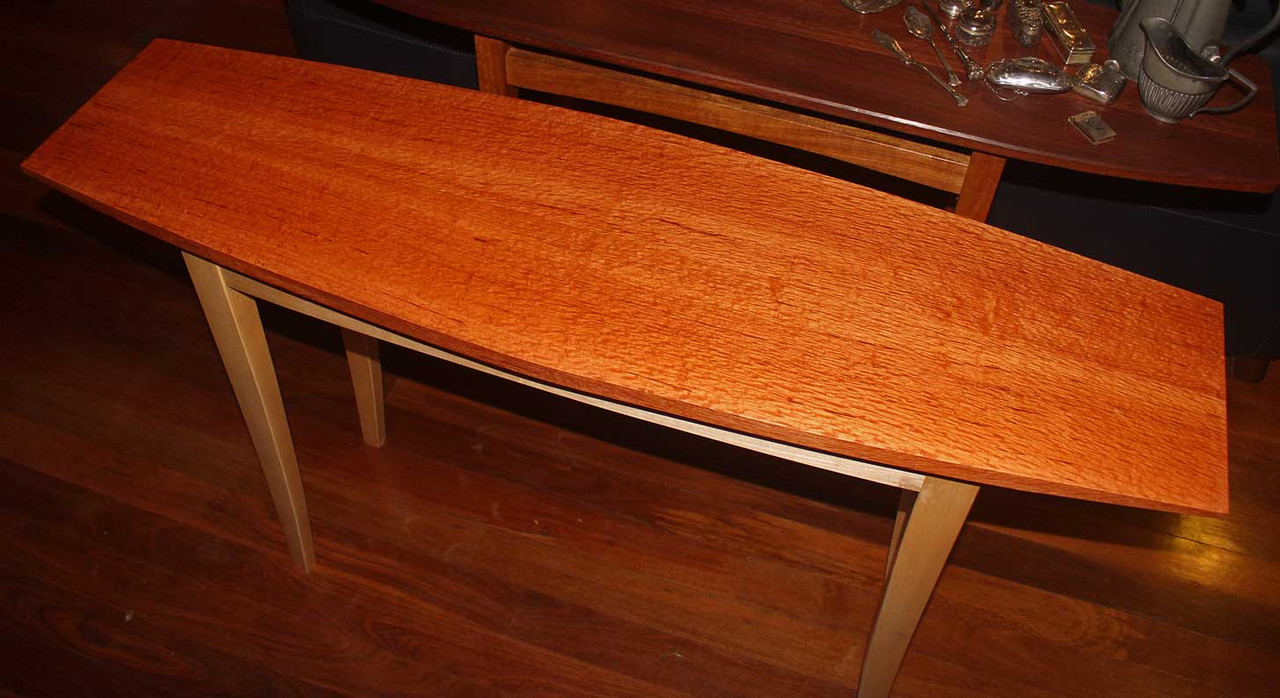
John, in addition to Jarrah, one of the local prized timbers is Sheoak. This tabletop is WA Sheoak, which tends to be redder than other varieties around Oz ...
This is a rough-n-ready pic of the Raffan Acorn. I don't know how to tell one sort of She Oak from another. For scale, the object is roughly 70mm in diameter.
Thanks, Derek. Those are fascinating. I forwarded the link to the first one to my wife, who is a certified safety professional. I'm sure it will give her nightmares. Those look like they were immensely dangerous jobs.
I had watched the second one just a couple of months ago. I'm in on a project where my cousin is on the County Museum board where I grew up. They or I should say we are beginning the salvage and restoration of the oldest home in the county, and moving it into town facing the County Courthouse.
They have taken it down, and have most of one pen of a Double-pen Dogtrot saved. Almost all of the other was just too eaten up by termites. It was built in 1842 by a fellow that carried mail on horseback from the two counties one each side of ours. Building half way in between would allow him to change mounts going either way.
It was built from Southern Yellow Pine, so that is what we will be using for replacement logs. I was hoping they would turn out to be Cypress, but we're not that lucky. While we will be sawmilling away the bulk of extra wood we will be making all the finishing cuts like those two guys in the second video hewing down those slabs with the broadax. I'm glad I watched this again because we will need to decide how much extra to leave for the final paring. On the second viewing I noticed that when he was coming down the back side just barely taking a little bit off, the broadax skipped off a couple of strokes which not only was a wasted swing, that probably cost a lot more energy by trying to keep the blade from going into the dirt.
Any of you sawdust makers that want to help and make some BIG chips just let me know and I'll talk to Huck to see if he will let you in on it.
Richard Raffan lives in Canberra, which lies in the ACT (Australian Capital Territory), the capital of Australia. This is the Eastern side of Oz. Canberra, by coincidence, borders on the Kosciuszko National Park. No doubt, the Sheoak Richard used comes from this area.
The Sheoak on the Eastern seaboard is darker than than in Western Australia. I think the stuff we get here has a finer fleck and is more delicate looking. My reference totally (although I would kill to have a piece of Richard's work. Lucky you!).
Here are two pieces of mine in WA Sheoak. You can see how light it is (noting that it can darken over time):
The Raffan acorn is probably 25(?) years old so it will have darkened with age despite never being exposed to bright light. The only piece of this sort of wood I've owned is a single quarter-sawn board and it is much lighter than any I've seen even with finish.
Just to rub it in, I've got three of Raffan's pieces or four if I can ever find that lidded box that has been missing since my last move. Oh, and there is a Ray Key in the display case too along with the work of a number of lesser-known but still talented turners. I was a collector before I ever made a serious try and doing turning myself. I really need to overcome my inertia and get back into the shop sometime.
Actually, from what I've seen I'd love to have one of your handsome works.
My son John got interested in turning when he was about 13. I taught him all I could, bought books and tapes, and took him to Atlanta to Highland Hardware to see Richard Demonstrate. John was by far the youngest person there and he and Richard hit it off. Richard gave him a turning smock he had had made. I still have it. This was over twenty years ago.


 Oh, and there is a Ray Key in the display case too along with the work of a number of lesser-known but still talented turners. I was a collector before I ever made a serious try and doing turning myself. I really need to overcome my inertia and get back into the shop sometime.


