WoodCentral Forums

Est. 1998 — 27 years of woodworking knowledge

Straightening a bark edge

Posts

Straightening a bark edge

#1

Straightening a bark edge

Bill Tindall, E.Tn.

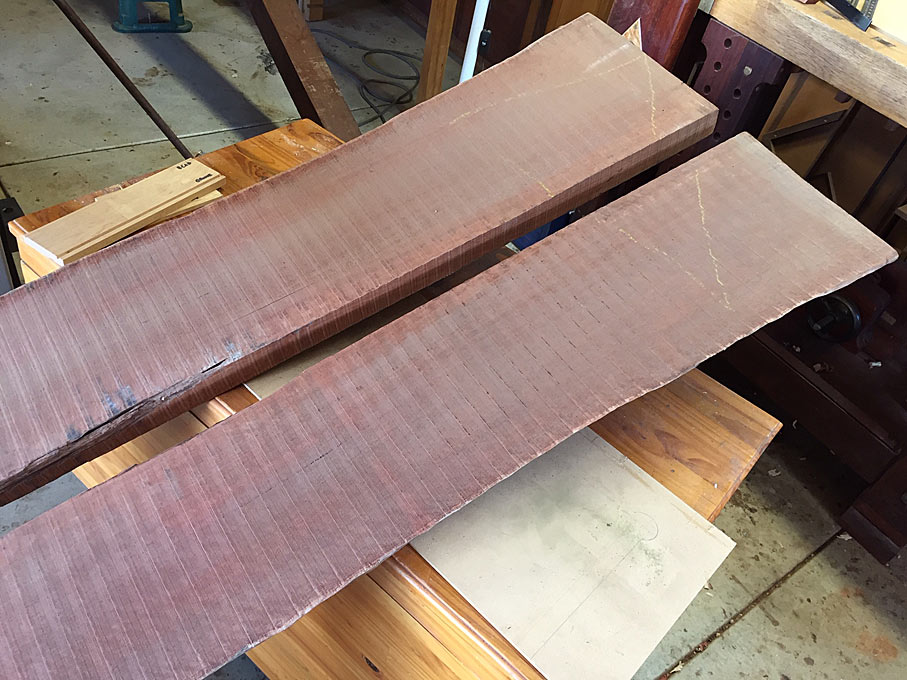
I sawed an ash from on the farm that died from the borer. I am considering using a plank from it for the desk top (we'll see how it looks). I was unsure any of the wormy boards would be used so I quickly just sawed it through without edging.

The problem: how to straighten a bark edge?

Before I provide the surprisingly easy solution, a word about safety. This technique should only be considered for a piece of wood of considerable mass and length and only with the blade shown.

I marked a straight line down the edge and fee hand ripped it on the table saw


with a blade used in a Skill saw.


It ripped true with barely detectable cutting resistance, a critical factor to ensure control.

I have been using this cheap blade in the table saw for much of my work lately. It rips effortlessly with a cut roughness easily removed by a light pass on the jointer. It splinters on exit from cross cut but for many cross cuts this cut quality is satisfactory. It makes little noise, little dust, and barely any cutting resistance which leads to secure control of cuts. Anyone bold enough to try this blade will be convinced of its utility for most table saw needs.

Re: Straightening a bark edge

#2

Re: Straightening a bark edge

Jim O'Connor

I've been using a thin kerf handsaw blade in my TS for several years and I agree with Bill they work great for ripping. I don't crosscut anything on the table saw.

Re: Straightening a bark edge

#3

Re: Straightening a bark edge

Barry Irby

I used to be a builder and framed many houses. I had dozens of skilsaw blades. I have used them on the TS for many things. If they don't cut well I just toss them. The other day I was using one and it threw five tiems as much sawdust on me as my 10" Woodworker II. I have been trying to figure why the smaller blade threw so much dust. OTOH A good one cuts like butter.

Re: Straightening a bark edge

#4

ps...I would cut the edge straight with a tracksaw


Re: Straightening a bark edge

#5

Re: Straightening a bark edge

james runchey

I cut bad edges with a piece of 1/4 plywood tacked on. Gives a nice straight edge.

Re: Straightening a bark edge

#6

the answer to your question

Bill Tindall, E.Tn.

I have been trying to figure why the smaller blade threw so much dust.

you forgot to turn the dust collection on :D

Re: Straightening a bark edge

#7

Never.

Virgil Johnson

I had to read this twice to make sure I read correctly and wait a while before replying. I don't care what the mass of the wood is or the blade type used a free hand operation on a table saw is dangerous and not worth the risk. You are an experienced woodworker and may get away with it a few times. A newbie might not be so lucky. I'll try some setups that some people think are risky but would never suggest this.

Re: Straightening a bark edge

#8

reply

Bill Tindall, E.Tn.

Would you do this cut with a Skil saw? Of course. Would you fear loosing control of the Skill saw doing the cut? Of course not. It is straightforward Physics. If the mass of the Skill saw is the same or less than the mass of the plank it matters not whether the plank is pushed across the blade (table saw) or the blade is pushed across the plank (Skill Saw). The risk is equivalent of loosing control of the plank or saw. Nil.

It works because the blade is small and thin and offers little cutting resistance and insufficient energy to throw the heavy board. I would not do this operation with a 10" rip blade and this board.

Re: Straightening a bark edge

#9

Re: reply

Garthinsandiego

Just a point of reference. A number of years ago a friend of mine needed to rip a piece of 2x lumber for a deck project. He carefully placed the timber on the edge of a picnic table and proceeded with the cut. He kept his hand behind the saw in order to avoid injury. At some point the blade bound in the kerf and the saw backed out, and climbed over his hand, making a severe cut between his thumb and index finger. What did he do wrong? I don't know. Maybe he should have attached the timber to the table and used both hands to control the saw. The point is that it seemed safe at the time. I don't think that it is reasonably possible to predict the negative consequences of all our actions. Our objective should be to reduce risk as much as we can. Free handing lumber through a table saw presents risks that are easily mitigated by other techniques.

Re: Straightening a bark edge

#10

Not that dangerous...

John in NM

Just looks appalling. I wouldn't fault anyone for not wishing to do this, but I don't think its especially dangerous.

The reasons are that the board has much more mass than the blade & motor armature, as Bill says, and also that all kickback accidents I've seen on a table saw were the result of over constraint - pinching work between the blade and the fence, drop pieces pinching against jigs like a tenoning jig, etc.

Freehand cutting like that reduces the constraints on the work piece to the bare minimum - the blade, the table, and whatever is pushing the wood.

An older guy in the shop I used to work for 20 years ago would do this now and then with mesquite. It did look alarming, but it always seemed to be a anti-climactic cut, just a straight forward job.

Re: Straightening a bark edge

#11

Re: Straightening a bark edge

Sgian Dubh

I've been doing much the same for a long time Bill, and I've always thought of it as pretty standard or normal practice. I've never used a set-up by deliberately fitting a smaller blade though, but simply used a standard rip blade plus riving knife and crown guard, that being the normal set up in Europe (the riving knife and crown guard being normal I mean).

The most common scenario is a big lump of waney edged oak, or something similar, where snapping a chalk line on the surface marks the first cut. This can be anywhere on the width of the board from just inside the sapwood to the centre of its width. In the absence of a chalk line a long straight edge and thick pencil suffice to mark a line.

With the use of a larger diameter blade, say 10" - 16" set quite high, plus a riving knife, the reality is that once the cut is established the tendency is for the continuation of the cut to be pretty much self guiding because of the length of the established kerf passing either side of the blade's plate, and then the riving knife beyond that.

It's not really technique suitable for small pieces of wood because of the risk of kickback that can be caused by a lack of inertia, but it's useful for bigger lumps where inertia can play a role. A 'bigger lump' might be defined as something that, for one person, is a bit of a struggle to lift up to the saw, or heavier, perhaps in the first place needing two people to handle comfortably. Slainte.

Re: Straightening a bark edge

#12

Re: reply

Virgil Johnson

Would I cut this with a circular saw? If I was not at my shop where my band saw is. With the board on a saw horse or supported on the ground I'd make that cut with a circular saw. I can readily let off the spring loaded switch of my circular saw at the first sign of the blade pinching. Not something you can do on a table saw. As a bonus the kickback is not launching wood at my abdomen. The operation you describe is a judgment call. You mention that it should only be done with boards of a certain mass and blade type. What are those dimensions and weight? How do you calculate in warp of the board? As I mentioned you (and others who replied) are experienced woodworkers who can likely make this cut without incident. Not everyone who reads this has this experience.

Re: Straightening a bark edge

#14

Re: Easier on a slider

Mark Nowicki

Even easier, and safer, with a $5 flea market hand saw.


Re: Straightening a bark edge

#15

Easier and safer still.

Virgil Johnson

Use the board in a live edge application.

Re: Straightening a bark edge

#16

Riving knife...

John in NM

Yup, cut is safer still with a riving knife. That is the only thing I would add to my ancient cabinet saw if it were feasible to install a true European style one.

Re: Straightening a bark edge

#17

Ellis Walentine

From the cockpit...

Ellis Walentine

Hi folks,

Here at WoodCentral, we welcome questions, answers, and testimonials that may be of interest or value to the rest of the community. Bill Tindall's recent description of freehand ripping of large slabs on the tablesaw using a 7 1/2" blade has caused some understandable safety concerns among several members of our community. Bill's posts on this subject attest to a technique that he has used, and I felt that the topic was one that merited further discussion here. Allowing his post doesn't constitute WoodCentral's endorsement of this operation.

Working with a variety of sharp power tools carries a higher risk of serious injury than most other endeavors. As with all woodworking choices, you are solely responsible for your decisions and their consequences. If something feels remotely questionable or dangerous to you, don't do it.

Ellis Walentine, host

Re: Straightening a bark edge

#18

Re: From the cockpit...

TomD

Well said. The only safe, manually fed, TS that is safe is the one that is turned off, and has spun down.

Re: Straightening a bark edge

#19

Re: False

TomD

The differences when ripping with a skillsaw, and TS are:

There is no limit to the power of table saws. A person reading this could try it with a 10hp machine, not a common option with a Skillsaw.

Skillsaws have relatively functional guards that can deploy from kickback.

You can, and carps. often do, put the plank on the floor and rip it bent over. There is little to lose when that blows up on you.

But here is the biggie:

Portable tools are often controlled with both hands on them. As such, if you have reasonable strength, your hands go with the tool when bad stuff happens. This is why a router controlled with two, or even one hand is far less dangerous than a pin router, which is one of the most open to engagement tools out there. Count your fingers if you are using it casually.

Chainsaws are the thrill ride in hand held tools segment because: The power can be insane; the kickback geometry is wild, like a saber; and you can have 4 feet of angry cutters coming at you. But if it is any consolation, you might loose your throat or face, but your hands are usually safe until the chain breaks.

The different tool types have their tricks, but hand power tools can be relatively safe in ways that stationary tools are often not.

Here is something a pin router can't do. You relax and rest the powered up tool in your crotch or on your leg. I did that once with a chainsaw, that did not run down as fast as I thought it might. But I was wearing chaps.

Re: Straightening a bark edge

#20

Re: The view from Swtzerland

TomD

Kinda off topic, but here goes.

I taught myself to climb from a book my parents gave me when I was twelve. By the time I got to the Swiss climbing school one summer, I had been climbing every weekend for about 3 years, on ice, or rock. Sometimes over water, where difficult rappel descents were required to reach the boat. I led all the pitches, from the ground up. I only rarely climbed with experienced climbers. I was guide, instructor, and leader. So while I was still a kid, I had a little bit of experience climbing in Ontario, Ireland, and the US, by the time I hit Switzerland.

On our first day, we set out to the cliffs and tried some rappelling. I was terrified at what I saw. We were expected to do a body rappel (rope goes through the crotch, around the front, over a shoulder, and into your hand. No mechanics, or harnesses) off a massive overhang, and a free drop to the ground. I had read the literature, and had done the technique. Both the literature and my experience were full of terrible burns, on barely vertical ground.

However, all the flat landers from Holland or, wherever were just working over the edge and taking the drop without any fuss. So I had to put aside my qualms and do likewise. It was great, I sailed on down and felt like I had been let into some special club. When I eventually got home I would never bother with those descenders again.

Of course, you can see this coming, I took my knowledge home, and the first time I tried it, I burned myself solidly on my weak side shoulder. I do occasionally body rappel, if the ground is low angle enough, but mostly I never did it again.

What was the difference? Well in Switzerland, at mountain schools, they avail themselves of Swiss Army ropes, that at the time were 13 mm in diameter, while in civilian use we used 9mm or 11mm ropes at the time. Even thinner today. That increase in diameter, made all the difference.

The point being that very often something that works in one instance is a catastrophe when only one small aspect is changed. I have seen this over and over. The real pro knows enough to get by in someone else's shop, or when doing a seminar in an unfamiliar place, but you can get in trouble when seemingly small details vary.

Re: Straightening a bark edge

#21

Re: Not that dangerous...

TomD

I agree it can be done. Though in this case there are probably 10 or 20 better ways to do it, so why bother? Often I cut the bark off with the trim saw in the woods. Just leave it there for the soil. There are so many hand, hand power, and power options that are better, a bandsaw being one. Circular saws normally track better, so there is that.

Re: Straightening a bark edge

#22

Re: Not that dangerous...

John in NM

In the shop I worked for, we all used the bandsaw except for this one old timer who preferred the tablesaw. He felt it was better because the cut was straighter, wasting less of the wood and less of the time for which the boss was paying him. Since he'd been cutting wood for about 40 years at that point, and still had all ten fingers, I figured he knew what he was talking about.

The best method is the one with which you are comfortable enough to do consistently without an accident. As a matter of physics I see this method as reasonable - it just looks terrifying because tablesaws are generally a little terrifying. But after years of working, the less fearsome machines are the ones that have bit me more often.

Re: Straightening a bark edge

#23

Bill, is your saw equipped w/ riving knife?


👍 This page answered my questions

Your vote helps other woodworkers quickly find the answers and techniques that actually work in the shop.