WoodCentral Forums

Est. 1998 — 27 years of woodworking knowledge

Grinding Wheel Grit

Posts

Grinding Wheel Grit

#1

Grinding Wheel Grit

Paul Leuba

I have a 1750 RPM grinder that I need to purchase an 8” wheel for sharpening chisels, plane blades and turning tools. I’m interested in the friable aluminum oxide wheels that are advertised on the Lee Valley web site. Should I chose the 80 grit wheel or the 120 grit wheel?

After grinding I will lap and put a micro bevel on the blades and chisels with the standard range of water stones, I’ll hone the turning tools with a 600 grit diamond card.

Paul in Hunt Valley, MD

Re: Grinding Wheel Grit

#2

Re: Grinding Wheel Grit

Derek Cohen (in Perth, Australia)

Paul, if you are going for a friable aluminum oxide wheel, then get the coarsest possible to keep heat down, such as 36 grit. Dress it frequently with a diamond dresser (another purchase).

Why not a CBN wheel? While they are more expensive to outlay, there are tremendous benefits: you could use a 180 grit with less heat. they do not wear out - so your settings do not alter. A white wheel will wear and require dressing frequently. The CBN does not.

Regards from Perth

Derek

Re: Grinding Wheel Grit

#3

Grinding theory

Bill Tindall, E.Tn.

Read my article in the Articles for more detail.

It takes work to push an abrasive particle across a tool. This work is converted to heat at the tool surface. If the sharp particle cuts a piece of metal from the tool much of this heat leaves with the particle (sparks). If a dull particle plows across the tool to dig a furrow the heat stays with the tool.

It follows that the key to cool grinding is sharp particles which can be achieved by various means-friable particle, seeded gel particle (SG), or simply rejecting the particles as they get dull (soft bond). In my hands friable alone will not keep a tool cool. A soft bond that sheds dull particles is required. If shed particles under your grinder is unacceptable consider a different abrasive format.

Re: Grinding Wheel Grit

#4

Correction: 36 or 46 grit

Derek Cohen (in Perth, Australia)

Tools for working wood: https://toolsforworkingwood.com/store/item/NO-WHEEL3X.XX/Norton+3X+Super-Cool+Grinding+Wheels

"For regular grinding of edge tools, I prefer a 3X wheel in either 46 or 60 grit. The slightly finer texture is a personal preference. For aluminum oxide wheels, I would want something even coarser - maybe 36 grit? Because I'm not a woodturner, a softer, more friable wheel ("I" Grade) is my preference. If you are using a 3X wheel also for grinding turning tools, you might want a "K" grade wheel. The stock wheels that come with most grinders are typically very coarse and very hard. While you can make them work for grinding edge tools, this option is far from optimal." (Joel)

https://toolsforworkingwood.com/store/blog/903

Re: Grinding Wheel Grit

#5

agree with derek..

David Weaver

...coarse.

If you're doing turning tools, just touch up the tips with a diamond hone instead of trying to find a grinder wheel that "Does it all".

CBN finer wheels probably OK for everything, but not cheap.

A dressed really cheap aluminum oxide wheel that's coarse will make less heat than a 90 or 100 or whatever grit white aluminum oxide wheel that's really designed to sharpen turning tools (that aren't heat sensitive).

Re: Grinding Wheel Grit

#6

A substantially different recommendation

Bill Tindall, E.Tn.

A quick summary could be that if LV thought a 36 grit wheel was required that is what they would sell. 80 grit will remove metal faster. You will need better technique to avoid over grinding with 80 when you are down near the edge. 120 will be slower but you will need better technique to avoid heating. I can’t honestly recommend beyond what I said. If you grind to near the edge the next step will easily remove the grinder scratches from either grit. So the choice is control of profile and heat, not scratch depth.

A 36 grit wheel is vastly more coarse than anything I have ever seen used for sharpening tools for woodworking or in a machine shop. The rate of material removal will be breathtaking and the finish coarse. I find this particle size ideal for rapid removal of large amounts of metal here on the farm. I suppose the claim is that this coarse particle is needed to avoid heating. It is not if the correct bond hardness and particle structure of wheel is used.

See my Article on grinding wheels in Articles.

What I do: I grind at 3600 rpm with a 120 grit pink wheel, H bond. Have for more than a decade. Crowned wheel, good rest essential (Wolverine), light touch, back and forth motion of the tool that I call "touch and go" like practice landings with a plane-touch, swing, lift. Tool doesn't even get warm. (BTW, once I get a straight edge from honing I never want to lose it with the grinder. I grind to near the edge, never past it) Followed by Fine diamond plate from EZLap then 1 micron diamond on cast iron (Corian is being investigated Hand Tool Form and may be equivalent).

I have taught numerous club members and shop visitors to grind thin Stanley blades as described above. In minutes they are successful, other than the person that stuck their finger onto the wheel to see if it was spinning. That did not end well.

If my 120 grit wheel was to wear out (it never will) I would replace it with 100 or 80 to get faster material removal. (I had a production run of these 120 pink wheels made for the club by Radiac) But, faster material removal is harder to learn to grind with.

CRITICAL!!!! A soft bond wheel is essential. I evaluated an 80 grit K grade white and blue wheel and I had a hard time keeping the tool from heating. H or I is ideal for this task. I have used 1/2" x 7" surface grinder wheels bushed for my arbor. Surface grinder wheels are available in a wide range of grit and bond. The LV wheel is likely good. Do they divulge what the bond grade is?

As an aside I needed to change the bevel angle a lot on a plane blade yesterday. I used a 60 grit wheel, 3600 rpm. Metal went away at a rate to where I was glad I was experienced in what I was doing. It ended well.

Re: Grinding Wheel Grit

#7

Re: Grinding Wheel Grit

Bill Tindall, E.Tn.

Have you ever ground a plane blade or chisel with a 36 grit wheel?

Re: Grinding Wheel Grit

#8

turning tools

Bill Tindall, E.Tn.

What I recommended will not be a good choice for turning tools. The soft bond that results in cool grinding for a plane blade will loose its shape when a 1/2 gouge is stuck to it. You will want a harder wheel, maybe K bond. Pink is a better composition for tool steel, but plenty of people use white. I assisted a class with Bonnie Klein and at break she sharpened 60 tools on a white wheel in just a few minutes.

Heat is not an issue with lathe tools. They will be made of tool steel(if modern) which is tempered at 1000 degrees +/-. You will never get to that temperature sharpening them by any means.

Re: Grinding Wheel Grit

#9

3X wheels

Bill Tindall, E.Tn.

Some years ago a ceramic aluminum oxide abrasive particle was invented. This particle is often called "seeded gel" or SG. A property of this particle is bits fracture off the particle to maintain sharp cutting edges, while the size of the particle stays about the same. The result is a wheel that holds its shape in heavy industrial grinding and runs cool because the particles stay sharp. These wheels, available at any machine shop supply like MSC, cost about twice a conventional wheel. I think they could be worth the price for wood turners that grind a lot. I don't think they make any sense for woodworking tools where a conventional wheel will last a lifetime.

Norton offered a consumer version of this wheel where the wheel was a mix of some SG abrasive and the rest conventional, I suppose to keep the cost down. They called it 3X. I evaluated an 80 grit K bond version of this wheel and found it generated a lot of heat when grinding chisels and plane blades. In my hands the wheel bond was greatly more important for cool grinding that having a bit of ceramic abrasive added to a conventional wheel to achieve cool grinding. After testing I never used it again. It seems to me that if one needed the benefit of the SG particle it would be prudent to just buy an industrial grade SG wheel.

When all is said and done, technique is the most important factor in controlling heat generation. Jam a 1/2" chisel, full width, into any wheel and it will burn. On the other hand I could grind this chisel on any crowned wheel using a light touch, and back and forth passes(if I had a good rest).

Re: Grinding Wheel Grit

#10

Re: Grinding Wheel Grit

Derek Cohen (in Perth, Australia)

Have you ever ground a plane blade or chisel with a 36 grit wheel?

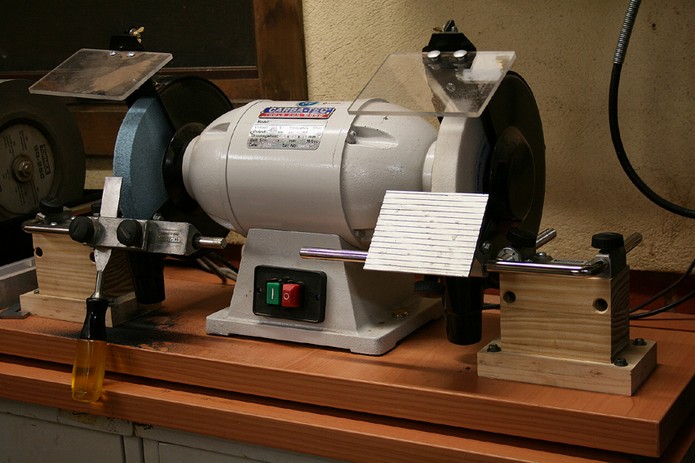
Bill, I used 46 grit wheels for about 15 years. This is the set up I used prior to moving to CBN wheels (about 4 or so years ago) ...


The grinder is set up with a blue Norton 46 grit 3X wheel and a white Norton 46 grit wheel.

That photo was taken in 2009, when I wrote about the Tormek BGM-100 tool rest for the bench grinder: http://www.inthewoodshop.com/WoodworkTechniques/GrindingNirvana.html

Regards from Perth

Derek

Re: Grinding Wheel Grit

#11

looks like wheels are not crowned?

Bill Tindall, E.Tn.

In addition to all the other variables contact area is a factor in heat generation. Before I used a crowned wheel it was more difficult to avoid overheating.

If the blue wheel is a K bond I can see the need to be something coarser than 80. I could not sharpen on the K bond 80 from Norton.

I do use a flat 46 grit wheel to sharpen lawn mower blades.

Re: Grinding Wheel Grit

#12

selling one for all...

David Weaver

I had a friable white wheel, a pink soft surface grinder wheel that pretty much shed particles on its own, and some coarse gray wheels.

I still have a brown wheel (hardness not as bad as the hardest wheels for our purposes but it sheds particles only grinding mild steel or iron, not hardened steel).

I think LV is trying to sell a wheel (especially in 8" size) that will satisfy people grinding HSS turning tools. A 36 or 46 grit wheel is a bridge too far.

I had (I think) 100 and 120 or 80 and 120 grit white wheels for my first grinder after taking off the out of balance gray wheels that came with the grinder. It turns out that with a good dressing tool, a crown and frequent dressing that the really coarse tools made less heat than the white wheels, but they are definitely coarse and wouldn't be suitable for turning tools.

A wheel that's dressed for a second with a T-diamond tool each time it's used will never really glaze or dull enough to generate much heat. Forget to do the dressing a few times or get lazy, and then grinding will slow down because particles are not being shed from the tool sending heat with them. The performance of a freshly dressed cheap wheel for the time that it took to refresh a hollow was just as good (or very close) to the very friable pink wheels (those pink wheels wear fast and send particles flying everywhere).

I gave up on those. CBN will be as economical on the long term as any of the pink wheels (maybe not short term) and the only issue with it is that it will show you just how much metal dust you're grinding (whereas the other wheels may lead you to believe the dust is mostly abrasive). CBNs heat transfer efficiency into the steel or aluminum wheel below it is some number more like 60 or 70%. I've never really used water at the grinding wheel - it's not necessary if a coarse wheel (even a cheap one) is dressed, but it's uncommon now for me to grind any tool on a CBN wheel that's several years old that I can't just lay into my palm after grinding. I used to pull tools across my palm to cool them and to feel how hot they were. The hotter the tool, the faster you pull it across your palm.
Re: Grinding Wheel Grit

#13

Re: Grinding Wheel Grit

Paul Leuba

Thanks all for the detailed and thoughtful information.

To address Bill’s question regarding the hardness code for the LV white friable wheels, I found on their web site a brief statement that the wheels are rated “K”.

Action items for me in going forward include researching the CBD wheels as to cost and availability. And to look into cost and availability of “H” rated wheels. My grinder has two arbors and it seems like a good option is the LV 80 or 120 grit on one side for turning tools, and an “H” rated wheel perhaps 80 grit on the other side for chisels and plane blades. If this is the chosen option, I will try the crowning of the wheel Bill suggests.

Paul in Hunt Valley, MD

Re: Grinding Wheel Grit

#14

agree except for pink

Bill Tindall, E.Tn.

A pink wheel is a different composition (modified aluminum oxide, modified with what I don't know) designed for hard steel. How much it sheds is a function of bond strength, not abrasive composition.

Re: Grinding Wheel Grit

#15

Re: Grinding Wheel Grit

Bill Tindall, E.Tn.

As David pointed out, frequent dressing will help compensate for a hard bond. I will defer to the expertise of the turners but I think K would be good for lathe tools and 80 grit.

Crowned I could use the 80 LV for chisels but I would be happier with a softer bond. Check places like MSC and Travers for wheels. Radiac is a good brand and of course Norton, 3M.

I would be wary of 120 in a K bond. It think it will start fires :)

Re: Grinding Wheel Grit

#16

yes....different...

David Weaver

it's a surface grinder wheel as far as I know, but I got an odd one that has a really soft binder, so rather than the abrasive itself fracturing with sharp edges, it just tears loose.

I had a pair of those wheels because they were $12 each. When I thought about whether or not I should stick with them (They were clearanced), I found that they'd be about $45 each and they definitely shed particles fast. I'd consume one at the pace back then (partially due to lots of hand tool use, but also grinding bevels on new tools and refurbished older tools) of one every two years.

Not sure how fast I'd go through SG, but i'm doing way more grinding than a typical finish planer and chiseler, so my lens may be different. CBN is good for regular use, but I'd bet not good for toolmaking (I do the heavy unhardened work on a brown wheel that mcmaster carr sells for about $16 - it wears well and is slightly better than the $7 wheels at HD).

Re: Grinding Wheel Grit

#17

To crown or not to crown ...

Derek Cohen (in Perth, Australia)

The technique of crowning the face of a wheel was described and made popular by Joel Moskowitz (from TFWW) in an article in FWW magazine.

I used this method very successfully for years when the blade rest for the grinder was flat, and I simply freehanded the blade across the face. The crowning offered control.

In the setup, above, the tool rest comes from Tormek. It hold the blade and slides it across the face of the wheel. Grinding now benefits from the face of the wheel being parallel to the rest. Hence it is dressed flat, and not crowned.

I note that Joel is selling crowned CBN wheels. I think that these are still useful - depending on your technique - but generally now unnecessary. The face of the CBN wheel changed the game. It does not gouge like a white (or other) wheel. It is slick for sliding across when freehanding, and withstands the impact of a blade being pushed into it. It does not load up. The king is dead. Long live the king.

Regards from Perth

Derek

Re: Grinding Wheel Grit

#18

Re: To crown or not to crown ...

Bill Tindall, E.Tn.

Joel Moskowitz ...don't know him. Crowning is a common tool room technique and its primary advantage is less heat. Only a small area of the tool is being ground at one time with the rest of the tool a heat sink to carry heat away. It may also promote a light touch.

If I was starting out I would consider one of the pricey wheels for the advantage of not shedding grits. An H wheel sheds. I have located grinding well away from any fine woodworking. But what I have works, I know how to use it and it will last a life time.

👍 This page answered my questions

Your vote helps other woodworkers quickly find the answers and techniques that actually work in the shop.