My son wants a media console about 7' long and 30" tall made of air dried oak. The oak will be fumed.
I was thinking of using dovetails to join the ends to the top. I am not skilled enough to do hand cut DT's. I have a 24" wide Leigh Jig. In reading the book it appears both pieces are inserted into the front of the jig vertically. The problem is the top will be 7' long. I would have to support the jig that far above the floor and then set the router on top of it and then use a ladder to get up there to operate it.
(I did this before on a toy box about four feet long and used a step stool to make the cut.)
Anyone know a good way to do this by inserting the top horizontally into the jig? (It appears you can use the horizontal clamp to do rabbeted drawer fronts)
Or would it be better to turn the jig 90 degrees and hold the router horizontally?
Barry, hand cut dovetails are really not all that difficult. Get some cheap pine and practice, then practice on some of the oak. I will concede that chiseling oak is hard work. You'll need really sharp, sturdy chisels.
I had a similar project several years ago. Entertainment center 9' long by 3' tall. I used the jig to cut tails on the end boards and cut the pins by hand.
If you make half blind dovetails, you'll have no trouble. The top is then inserted horizontally, so you won't need an 8' tall work bench.
put 3 approx 3" wide boards across the top and half blind dovetailed into the sides- front, back and middle. Fasten a top to these boards and let it overhang. Because the half blinds will be hidden they don't have to be presentation grade. You can cut the tails on a band saw to avoid standing them up on end to cut by hand.
If I had to do that, I would stand the board on end, carry the DT jig and router up to the loft, clamp it to the loft rail, and put enough dunnage under the board to lift it high enough to clamp it to the jig on the loft rail. In preparation for two story dovetails and 9 ft. tall case clocks, when I moved into this shop, I removed a 9' x 12' portion of the attic floor directly above my work bench. But, it didn't take me long before I had filled the space with the hull of an 11' racing dinghy, so I haven't built any clocks since.
You do realize that if you cut your pins with hand tools and your tails with power tools, or vice versa, they will never fit together properly. It's either all hand tools or all power tools!
You got that right! White oak is HEAVY. If this thing is 7' long it's going to be huge and awkward and it has to go upstairs with stairs that go half a flight to a landing and turn 90 degrees.
I have been thinking about making it Knock Down in some fashion. Maybe two units side by side or an inner and outer unit that makes it so you can carry the case up and slide the guts into it upstairs.
This is one reason I was considering dovetails. If it gets thrown down the stairs, lands on someone and kills them you at least want the thing to survive to be used again. Be a shame for it to fall apart.
I have a landing on my stairs and considered standing the board up on that with the DT jug sitting on the railing. Nixed that idea immediately based on the mess.
Considering doing it in the driveway. I have lots of various ladders. Just trying to avoid dying.
"I am trying to figure out why I can't use it in the configuration to cut half blind dovetails but make them through cut."
If you want to do that, I think you'll need to use two different thicknesses of stock. Thicker tail boards, and thinner pin boards. It has to do with the geometry of the dovetails.
Cutting the pin boards on through DTs, you use a straight cutter set to whatever depth you require.
If you deepen the cut using a dovetail bit, the cut gets wider. I think if your tailboard was as thin as the height of the HB DTs, you could have through DTs using the jig with the stock mounted horizontally.
There's no way to cut the pin boards using a straight cutter with the router facing one of the faces of the board instead of on the end of the board. Not with the Leigh jig, anyway.
"You do realize that if you cut your pins with hand tools and your tails with power tools, or vice versa, they will never fit together properly. It's either all hand tools or all power tools."
I hope you're being facetious -- I do that frequently.
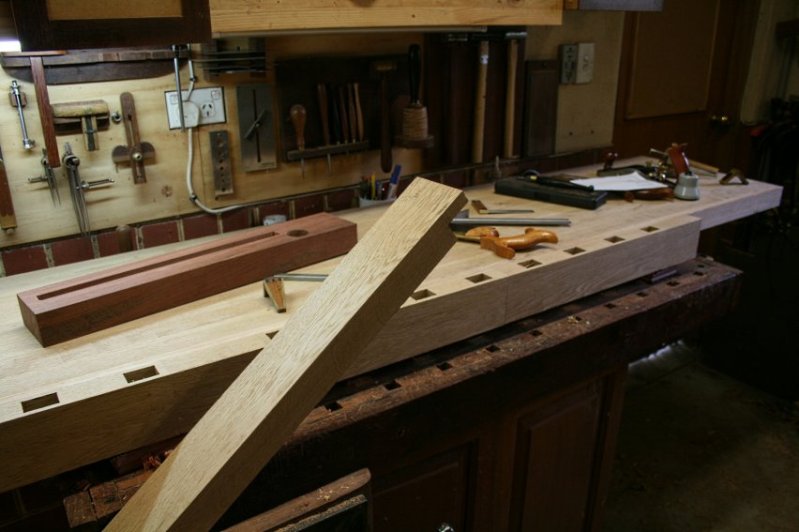
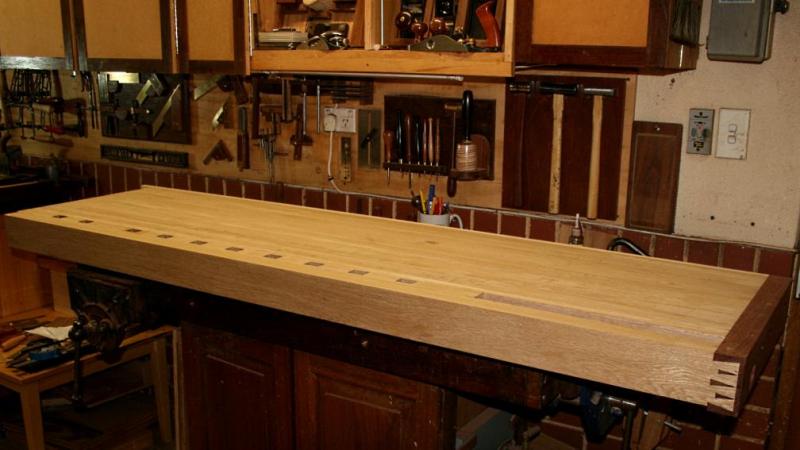
... it did remind me of dovetailing the end of my bench several years back, which is about 80" in length ...
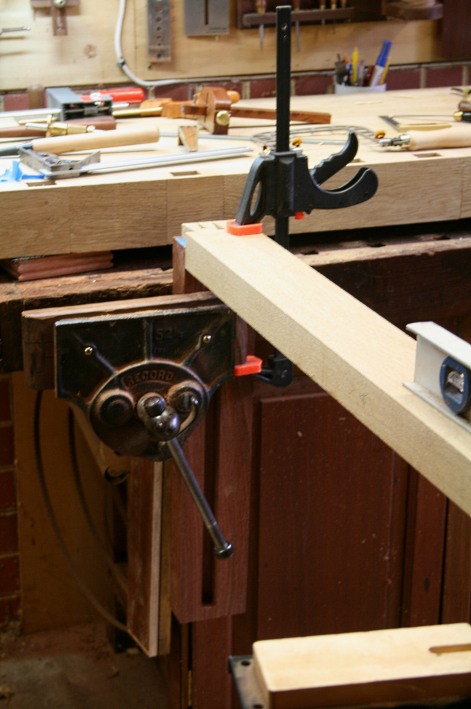
Transferring tails to pins - well, at least the pin board could stand upright. The tail board stretched out across the shop, held with stands and levelled ...
This is its full length ...
Anything is possible with hand tools. I do not know how you could do this with a router jig!
Easy Peasy....You just stick the pieces into the fragilator and let the laser do it's thing....a day or two of programming and about four days of heavy smokey cutting and it's done. Except you have to send it to Detroit to have it anodized and on to San Diego for tempering. Then you just cut away everything that does not look like hand cut dovetails. It's a CNC process you hand tool guys refuse to use.
Yes, of course I was being facetious. That's what the big grin was intended to convey. Maybe next time, I should use more grins.
I was also being at least a little facetious about using the loft in the shop. I realize that the luxury of that sort of arrangement is very rare. If you have a cellar shop location, DO NOT cut a hole in the dining room floorboards and clamp the dovetail jig to the dining room table.
With the possible exception of Roy Underhill or Joshua Klein, nobody pays attention to the shape of the wood dust or chips on the workshop floor.
I have had a rarely used leigh jig for 35 years or so. I have run into that problem, and I took it to my rear deck which has a rail around it, and just hung the board over there. That piece was only about 5 feet, but It would handle 7 feet. I don't see why it would be impossible to do it horizontally, or maybe at a ramp angle. Particularly if you have a lighter say 7/8 hp router. I have a light PC that I use for Leigh in maple, and it cuts no problem.
I have also used the upstairs and downstairs in my shop for similar issues. Not dusty ones. I did that as the only way to hardware bond some studs in my bench ends. Sounded like a plan until it dawned on my bench was not going to stand on end in my shop.
While it probably isn't worth the trouble. You could mark out your dovetails and use something like a forstner bit to rough them out, so if you are using the router at an odd angle, you would be only cutting a minority of the material out.
You run into the same issues when hand cutting. Not as big a deal, but it will still require some care. And it would be an odd approach to learn dovetails with.
Practice cuts are a good idea. Stress and chance of messing up rises when one is attempting something unfamiliar with expensive materials that one already has some time in.
Recently I was doing some easy boatbuilding where I had to use my favourite jigsaw to cut out some light ply contours. It involved doing scarfs and so I got to one of these long pieces a day in my spare time. Every night I was sick from the dust. Seemed odd. Then I realized I was working off an edge of my deck, and it was like a table about chest height. Great since it was 20+ feet long. But the result was I was driving the dust right hard into my face. Broke out the Racal helmet, and it was a pleasure to do. But the point is that while I didn't have any ruined pieces, I had changed just one thing about my setup and got results I didn't at first expect, or identify until I had spent a few miserable days sniffing.
Re: William,I want to hear about, 11' racing dingh
William Duffield
It is a tragic story, in many ways. The boat is named IMP TOO. She is a Classic Moth, which is a development class. She was the U.S. National Champion in 1938.
A lot of development has gone on since 1929, when the class was defined and the first Moths were built. Probably, the most radical enhancement has been the addition of foils. These new boats are now even faster than my greyhound.
My friend George, who owns the boat now, tells the next parts of her story a lot better than I could.
So, why are we restoring it? Some time back in the '90s, IMP TOO was restored by someone else and brought out to race. I suspect it raced at two regatas, since George gave me pics of it with the hull painted completely white, and then later in red and white. After the second regatta, it was loaded into the bed of a pickup for the ride home. The truck stopped for a drawbridge, and IMP TOO was rear ended. The pieces were picked up and tossed back into the truck bed. I have several pics (tooth picks? ) of her in that condition. Here are a couple of the more interesting ones.
This is the inside view of the nose block, carved from a knee of an Atlantic White Cedar. The boat was completely built from AWC, joined with urea formaldehyde or resorcinol glue (I'm not an expert on 70 year old glue tech) and thousands of 4" brass screws.
Tonight's last picture is an outer view of the same nose block.
1) hand cut the dovetails and if you are not pleased with their appearance, cover them with moulding.
2) make the cabinet in two pieces that you can attach with screws or whatever later on. That should get the length of the boards to a workable size and allow you to machine cut. It also makes carrying it up the stairs much easier, just wait until its in place to assemble.
3. connect the pieces with sliding dovetails. They are strong and nothing shows of the outside.
I have talked to my son about all of the things you mentioned. No game. I agree that making it in two or three pieces would certainly make life easier when moving day comes.
Figured out today how to make half blind dovetails with the Leigh jig. They won't show on top but they will be strong.