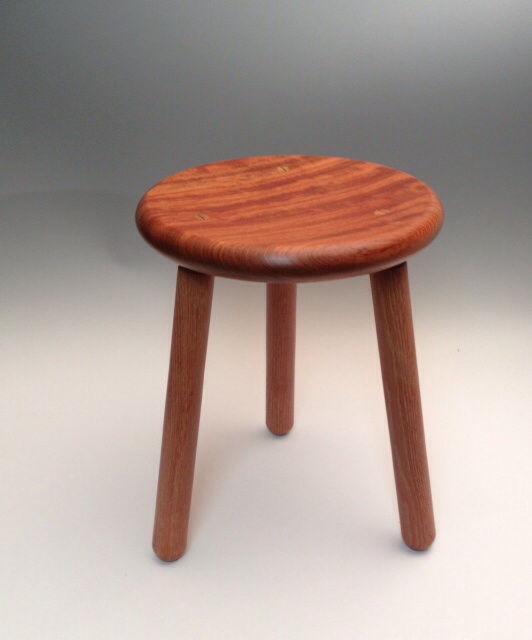
"Beginning woodworkers" is here broadly defined as anyone attempting something new to their woodworking.
We see it most often in finishing but it crops up elsewhere as in a mortising post below. Someone assumes something is going to work, tries it on the finished piece and encounters a problem that would have been avoided easier than fixed.
Don't assume what you have never done before will be easy, or even work.
If you have never done it before, prove you can by a practice trial. Odds are in your favor that practice at the task will in the end be the fastest route to completion, especially successful completion. This advice is especially true when it comes to finishing with some wood or some material never used before.
Excellent advise, Bill, even for those many of us here who have been woodworking for decades.
There is always something new to learn. Everyone teaching you, whether in person one-on-one, or in a workshop, or a magazine article, or a book, or a professionally produced video, or on YouTube, has a different set of experiences. The often won't show you the nuances of technique or tools or materials, often learned at the School of Hard Knocks, because they will have forgotten that they do most of them. While learning from someone who does it just right is valuable, you can also learn many important details from someone who has just learned the process themselves. Use the experts first, but if that doesn't help, you might try asking someone who has just learned the technique.
If your practice piece is successful, or even marginally successful, you should be able to at least make use of it in your shop, to how yourself and others in the future what you did right, and what you did wrong. If you burn it, the lessons that it holds are lost forever.
My mentor taught me a valuable lesson. Whenever he was preparing to build something, he built it first in his head. He didn't start building it for real until he was sure he understood everything he would need, materials, tools and techniques, to complete it.
...to learn to make repairs or small fixes that you haven't tried before, too. No matter how long you've been doing things.
I can't hide anything on planes, but sometimes i have lines to move on them. That's different than a lot of furniture.
I had to patch 3 out of 16 tenons on the doors I made for a cabinet just recently, but doing so will have no effect on the furniture long term.
I recall Peter Follansbee mentioning that he started to work with walnut after a long time working with white oak. You'd figure someone who has been working and demonstrating a very similar style for a long time could just adjust quickly (or maybe not at all) and make the same stuff, but his comment was more or less that he had some things to learn about working with walnut as he was used to oak.
Two things happen as you work for a while:
* you get better, and you may learn faster
* you get better at accepting when things don't go perfectly
If you have a drive to get better a little at a time, you'll be making things for a long time, and you'll enjoy it. And you'll learn what you enjoy and learn to do those things where you can.
I could lengthen my process for cutting mortises and tenons given that I don't do them that often, but I wouldn't enjoy it. It took probably less than 10 minutes to patch the 3 of the 16 that needed a little bit of help after cleaning up fit. It wasn't unenjoyable.
We are all beginners in a way when it comes to finishing. As you so often have pointed out here, you are never certain what a finish will do to a particular piece of wood until you try it.
Whenever I go astray and just start finishing without a test, someone the wood seems to know and has a surprise for me, even if its a combination of finish and wood I have used many, many times.
I once had a teacher, a German immigrant, who insisted that before a student does any process, he should write down the process in detail with notes as to what tools and supplies will be needed and how to evaluate the quality of the work before moving to the next process. I hated to do it, but I made way fewer mistakes that way.
...sort of reminds me of my early days getting middle of the road amateur tools (like 1k bandsaws and 1k tablesaws).
glad not to worry about those things as there's not a whole lot of "feel" when you're faffing with power tools as there is when you're improving with hand tools.
…and make a full size drawing. (I understand that is a requirement at NBSS.)I guess my mentor has been doing it long enough that a written list of instructions for most pieces of furniture was no longer necessary. I like to make a cut list, organized by material and thickness, with both rough dimensions and finished dimensions, and two columns of check boxes, one to use at the chop saw or saw bench, and the second to use at the table saw or work bench. It is also useful to write part numbers in chalk on the rough cut parts, because you know Murphy will be out there shuffling parts around as soon as you turn your back and go get a cup of coffee.
(Of course, that doesn't work for finishing, unless you are going to paint it, or you count marquetry, stringing and banding, etc., as part of the finishing process. )
..when you do a test piece, as obnoxious as it is, it's good to stop, do as you say beyond just the goals, and write down the problems and exactly what you'll do to address them.
At some point down the road, if you make a combination once every 5 or 10 years, it'll take 2 minutes to look over the notes and go "oh!", vs. much longer to relearn the process again.
I always like to watch the folks who finish guitars and then do the buffing work. They work like it's really easy. I think it takes a couple of years for them to get to that level doing several a day. When Fender or someone mentions that they budget an hour and a half for finish sanding touchup and the buffer, it sounds like a lot of time when you watch the people work until you try to do it once yourself and realize they have to fix or avoid any problems in that time!
The total man hours for an entire build are only something like 7 hours (For them - heavily automated), so nearly a quarter of the guitar hands on time is just buffing. Even that position is starting to go away, though, as robotics companies market robot buffing machines.
Legs with holes for this and that are usually left and right handed like chicken wings. The desk I am making has a leg with 13 mortises and 8 dovetails. There is another leg a mirror image. I have tape with notes and arrows in several places designed to keep orientations correct before the next hole get punched in it, ideally in the correct place. Chalk is good but rubs off. I have come to using tape for labeling.
I agree with your criticism. Chalk is only useful for the first stage of breaking down lumber into component pieces (as I noted, at the chop saw or saw bench, or RAS) while the lumber is still rough and would destroy a P500 point. A much more complicated system of parts and orientations descriptions is needed almost immediately.
I agree with Bill. Whenever I try a new technique(mostly turning)I make a practice piece from scrap wood. I am currently making a baby rattle for a new great granddaughter. I have been turning for almost 60 years, but, I still am learning.
Bill's definition of "Beginning Woodworker" applies to me, even though I've been woodworking in one form or another for over 60 years. Every piece I build has some element that is new to me. Sometimes but is a simple thing, other times it is a major element in the process. That is why woodworking continues to appeal to me. It forces me to continue to expand my mind and my skills; there's always something new to learn. The thing I have to guard against is believing that I can nail a new element on the first try. Sometimes I can, but more often than not, I make a mess of it. As a consequence, I mull over my next step endlessly before I take it. That decreases my efficiency and prolongs my build times dramatically. The good part, however, is that I'm not on a production schedule. If it takes me a month to accomplish something that someone experienced with the process could accomplish in a couple of days, so what? If I accomplish it successfully, I'm happy and enjoy my success. If I blow it, again so what? I have lots of time. I can do it over. Either way, I've learned something new. That's why I love this craft.
I have learned the hard way that Bill is providing sage advice. Bill got me into the woodworking world, but I abandoned East TN before he shared this nugget of truth.
 )
)