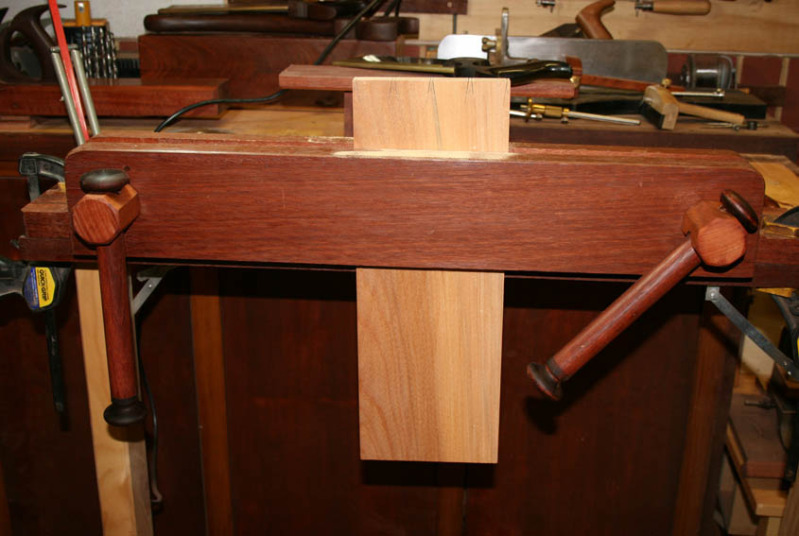
A 3/8" bolt, coarse thread, and nut is sufficient. Having avoided building one for years because of the cost of parts I finally built one with parts on hand to see if I would use it. The faster thread of a 1/2" bolt should be considered.
1. Just completed 6 drawers with it, and more due. I would no longer be without it.
2. I turned knobs on the lathe and embedded the bolts in the knob with epoxy. It takes a surprising little amount of force on the knob to secure the work. I found that a cylindrical knob that fit my hand, rather than a wheel, was ergonomically superior. I did not need the force that a wheel could provide.
3. Build one just sufficient to do the largest drawer- drawer width plus about 2-4". I would find the wide ones people build inconvenient and unnecessary for drawers.
Do you know any metal workers? My good friend made this for me. He machines down an acme nut to round, then bores out a 2 1/2 pound barbell weight. It spins like a dream. The weight of the barbell weight makes it spin effortlessly. Spin it up snug and you really don't have to tighten it any more. I've seen his vise, but I have yet to make mine.
I am still without one and just built one case outside this past weekend and will build another one soon.
Wait, that's not accurate - I actually made a moxon vise, but it was intended to double as a large rigid router fence, so it's heavy and its utility doesn't exceed my laziness.
A full length leg vise is a wonderful instrument for cutting case sides and drawers since it grips the entire length of the wood and is fast.
But I have to respond to this recalling that you weren't "on the moxon team" a couple of months ago
I used 3/4" UNC allthread and matching nuts for mine, from the Home Depot. A better choice, but more expensive, would be 3/4" or even 1" acme allthread, which you can find at Fastenall.
As for hand wheels, I turned my own from the densest wood I could find in the shop, which turned out to be bloodwood. My lignum vitae wouldn't accommodate 5" ø wheels.
5" wheel? My knobs are 2" and a gentle snug secures the work. I think people WAY overestimate what is required to secure a drawer side. A 1" chisel handle would be sufficient. Same again on the acme thread. Good for lifting a car but orders of magnitude overkill for this purpose. Before all get their shots in a knot, I am not commenting on how others have made this tool. The comments are a guide for those designing theirs that don't already have one.
This vise provides an opportunity for those that get satisfaction from building nice shop tools. For the furniture out the door, results oriented, this thing can be made in an hour for $5, and worth more than an hour to make it. I thought I se the bar for a crude one but our club president stopped by with one he just made. He didn't even round the knobs. But again, he way overestimated sufficient knob diameter required for sufficient torque.
I built mine before I ever heard of Moxon. I saw one in the workbench book and copied it. Screw box and tap. Cost nothing except labor. Red oak jaws,walnut screws. I installed A vise garter in the moving jaw to open the jaws when the screws are operated. It works just fine for cutting dovetails.
I have some Acme threaded rods and matching nuts. I will have to go measure but I believe the rods are two feet long and an inch in diameter. More nuts are available at Fastenal. If anybody wants one of the rods I would sell it for $10 and shipping.
....of how small a handle/knob/wheel works adequate. Who ever set us off on cast wheels and acme threads has not helped in the adaption of these handy devices.
..about dissatisfaction with the boutique version of the hardware (heavy devices, heavy hardware to go with them, and expensive) is probably where I got crossed up with my memory.
Though it's still the case that I ceased to use one of these once I got a leg vise. I like the center of my bench clear without finagling because my dog holes and hold fasts are there, which, I guess, ties into the other discussion down the board about working with fixtures on a bench to make up for things missing from the bench.
I use mine for drawer parts, but also for a variety of other things. By turning the two wheels different amounts, its trivial to clamp odd shapes. Also very easy for moving things a lot or getting big pieces just at eye level. Great for smoothing curves on chair legs, holding pieces for spokeshave work, etc.
I have also made one of the "bench top mini benches" many use for close up detail work, such as inlay. Set behind the Moxon, it provides depth and additional clamping surfaces that often come in handy.
My router fence-ish version is like this with a fine screw wood screw. I did have to pay about $6 for the dowel and bought the tap box (still have it).
It will build the forearms of any user who is working quickly through varying widths of material, but there's not too much of that as I can recall so it was only a hassle taking the thing off the router table and putting the fence on it. Along with the fact that the one that I have weighs about 20-30 pounds together.
I find that when making wooden knobs like that it comes out better if you first put a T nut on the bolt. Seat it into the wood handle and then seat and epoxy the nut on the other side of the handle.
A million years ago I bought a box of ten 1"-8 steel nuts to make fixtures and faceplates for my Jet lathe (the spindle is threaded at 1"-8). They cost about a buck a piece.
Fast forward 15 years and I decided to make a Moxon vice. Since I still had nuts left over, I just bought a piece of 1"-8 allthread - about $12 - and built it up. Turned some knobs to seat the nuts in (turned wheels as well - I had extra nuts) and it works great. 1" is overkill, but since I already had parts, that is what I used.
Total cost was about $15-$20 bucks and wood I already had.
If you have the wood, and can get free shipping, you could build one today for under $25 that will be strong enough to clamp and elephant.
There are a few options on how the threads tighten up.
I made mine so that the threads turn with the knobs and screw into the back plate. If the threads are stationary and only the knobs or wheels turn, when you are working on thin stuff, the threads stick out too far for my liking.
I also made mine configurable. The back plate has three nuts in it. The outer set can hold a 24" panel. The middle and outer will hold 12". I have two face plates. I almost never use the long one, but I have it if I need it. Swapping the screws around takes 3 or 4 minutes, but it doesn't happen very often.
It takes me days to build the drawers for a dresser. It is convenient to set the vise up on the bench and leave it there until done. With this situation in mind I opted to build a vise just for drawers. I can leave it in place and still have adequate bench to work on the other parts of drawer making. If building a simple cheap one I think it worth considering building a length that will cover most of the needs, if there is a most, and build a second if needed for occasional wider stuff.
I had 3/8" bolts on hand of the required length. They have worked fine. The thread pitch enables adequate tightening with modest torque. Coarser threads will require more torque leading to larger knobs.
I had in mind that a "fast" thread would be best for rapid adjustment. It did not turn out that way. Once set for drawer front thickness, and shims for the sides, the knobs only need to be turned partial rotations even with the standard 3/8" thread. It turned out for me that the lesser torque for the finer thread trumped faster adjustment, though not planned that way. It may be that the large wheels are necessary for the large acme threads.
I agree. I have considered making a dedicated small vise. My original used 1" because that is what I had. If I make a smaller model I would go with 1/2" or 5/8".
The first one I made had 1" diameter knobs and 5/16-18? thread. It seemed to take for ever to loosen and tighten the jaws, so I replaced the jaw, the allthread and the knobs. Second generation knobs were hard maple and 4" in diameter, and to my mind, work much more efficiently. The 5" bloodwood knobs were an experiment, which I though was worthwhile after trying the Benchcrafted wheels. I like their operation better, but still not as much as the very expensive Benchcrafted cast iron wheels.
And, my bloodwood wheels attract more attention when I'm demonstrating, which helps engage conversation. Since I'm not selling Moxon vises or any other hardware, I don't mind at all explaining strategies for making one jaw work as well as two, or much cheaper but effective hardware, or how an auxiliary bench might alleviate some back pain, or the advantages of learning skill building through the services that SAPFM offers, etc.
Hmmm...since I still have my old Moxon jaw, allthread and knobs, when I go to demonstrations, I should take it with me and mount it on the other side of my auxiliary bench, so people can try out both and decide for themselves what they prefer. I am not, however, going to go out and buy the Benchcrafted hardware and build another vise to mount it to, since I am happy enough with the performance of what I have already built. Hopefully, someone who "needs" the fanciest, off-the-shelf, boutique vise can extrapolate from mine and decide for themselves how much they want to spend and how much time they want to take to build it. Ialso have some Acme threaded hardware that I have considered using to improve the action of my vise, but haven't yet decided whether retrofitting my bench with it is worth the time and effort. Maybe, if I build another auxiliary bench (in a group build for one of the local woodworking organizations I belong to), I'll incorporate the faster Acme thread hardware.