WoodCentral Forums

Est. 1998 — 27 years of woodworking knowledge

Resawing poplar for drawer sides question???

Posts

Resawing poplar for drawer sides question???

#1

Resawing poplar for drawer sides question???

Barry Irby

I am about to make a chest of drawers for my grandson. I have some air dried poplar that was cut 5/4, thick enough to get a full 1" thickness out of it. I am planning to resaw it to 7/6" or 1/2" for drawer parts. How would you approach this?

This lumber was air dried under a tarp in my driveway for years. I have brought it inside. While I have not put a straight edge or winding stick on it it appears to be flat and straight.

I have a bandsaw set up for resawing and will most probably use that.The bandsaw is new to me. It's an old Hitachi with a 3" wide resaw blade on it and I have used very little.

Would you dress the lumber including whatever is necessary to flatten it and take out any cup and twist first and then resaw it or would you resaw it in the rough state and then dress and flatten it?
Re: Resawing poplar for drawer sides question???

#2

Re: Resawing poplar for drawer sides question???

dave nichols

I would flatten it before resawing. If you resaw first and then try to flatten the would you may not be able to get the thickness you want.

Re: Resawing poplar for drawer sides question???

#3

I'd resaw first...

David Weaver

...the reason I'd resaw first is that there's a fair chance that some or a lot of it will relieve itself when you resaw it. If you dress it and resaw it, you may end up with some thin bowed or twisted boards that you can't use that you spent time dressing.

Re: Resawing poplar for drawer sides question???

#4

Re: Resawing poplar for drawer sides question???

Sgian Dubh

"Would you dress the lumber including whatever is necessary to flatten it and take out any cup and twist first and then resaw it ..."

Yes, that would normally be the best approach, particularly as you don't have a great deal of material (thickness) to spare. I'd do no more than is needed to get both faces with flat spots parallel to each other, meaning there may well still be some rough islands in between the flat parts of each face. Also, square an edge to the faces to run on the bandsaw table.

However, don't be surprised if the resultant two boards from deep ripping need to be flattened and thicknessed again because of subsequent warping through stress release caused by the deep ripping operation. Hopefully this warping will be minor, and further flattening will result in thicknesses you can use ... I refer you back to taking off as little as possible of the original board as described in the previous paragraph.

That's a good result, but the risk with deep ripping (resawing) is that you release significant stress within the original board, which could mean that the two resultant boards are essentially unusable. You could test for this possibility prior to deep ripping by undertaking the fork or prong test. This test, admittedly, primarily shows if a board has, or is free of transverse stress rather than longitudinal stress: but, more often than not, if a board has one form of stress there's a very good chance that it has the other. Slainte.

Re: Resawing poplar for drawer sides question???

#5

My experinece

Bill Tindall, E.Tn.

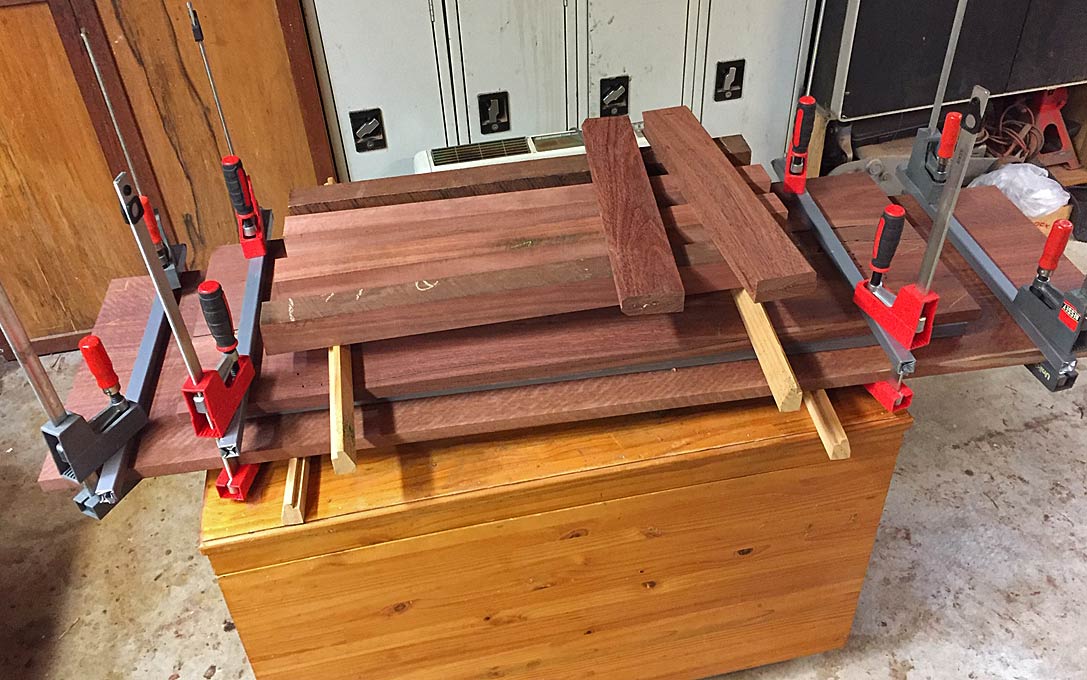
As a result of doing what you what to do with dozens of air dried drawer side pieces.........Do this: cut to rough length, resaw, make stacks of the resawed pieces with thin stickers in between and clamps on the corners to hold the sandwich together and flat. Then put the sandwiches somewhere to dry. (just completed using 18 pieces for drawer sides processed this way. )Many dozen preceded these, more of less successfully, until I found what was necessary.

Humidity inside is likely low now and will be suitable. Marvel at how much you have to tighten the clamps to keep the sandwich tightly squooze together as the pieces dry and shrink. When the sandwich is no longer shrinking, about 1-2 weeks, then proceed to flatten one side and plane to thickness. I do 7/16 sides with slips, but if I did not do slips I would do 1/2".

If you short cut this suggestion you risk warped sides as the thin pieces dry to current indoor humidity from whatever the moisture content the lumber is now.

Re: Resawing poplar for drawer sides question???

#6

What makes the usual approach risky here

Bill Tindall, E.Tn.

This lumber is air dried, whatever that means in terms of %MC. If it is going to dry significantly after resawing, based on my experience with this situation, I would do what I recommended below. A drawer will not be more than 8" tall. It will not be difficult to resaw cuttings 8" tall or less from rough lumber. After drying further every bit of original thickness may be necessary to achieve a flat finished drawer side.

BTW, if something doesn't leans up on one side it can make a back. Or it can make a thinner bottom. Or it can make a panel for the frame and panel back.

Re: Resawing poplar for drawer sides question???

#7

Re: Resawing poplar for drawer sides question???

jessecloud

Hey Barry,

First of all, that's probably a darned good saw you have there. I took classes from a guy who specialized in bent laminations and that's the saw and blade he used. He would cut very thin strips by the hundreds and they came out smooth and flat. Some said his saw was underpowered, but I watched him cut maple like it was butter. In any case, get some practice on that saw before you start cutting your chosen wood.

And Bill Tindall was right, if a piece doesn't come out perfect, it still can be useful. The backs of some of my drawers are good examples.

Re: Resawing poplar for drawer sides question???

#8

OK, so what I did...

Barry Irby

I skip jointed one side, if such a thing exists, and then skip planed the other side, very lightly to get sort of flat and parallel. Then re-sawed them and got two pretty decent pieces. I had to leave so I just set them around to dry and will strap them up when I get home. Looks like all is well unless the gremlins got into them as soon as I left. I don't know why, but I marked the pairs.

Thanks for the help.

Re: Resawing poplar for drawer sides question???

#9

Quarter sawn

Derek Cohen (in Perth, Australia)

Barry, what you have done sounds just fine to me.

Once I leave fresh boards for a while, I sticker and clamp them. They relax and stay flat ...


What I want to suggest for future re-sawing for drawer sides, depending in the thickness/width of the rough sawn board, is to saw it up in such a way that you can glue it together to create quarter sawn sides. This is the most stable grain direct for drawer sides. It takes extra work, of course, but for the piece of mind is worth it.

The process involves ripping a flat sawn board into strips, glueing these as a stack, and then re-sawing the result. It is not economical, but it is better construction.

Regards from Perth

Derek

Re: Resawing poplar for drawer sides question???

#10

Re: What makes the usual approach risky here

Sgian Dubh

There's certainly good reason to do what you suggested, i.e., cut pieces close to length prior to deep ripping, then stack with stickers and clamps. All the same, I still prefer to partially flatten as I described earlier prior to resawing. As to working wood with an unknown moisture content, that's easily determined if really necessary with either a moisture meter or an oven drying test using a microwave oven, some reasonably accurate scales and a few paper towels: a half to three quarters of an hour task using a microwave.

Either method for testing MC would determine if the material is too wet for deep ripping (or any other task for that matter), and I'm not sure why anyone would choose to use material that's too wet for the job in hand. Too wet for me in this situation with this sort of task planned would be material that's above about 12 - 13% MC. I find I can get a reasonable idea of wood's MC just by working it with either hand tools or machines. Dry stuff works differently to wet stuff, in that dry stuff has, for example, a 'crisper' sound than wetter stuff as it's cut with a saw or planed, and there's the quality and form of the chips and shavings that provide the worker a clue to moisture content. Slainte.

Re: Resawing poplar for drawer sides question???

#11

Re: Quarter sawn

Barry Irby

I knew that quartersawn was better, but I had not thought of creating quartersawn lumber this way. Hmm? I have some thicker stock, I could look for some that is already properly sawn or resaw some of the other and glue it up. Thanks for the idea.

Re: Resawing poplar for drawer sides question???

#12

This wood seems dry.....

Barry Irby

I have a moisture meter and I was going to test it, but.... I got the pin meter out after it being in a drawer for years. I got it in a buck of stuff at a tool auction. The batteries were not only dead, the little snack connectors that work with 9 volt batteries were missing and the batteries were soldered in. I have ordered new ones and they will be here in a day or two. I have another (pinless) meter I used in home inspections, but never used it in any sort of absolute sense. (If I suspected your toilet were leaking, I metered a spot several feet away to get a background reading and then checked near the toilet to see if it were wetter.)

While waiting for the parts, I used the pinless meter and noted the reading. In a day or two I will check again.

Beyond that, this wood seems dry to me. That's the intuitive assessment based on fifty years of experience with wood. And, I have done this before with this very stack of wood. Built three chest of drawers and a number of other drawers over the last five years. Some years ago I resawed (deep ripped) a lot of it and had a stock that only recently was exhausted. Perhaps it's time to restock.

Now to learn the microwave method.

Re: Resawing poplar for drawer sides question???

#13

I do not recommend the microwave method

Bill Tindall, E.Tn.

If doing the drying to constant weight, the NHLA reference method, it is just as easy to do it right as not. Dry in an oven to constant weight at 220 F.

There are two problems using a microwave oven to do this measurement.


If there is a deposit in the wood that preferentially absorbs microwave radiation it will pyrolyze, fill the kitchen with smoke and you will be banned from doing experiments in this device. I don't recall why I was microwaving this piece but you can see it was a bad idea.

Second, it takes more than a few minutes to diffuse moisture from the center of a piece of wood. Drying to constant weight becomes tedious with the constant attention microwave drying involves. However, it is a good way to get a quick approximate check of the moisture content to see if it too high, if it doesn't fill the kitchen with smoke.

Re: Resawing poplar for drawer sides question???

#14

If the lumber is indeed dry......

Bill Tindall, E.Tn.

You will know in short order if the lumber is in fact dry. If not dry there will be a moisture gradient. After resawing one side will gain or loose more than the other and you will have cupping, a fatal defect when trying to tease maximum thickness from something resawed.

I know that the drawer siding billets I have are not thoroughly dry. Hence, the more involved procedure I reported above for resawing and drying.

Philosophically, if there is risk of reawed lumber moving after resaw I avoid any loss of thickness until the cuttings are stabilized. That small thickness needlessly removed by skip planing may have been removed from just the location thickness is needed to flatten after equilibration. If the cuttings were reasonably flat in the rough I would not have flattened before resaw, for the same reason. Otherwise I too would have begun flattening before resaw and sawed from this face against the fence.

Re: Resawing poplar for drawer sides question???

#15

Re: I do not recommend the microwave method

Sgian Dubh

Bill, my experience using a microwave to undertake the oven drying test is somewhat different to yours because I've never experienced either of the problems you describe. The ability to establish wood MC in less than about 30 - 45 minutes in a microwave oven isn't especially challenging, requiring only the use of a wad of paper towels under the sample(s) under test, low settings, short bursts, frequent weighing of the sample, and short rest periods between cookings. The results are accurate enough to provide useful information to the woodworker, all depending upon the accuracy of the scales of course. And this method does save setting up a cooker (domestic, for example) for a long period, which may, or may not be popular with other household members, ha, ha.

I've heard a few tales of people overcooking their wood samples (not me) ... with similar results to your burnt example, but in all the cases I can recall it was the result of rather over-enthusiastic cooking, i.e., too high a setting and cooking for too long, with too few rest periods. Slainte.

Re: Resawing poplar for drawer sides question???

#16

Quarter sawn comment

Bill Tindall, E.Tn.

While quarter sawn oak drawer sides are ubiquitous in late English Period furniture I don't see this practice widely used in American Period furniture using poplar for sides. I am less familiar with southern yellow pine use, but the limited pieces I have seen do not indicate quartered sides were considered important.

I have no doubt there was good reason for the English choice, but I have no clue what caused in this choice. Given the aggravation to create quartered lumber by the means you use I don't see it worth the effort for the wood we used in drawer sides.

The only benefit quartered lumber could have is the ability to fit the drawer height to tighter tolerance. The difference in seasonal expansion on a quartered vs flat 6" drawer made from KD poplar would be in the thousandths of an inch.

Now if drying poplar drawer sides from resawed billets the difference in shrinkage is significant. The quartered slices will likely dry flatter and there will be less loss from drying distortions. Hence, I chose to rift/quarter saw the billets that became my drawer side stock.

Re: Resawing poplar for drawer sides question???

#17

Re: I do not recommend the microwave method

Bill Tindall, E.Tn.

The results are accurate enough to provide useful information to the woodworker,

I do not disagree if the goal is to determine whether the wood is too wet to use or maybe ok. Then it becomes a matter of personal convenience whether tossing the test piece in oven at 220F is more or less convenient. If the first weighing shows the MC too high- done. If the first weighing shows an estimate of 10% then more drying is called for. Is it really 10 or something higher because the wood was not 0% MC at the first weighing?

If the goal is to know the moisture content the test piece must be dried to constant dry weight. This procedure requires at the minimum two heating cycles, and more likely 3-5 depending on how wet it started. This fact makes the MW less convenient in my mind.

Like you I can feel if it is dry enough.

Re: Resawing poplar for drawer sides question???

#18

Re: I do not recommend the microwave method

Sgian Dubh

I've never done it, Bill, but it would be interesting to take two sequential wood samples from two or three boards and oven dry one of each pair in a microwave, and the other half of those pairs in a conventional oven to determine if there is a significant difference between the two methods.

I'm afraid you lost me a bit in your post to which I'm replying. The method I use with a microwave oven does involve repeated cycles at the final stage to ensure a constant final weight prior to calculating the original moisture content of the sample.

Regarding your point (in the other sub-thread here) about 1/4 sawn oak in British/English furniture drawer sides, my experience is that that choice is less common than many non-Brits perceive. I'd guess, and therefore it's anecdotal, from working with many examples of old and not-so-old British furniture is that a great deal less than half used 1/4 sawn oak. I speculate that one reason for its use in drawer sides might have been driven by the fact that the movement factor for 1/4 sawn oak and the movement factor for tangentially sawn mahogany (drawer fronts) are very closely matched, i.e., ~4.5% from FSP to 0% MC (if I recall that correctly). I can't say that the Georgians through to the Edwardians in the UK knew that when they built their furniture, but they might have done. Whether or not they knew I don't suppose matters, because I don't think the amount of movement differential between a drawer front and a drawer side is ever normally significant or problem, whatever the choice of material for both parts. Slainte.

Re: Resawing poplar for drawer sides question???

#19

drawer sides

Bill Tindall, E.Tn.

There is a shop in Shelbyville, KY that imports English furniture by the shipping container full, mostly 19th century, invariably mahogany. Every drawer I have examined there from this period was quartered white oak. The occasional earlier pieces were not. Maybe it was riven, and quartered because of the way it was produced and nothing to do with properties. The modern reproductions they import from England used to be quartered and now they are not.

I would be curious to know if the MW will dry to the same level as an oven. As the water concentration in the wood becomes lower the absorption of radiation becomes smaller and I would suppose the wood would be cooler. Maybe I will test it. I expect the differences are too small for us to fret over, but they could be significant in a law suit involving MC of KD lumber.

Re: Resawing poplar for drawer sides question???

#20

Microwave drying????

Barry Irby

I have picked up a small piece of wood cut at random out of this stock. The sample is a piece of poplar about 1" by 1" by 3" and it weighed 59.5 grams. I have been drying it in the microwave. about half a dozen cycles at full power for 15 seconds. I got quite hot but did not burn. (I burned up a turning a few years ago so I have had that experience.) I discovered the microwave has a Keep Warm function and put the blank in for five minutes at a time. I Have run it several times at the keep warm setting and this seems to be working quit well.

It started at 59.5 grams and is down to 54. so, 59.5 - 54= 5.5/54 X 100 = 10.18% I ran it again for an additional five minutes and it remained at 54 grams. So, apparently this wood is about at 10%

This could explain why when I resawed it, nothing happened, at least not so far. After more than 24 hours the stock has not cupped or twisted.

Tomorrow I may oven dry a similar piece to see what happens.

Have I made some sort of blunder I am not seeing?

Re: Resawing poplar for drawer sides question???

#21

Re: Microwave drying????

Sgian Dubh

Barry, when I test for MC using a microwave oven I never use a higher setting than the second lowest, and that only for the first couple or three bursts of heating for about 45 seconds to perhaps 75 seconds per burst. And that's with samples I know to be quite wet, i.e., I can tell from cutting the sample that the stuff is obviously up at more than about 20 -25% MC. The way tools handle the wood: chip and shaving formation are the clue, and the way those cuttings come off the tool (both machines and hand tools), or it could simply be that I know the piece under test has had too little time to dry significantly from green. My current microwave has a 'Defrost' setting and 'Min' below that, and then there are three more settings ranging up to 'High'.

Therefore I only ever use Defrost and Min settings, and for the vast majority of heat bursts I use Min for heat cycles of a minute or less. I go slowly and gently, with one or two minute gaps between heating cycles. Patience is the key, and I think your 15 second burst at a High setting are bit too aggressive. Apart from that, you seem to be doing everything else right. Slainte.

Re: Resawing poplar for drawer sides question???

#22

Re: drawer sides

Sgian Dubh

I find interesting that you've come across so many quartered oak drawer sides in British made antiques in the US, whereas here in the UK my experience (only anecdotal) is that the use of quartered oak for this purpose is less common. Of course, it's always possible that my observations are wrong, or I've maybe worked on too many pieces of low quality old furniture, which I know has frequently been the case having worked on a lot of pretty shonky stuff one way or another, particularly a few decades ago when people used to keep and rescue old bits. Nowadays I think people prefer to go to IKEA or a similar outlet for a replacement, and dump the old wobbly brown piece at the recycling centre, or maybe just the dump, ha, ha.

I've no experience or opinion regarding lawsuits to argue about wood MC, whether microwave oven tested, or convection oven tested. Is that really a concern over there? Slainte.

Re: Resawing poplar for drawer sides question???

#23

antiques and disputes

Bill Tindall, E.Tn.

The furniture this shop sells has prices in the range $1000 -$5000. It is hand selected by their buyers in England, but I do not know what the sources are (estate sales?). I met someone that worked in an English factory in the late 40's early 50's making drawers for mahogany furniture. They were reported to be quartered oak sides. I have no other data.

A factory ordering a truck or train car load of lumber will order with a moisture specification. If upon delivery the lumber is not 7% (typical specification)or less it will be rejected. If there is a dispute about the moisture content the lumber will be tested with the NHLA reference method using an oven and drying to constant weight. This value will be admissible evidence in arbitration or court. Anything else will not.

Re: Resawing poplar for drawer sides question???

#24

Blunder?  probably

Bill Tindall, E.Tn.

I have picked up a small piece of wood cut at random out of this stock.

Not sufficient description to determine if this sample is representative. Ideally, the test piece is full width of a board cut from a location well removed from an end.

So, apparently this wood is about at 10% What you know: this sample is at least 10% MC presuming you did not heat it enough to generate volatiles other than water.

resawed it, nothing happened, at least not so far. It would have been most useful to have weighed the freshly resawed piece and followed it weight to see what it did when exposed to living conditions.

Tomorrow I may oven dry a similar piece to see what happens. I hope you take the time to do it correctly.

Have I made some sort of blunder I am not seeing? Likely . How and why in drying does water get out from the center of a piece of wood? First a moisture gradient must be established from the center to the surface. In this case the surface must be exposed to temperature and humidity conditions where the moisture content of the surface is 0. In this situation moisture will diffuse from high to low (just like heat). The "diffusion coefficient" is a measure of the rate at which water diffuses through the wood. To get a water molecule from the center of a 1 x1" block of wood to the surface in 15 seconds would require a diffusion coefficient about 2 to 4 orders of magnitude greater than what I guess it might be. The time scale of your experiment is 100 times too fast.

Re: Resawing poplar for drawer sides question???

#25

Re: Blunder?  probably  Yeah but....

Barry Irby

The piece I chose was from the middle of the board, well away form the ends. The reason it was cut out was it had a small knot in one edge.

The piece got hot, but not so hot I could not hold it in my hands. Does it matter if I damaged the piece as long as I reduced the moisture to near Zero? I was not trying to salvage this small piece, but using it as sample of it's neighbors.

My son has one of those point and shoot thermometers, actually two and I may see if I can borrow one. Then I could read the surface temperature. Not sure that would help me because I would have to do more research to know what temperature is critical. You mentioned drying the samples in the oven at 220 degrees (F) I think. I am assuming that that is just above boiling for a reason.

Out of curiosity I am going to dry a couple of samples in my oven today. I will weigh them first and after to be able to do the calculations but I will also take moisture readings with my Tramex pinless meter to see how it reads compared to the oven dry method. It would be nice to know if it gives any relevant information.

I am using a small scale. I had a larger postal scale but have misplaced it. I also have a freight scale that will weigh up to 400 lbs, but that is a little gross for pieces this size.

Next we move to thermally modifying poplar. Saw some the other day and it was beautiful.

And if my oven were big enough I would be using it to kill some PPB's.

👍 This page answered my questions

Your vote helps other woodworkers quickly find the answers and techniques that actually work in the shop.