WoodCentral Forums

Est. 1998 — 27 years of woodworking knowledge

For those who drill holes in stool or chair legs?

Posts

For those who drill holes in stool or chair legs?

#1

For those who drill holes in stool or chair legs?

Barry Irby

My son turned 3 legs for a stool years ago and recently rediscovered them. They are curly maple. He noticed a matching 2 x 4 in my lumber rack and decided we should make a stool. A little father and son time in the shop seems like a good idea now that he lives only an hour away.

We have glued up a top and turned it. We drilled three holes for the legs at about a ten degree splay angle. At this point we stopped and are waiting for the next session.

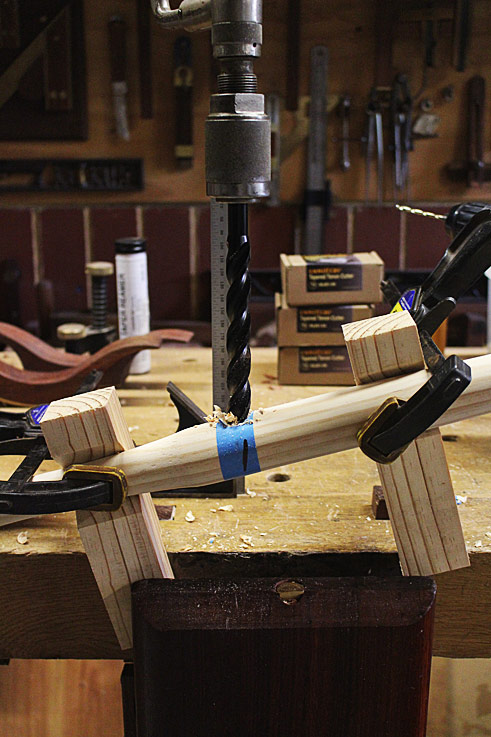
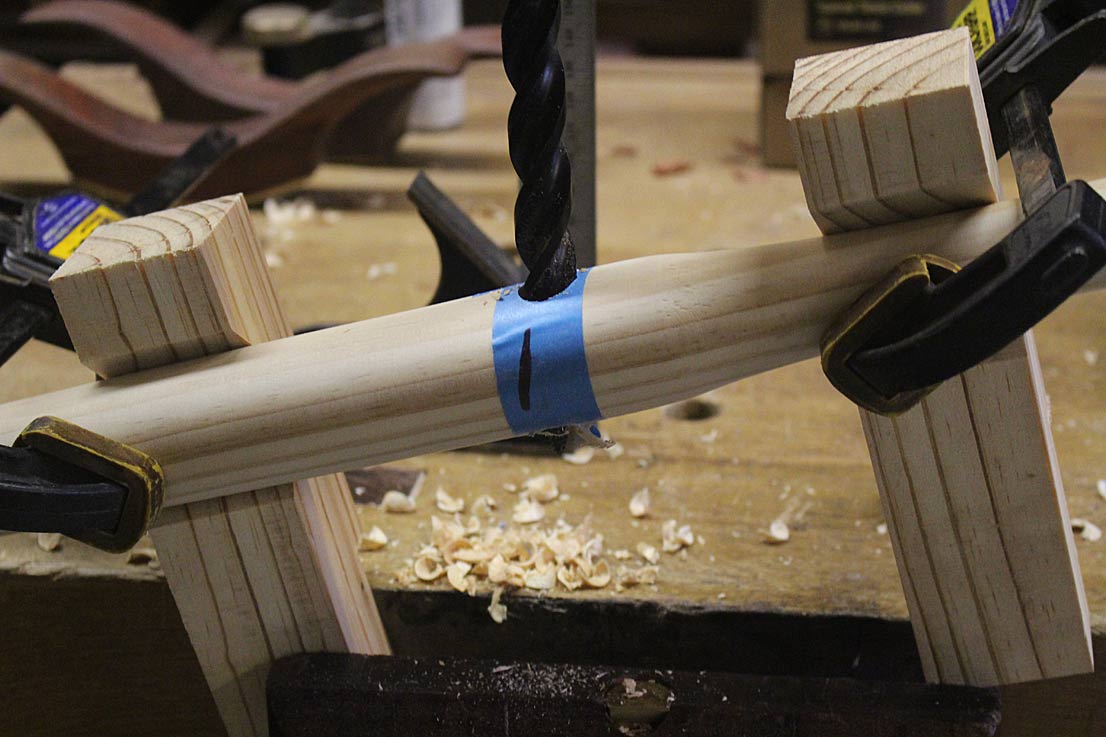
My question is how to drill the holes for the rungs. He insists on three leg to leg to leg rungs. (I was thinking two rungs, one leg to leg and the other rung to leg.)

So how do you drill for rungs? It seems there is a 60 degree included angle and a 10 degree splay angle. I have been looking on YouTube and see people using mirrors and squares and Tee Bevels, but remain confused. These legs are tapered, larger at the floor than at the seat. Any help would be appreciated.
Re: For those who drill holes in stool or chair legs?

#2

Re: For those who drill holes in stool or chair le

Ralph Lipeles

With the 3 legs sitting in the holes in the top, I cut a piece of cardboard at the angle that I will be drilling. Mark where the hole will be drilled, remove the legs from the top and drill using the cardboard as a guide for the correct angle.

Re: For those who drill holes in stool or chair legs?

#3

Re: For those who drill holes in stool or chair le

Derek Cohen (in Perth, Australia)

Barry, similar to Ralph, but i use a sliding bevel to measure the angle, and then hold the piece so ...


Regards from Perth

Derek

Re: For those who drill holes in stool or chair legs?

#4

Jack Guzman from Maine

Re: For those who drill holes in stool or chair le

Jack Guzman from Maine

I do something similar to Derek's except I hold the piece parallel to the bench top. I place a mirror behind it and set a bevel to the correct angle and drill while using the reflection to keep the angle right. Doing the stretchers your way is much easier than trying to get all six holes dead on.

Re: For those who drill holes in stool or chair legs?

#5

JL

Re: For those who drill holes in stool or chair le

JL

A different way:

Seat the legs firmly in the seat.

Set the assembled stool on a flat surface (seat down).

Stretch a rubber band (long one) from one leg to the other - making sure to get it "level" to the seat. Mark the places where the rubber band goes. This is where your rungs will be.

Determine the angle w/ a protractor at the rubber band - that will give you your drilling angle. Mark the place where the rung will go.

Remove leg and drill at that angle. I have a variable angle jig that I made which I use w/ my drill press.

Alternatively - just drill by hand - there is enough "slop" so that you will get a reasonable fit w/ your rung.

Re: For those who drill holes in stool or chair legs?

#6

Why All The Measuring Of Angles?

Mike in Zuni VA

You are introducing the possibility of introducing errors. I would recommend the direct drill approach that I learned at Country Workshops and is illustrated in Drew Langsner's "The Chairmakers Workshop." Amazon has it as low as $35.00.

First an observation; If you are going to use three stretchers I would not put them in the same plane unless where the mortises intersect is large. You are going to create a weak point in the leg where the mortises meet/intersect. I would offset the stretchers by a little more than 1 dia. of the tenon (just enough for the holes not to intersect). Determine the center of the mortise in each leg by whatever method you are comfortable with. The rubber band method that some mentioned is fine. I just eyeball it. Mark the center of each mortise. I use one of two methods to drill.

Method one is to use a long scraper/spade bit in a cordless drill. Twist the leg in the seat mortise so when you put the point of the bit in the center of mortise the shank just clears the adjoining leg. Line the shank up with height of the other mortise that you had already laid out. Hold the leg you are drilling with a finger approximately where the bit is going to exit on the opposite side of the leg and drill slowly. You are feeling for where the point is going to exit the wood. Sometimes you can feel the heat before the point breaks through. Sometimes I get a pinhead hole where it breaks through. This is no big deal for what I do. If I apply too much glue in the mortise or on the tenon it prevents a hydraulic lock. When I turn my stretchers I usually make them about 1/4" longer then the actual shoulder to shoulder measurement. Repeat for the other leg. Install the stretcher for the two holes you just drilled and mark the next two mortises and repeat for the 3rd stretcher.

Method two is similar, but with hand tools. I use a spofford brace and the appropriate sized green woodworking bit that Lee Valley used to sell with a spade bit extension, and an adapter that I had made to use the extension in the split chuck of the spofford brace. I prefer the spofford brace as it is slower and more controlled.

This method also works if you use two stretchers.

If you wish, I can come to Richmond and demonstrate it for you.

Mike in Zuni VA

Re: For those who drill holes in stool or chair legs?

#7

Re: Why All The Measuring Of Angles?

Jim O'Connor

I do it much the way of Mike. Freehand, upside down and about my eye level. Offset the holes for the next pair of legs, especially on 3 leg stools. For tall stools this gives folks with long or short legs a place to hang their heels.

I generally use a brad point drill. I use a level on the outside of the legs to mark a spot and just eyeball the high spot of the leg in relation to its entering spot.

👍 This page answered my questions

Your vote helps other woodworkers quickly find the answers and techniques that actually work in the shop.