Re: Need Some Input
TomD
"drill for the bed bolt connectors."
I prefer hardware bonded studs, you can maybe find info by searching here, though the search function is hard to use.
"What length would you recommend for the new bench?"
That is up to you. Unless you are planing another move soon, I would go for as long as possible. I think 8 feet plus a little is perfect. Basically room height, so you can pretty much make anything you would own on it. Traditional euro is 7 feet, as it probably works as well as my preferred length since how much furniture is full height in the room. But only you know what you make and how much space you have. Space is probably more important.
Have you thought of two benches? This is particularly good for chairs. The (famous woodworker) Frid's bench was euro style and only 5 feet long. He made every kind of furniture you can think of. It must have been too small for some things, but he got by. For chairs, a 6 and 4 would be ideal. If I did that, I would cut the 6 to 2 foot width, and leave the 4 full width. I would have two vises on the 6 footer, and a double screw vise on the 4 foot edge of the 4 footer. I would save the 6x1 foot piece as an outside plank for dirty jobs, like dusty plane or router work.
"How much overhang would you have on each end?"
What do you have now, if you like it build it the same. However, if you do a tail vise you usually have to tuck in that end a lot more, so your hardware will determine the set back. If you have dog holes make sure you pick a spacing that does not obscure them.
"Would you add aprons to all or some of the sides?"
No, I prefer being able to access the edge. But if you want one you can have one. normally that requires support from legs, and will determine aspects of their position that may already have been set. Doubtless you could kludge something together if you wanted it badly enough. If you have room to work on all sides of your bench at once, you can have different set ups on opposite sides for greater versatility, and could have an apron.
"Would you add a trail vise and if so is the 2 1/4" thickness adequate for the tail vise?"
Yes, if you have space there is no reason not to have one. There are lots of ways to work without one, but there is never any reason not to have one... If your bench is long enough.
With most modern hardware I have seen the problems are more that your bench is too thick. A lot of commercial blocks are 1.75" thick or thinnier, so you have to trench out to get the hardware in. But certainly I think your top is not too thin.
"What other ideas or considerations would you recommend?"
Put more thought into it yourself. Don't get into that way of thinking where you think what you have is OK. Ask yourself every single way in which it was not perfect, and what you could change. What about making the 6x2 height adjustable. Or make them different heights for low and high work. Are they the right height now? You could cut that 1 foot off for the 6x2 and use the narrow piece for an apron. Do you need a router table. What about built in shooting. What about wheels. If you cut 3 feet off one end, could you glue that piece on for a supper thick end for mortising and heavy banging. Do you use work boards for production. Where will you attach those. Do you have round dogs. Look up all the options for those in catalogs to figure out your needs. LV has tons of stuff. Do you want some square holes if you have round. Do you need to build in a vacuum chuck? Tool storage or racks. Do you want breadboard ends? Do you want a Moxon vise, what parts will you use for it, and where will it go.
Could you use offcuts for a shaving horse?
I would look at some bench books. The original Landis book if you can find it was the best, because it looked at all kinds of shop configurations. More recent ones have tended to be cultish.
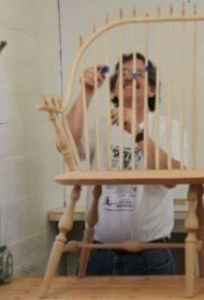
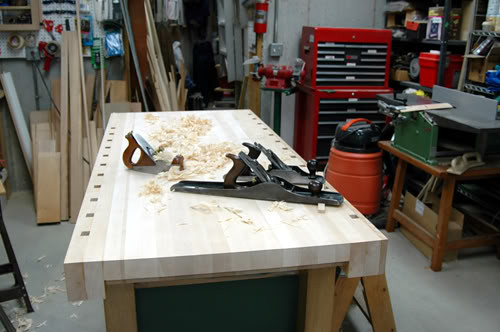 [/url][url=https://flic.kr/p/2iqKSXP]DSC_0005BE[/url] by [url=https://www.flickr.com/photos/158680038@N03/]Hank Knight[/url], on Flickr
 [/url][url=https://flic.kr/p/247Ywuq]IMG_1221[/url] by [url=https://www.flickr.com/photos/158680038@N03/]Hank Knight[/url], on Flickr
 [/url][url=https://flic.kr/p/29MoZny]DSCN0615[/url] by [url=https://www.flickr.com/photos/158680038@N03/]Hank Knight[/url], on Flickr


