Re: Insight?
Derek Cohen (in Perth, Australia)
Card scrapers and the ones illustrated by you all are ground 90 degrees. Fixed blade scrapers- chair scrapers, scraper planes, floor scrapers- are sharpened at 45 degrees and then the burr established. Why the difference?
For example, what would be the result if one used a beveled plane blade for a scraper instead of the 90 degree plane blade stock? Ditto for the lathe scrapers. What would be different if they were ground at a more acute angle?
Bill, it is an illusion that card scrapers are square edged and fixed blade scrapers are 45 degrees. In reality, they are all similar to plane blades. All have a cutting edge with a cutting angle. The hand adjusts the cards, and those for the planes are prepared thus.
The card scrapers have a roughly 10 degree hook, but they are also angled to the wood, which increases the cutting angle (if the hook is a higher angle, one ends up canting over the card at a lower angle).
Fixed blade scrapers need a specific angle to work correctly. One can use the blade with just the 45 degree bevel, however it will not cut well (only beginners do this since they lack the experience to form the correct angled hook).
Now it is also possible to vary the angle on the blade in a scraper, such as a Stanley/LN/Veritas #112. Originally, I believe that the bevel angle was 60 degrees for maximum edge retention. Some prefer 45 degrees, and I have even used 30 degrees - the edge does not last as long, but the hook is easier to roll.
I had a discussion about 15 years ago with Paul Hamler about thick versus thin blades for scraper planes. He was (still is) a supporter of thin blades, at a time when LN was making a thick blade for their #112 and also a thick replacement blade for the Stanley #112. I explored this and wrote this article:
http://www.inthewoodshop.com/WoodworkTechniques/Thick%20verses%20thin%20112%20Scraper%20Plane%20blades.html
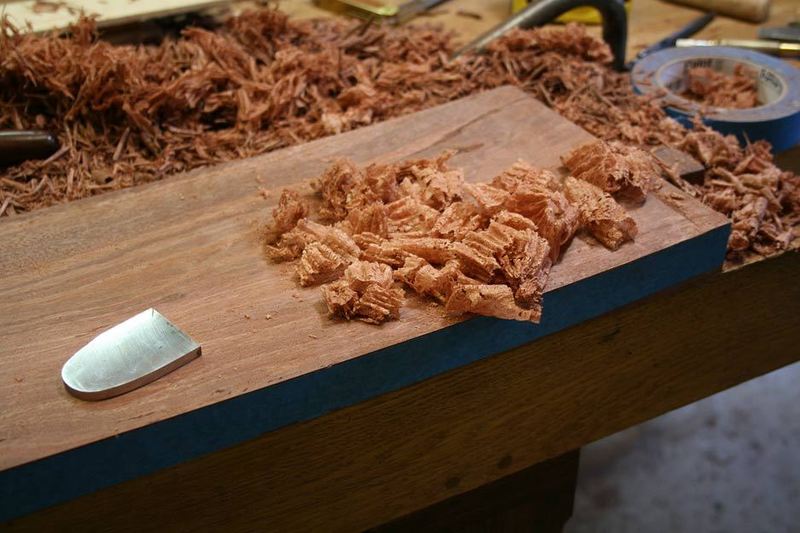
Both thin and thick blades made nice shavings ...

Regards from Perth
Derek
 Just goes to show that there is more than one way to go about this.