WoodCentral Forums

Est. 1998 — 27 years of woodworking knowledge

Another Moxom vise variant

Posts

Another Moxom vise variant

#1

Another Moxom vise variant

Bill Tindall, E.Tn.

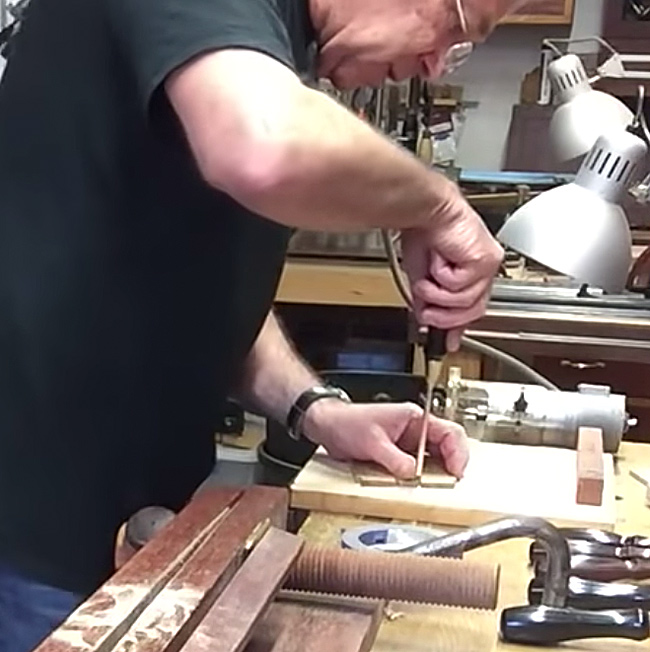
We had a professional maker of Shaker inspired furniture for our club program last night. He didn't like the ergonomics of paring dovetail waste with the board flat on the bench. So picture what we are calling a Moxom vise like arrangement. Now imagine that the front jaw is an inch lower than the back jaw. And in registration with this front jaw a strip of HDPE is embedded in the back jaw.

The tail board is clamped in the vise with the scribed base line registered with the top face of the front jaw. The tail is pared to the base line using the top face of the front jaw as a guide. The plastic strip absorbs the impact of the chisel breaking through the back side.

This approach has some merit for consideration. The waste is removed without flipping the board to the other side. Paring is much easier on the chisel edge than chopping. The top of the jaw guides the chisel.

Depending on the way one's Moxom vise is made, it could be possible to simply have two front jaws for the vise, one for sawing and one for waste removal.
Re: Another Moxom vise variant

#2

Re: Another Moxom vise variant

Derek Cohen (in Perth, Australia)

We had a professional maker of Shaker inspired furniture for our club program last night. He didn't like the ergonomics of paring dovetail waste with the board flat on the bench. So picture what we are calling a Moxom vise like arrangement. Now imagine that the front jaw is an inch lower than the back jaw. And in registration with this front jaw a strip of HDPE is embedded in the back jaw.

The tail board is clamped in the vise with the scribed base line registered with the top face of the front jaw. The tail is pared to the base line using the top face of the front jaw as a guide. The plastic strip absorbs the impact of the chisel breaking through the back side.

This approach has some merit for consideration. The waste is removed without flipping the board to the other side. Paring is much easier on the chisel edge than chopping. The top of the jaw guides the chisel.

Depending on the way one's Moxom vise is made, it could be possible to simply have two front jaws for the vise, one for sawing and one for waste removal.

Bill, I cannot recommend this method. It is far too easy to aim a little low and take out the baseline on the opposing/back side. You friend must have very good aim or lead a charmed life. It is a better method to pare half way through the thickness (aiming slightly above the baseline), then flip and pare the other half. Finally finish by removing the slight tent.

Regards from Perth

Derek

Re: Another Moxom vise variant

#3

Interpreting advice from professionals

Bill Tindall, E.Tn.

The first place I look for advice on how to do some woodworking operation is a shop doing it to make a living. If the shop is successful then one can reliably conclude what they do is quick and reliable. But questions remain. Are they doing exactly what I need to do and if not are the differences significant? Will my skill level and available tools enable me to do what they do? If not, is it worth learning?

In the case at hand, the person builds from cherry and poplar using conventional Period Correct construction. Check, check, check...we are building with identical construction. His pieces sell in galleries for $4000 to $8000 (wholesale $2 to $4K). A partial check. He is building to a higher standard than I am. I'm willing to sacrifice refinements in places that don't show to save labor and dovetails is a place for me to employ what he referred to as "journeyman" construction (in contrast to "master").

I am not willing to dismiss what he does as easily as you are. But as I like to say....the proof is in the pudding. Waste removal is a slow and for me an unenjoyable part of building with dovetails. I am going to try what he does.

Re: Another Moxom vise variant

#4

Re: Interpreting advice from professionals

Derek Cohen (in Perth, Australia)

The first place I look for advice on how to do some woodworking operation is a shop doing it to make a living. If the shop is successful then one can reliably conclude what they do is quick and reliable. But questions remain. Are they doing exactly what I need to do and if not are the differences significant? Will my skill level and available tools enable me to do what they do? If not, is it worth learning?

Bill, I agree with learning from those who are successful. However, I have done enough dovetails to also recognise that this method is for those very confident in chopping the baselines perfectly square each time. The difference between someone who does this every day, and much of the day, is quite different from the weekend warrior, who may dovetail a few occasions each year.

I have used the technique you described (although the tail board was positioned flat on the bench). I have done it successfully much of the time. However the tails I punched out are in softish wood (for drawer sides) and the baselines are generally 3/8" to 1/4" wide.


(reference - the world's most boring dovetailing video - at 20:28 ... https://www.youtube.com/watch?v=QKMADs1MNpE)

My experience here says that this is a risky technique. It takes little more time to control the chop by going half way from each side, and this is not wasted time when the result is more certain.

Speed may be important for a professional shop, but it means little to me if I am going to make mistakes. My speed in working is pretty decent ... for an amateur. I am not a professional and never will be. I aim, however, to be the best amateur I can be, and this includes working as efficiently as possible. No doubt this will keep improving, but I am not going to try and recommend that one emulate a professional without first developing the intermediary skills.

In my opinion, this is better: http://www.inthewoodshop.com/Furniture/ThroughDovetails3.html

Regards from Perth

Derek

Re: Another Moxom vise variant

#5

My description must have been unclear

Bill Tindall, E.Tn.

If I understand correctly your objection to the method described is that the entry cut might not align with the exit baseline unless the person chiseling was of exceptional skill and experience. Did I not make clear that the chisel is being constrained to the entry baseline, as well as guided, by the top surface of the front jaw of the vise, which in his case was something over an inch deep?

I gave this method a quick trial and the objection you raise is not difficult to overcome. With the broad registration of the chisel on the jaw top surface (simulated in my case by a board clamped across the piece) chiseling a flat dovetail bottom was trivial.

However, there was another issue I did not overcome to my satisfaction. One can not plunge even a 3/8" chisel into the baseline if the waste to be removed is more than a whisker. Rob band sawed out the bulk of this waste as I do. But even taking way more time than I usually do to saw very close to the dovetail baseline I was still left with too much waste to plunge a chisel straight into the baseline with a paring cut (no problem pounding a chisel into the baseline as I usually do).

Rob orally described this technique and obviously some details were lacking. I don't know if he whittled away at this waste until a final paring cut was possible, or he used some sort of shearing cut to make an entry "vee" and then proceed to widen it with the edge of the chisel, or something else. If I encounter Rob again I will ask how exactly he goes about chiseling the waste once the dovetailed board is clamped into position.

Re: Another Moxom vise variant

#6

I think it was clear to me...

John in NM

I think you guys are both saying the same thing really - it works great when the cut is very light, perhaps halfway between chopping and paring as far as technique goes.

The problem Derek describes comes from too heavy a cut - just as you mention is the drawback. The problem is that the reference surface isn't actually a constraining surface, its more of a guiding one. Too heavy a cut and the waste chip pushes the chisel out of plumb and into the non-waste material. Continue on that path and you'll cut past the line on the other side.

Re: Another Moxom vise variant

#7

Re: I think it was clear to me...

Bill Tindall, E.Tn.

The problem Derek describes comes from too heavy a cut - just as you mention is the drawback

The drawback is I don't know how to deal with the reality of facing the need for a heavy cut. One can't just stick the chisel into the waste. If paring, it has to be removed in light cuts of some sort.


The situation is similar to what I deal with in making the dovetail sockets for drawer dividers. I am paring against a guide block. Indeed if I drove the chisel into the waste it would deflect. But in fact the waste is removed with arcing paring cuts using just 1/16" of the tip edge of the chisel. The waste removal goes remarkably fast-seconds. There is little orthogonal force on the chisel blade and the cut runs true parallel to the guide block. I suspect Rob does something similar but it was not obvious what. I'll ask if I'll ever get the chance for if this dovetail waste can be removed as quickly as the socket waste I have experience with Rob's method warrants further exploration. .

👍 This page answered my questions

Your vote helps other woodworkers quickly find the answers and techniques that actually work in the shop.