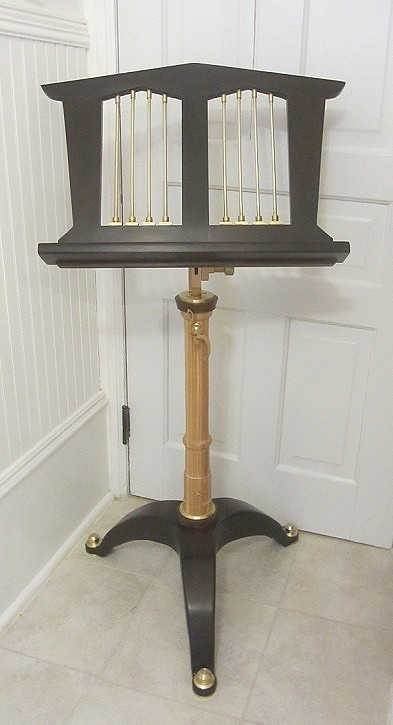
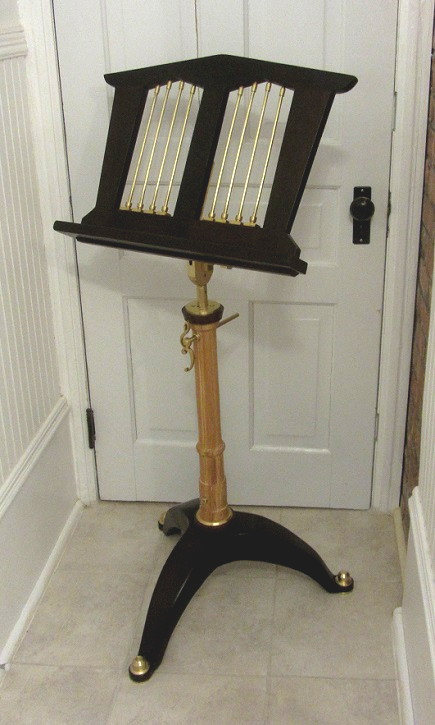
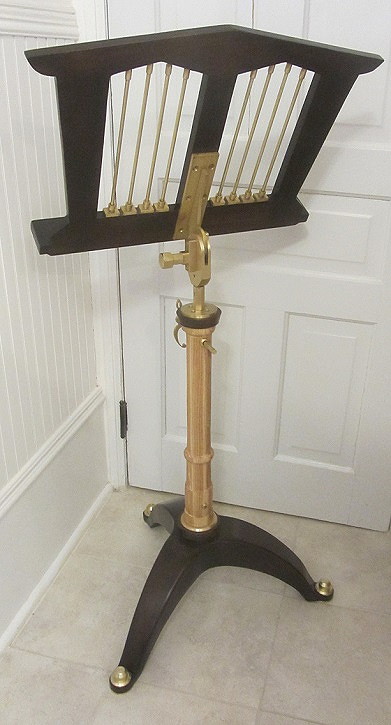
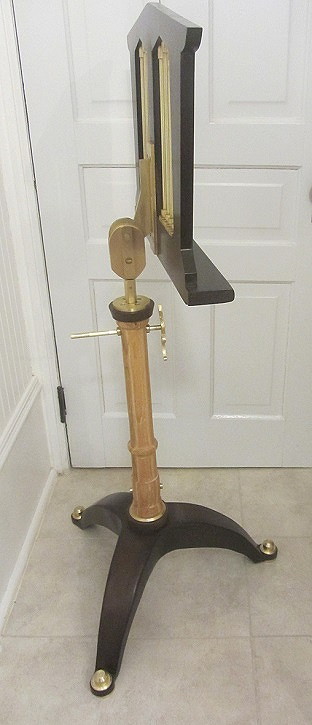
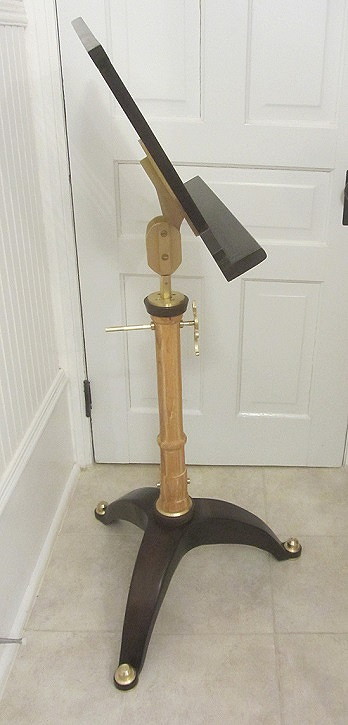
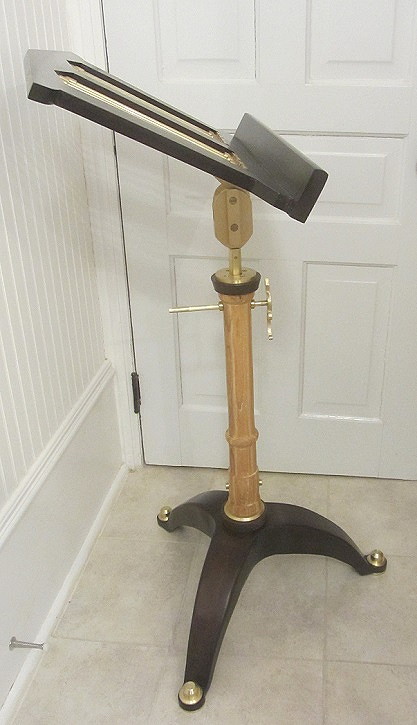
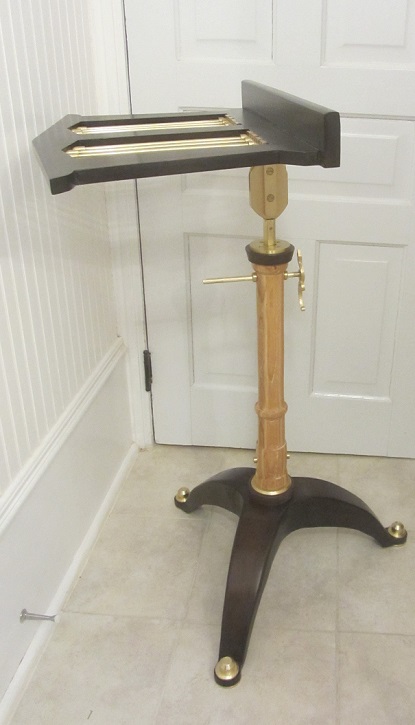
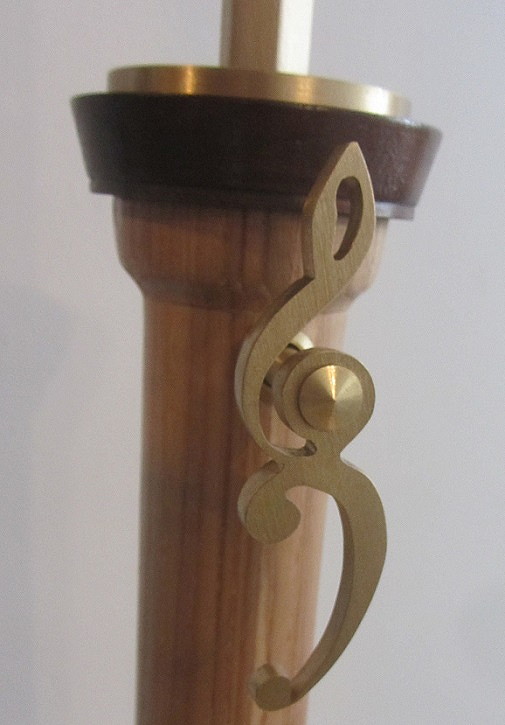
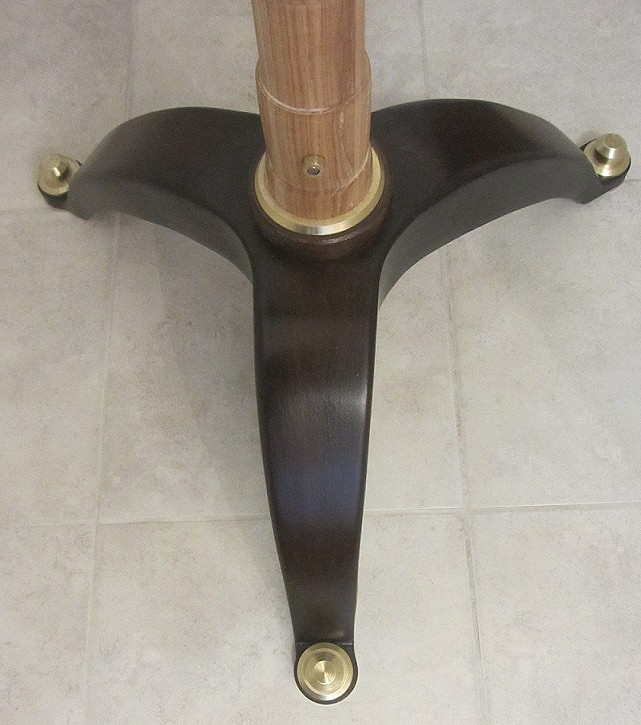
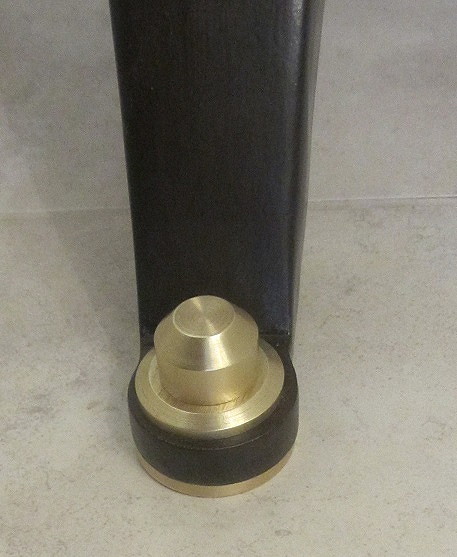
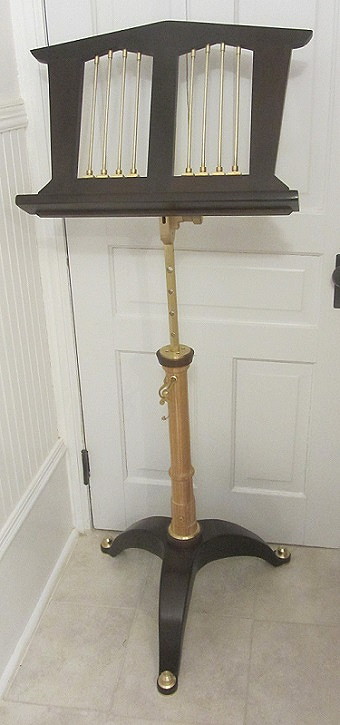
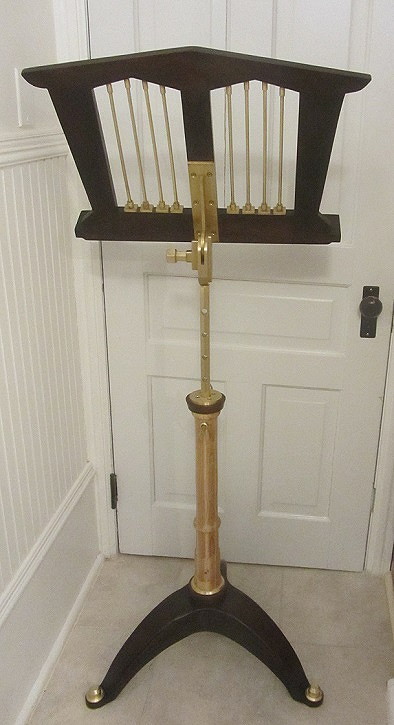
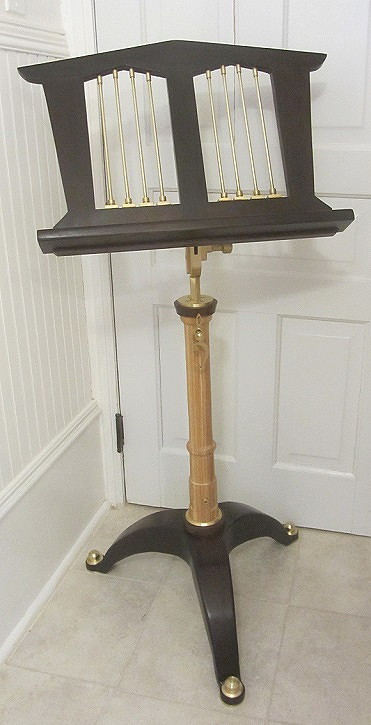
My home has very little space in which I can photograph pieces like this and get good lighting with no extraneous/distracting elements in the picture at the same time. This entryway to the bathroom is the least "cluttered"....
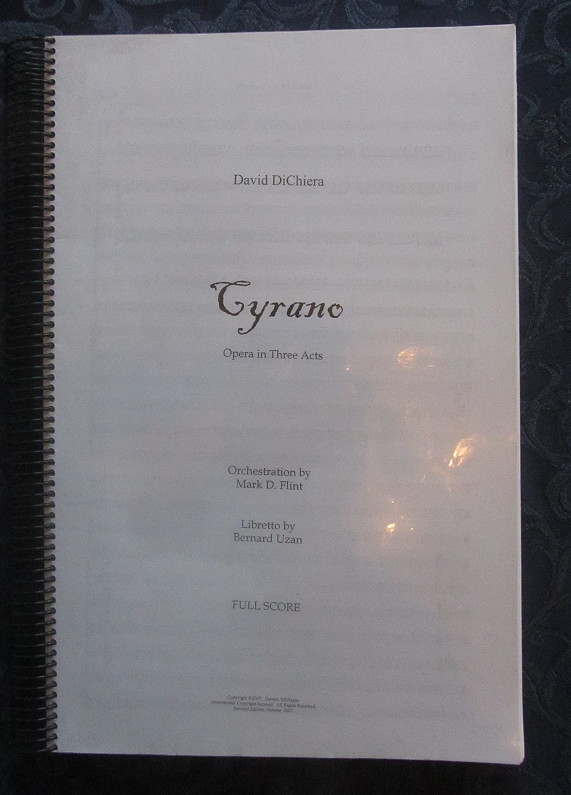
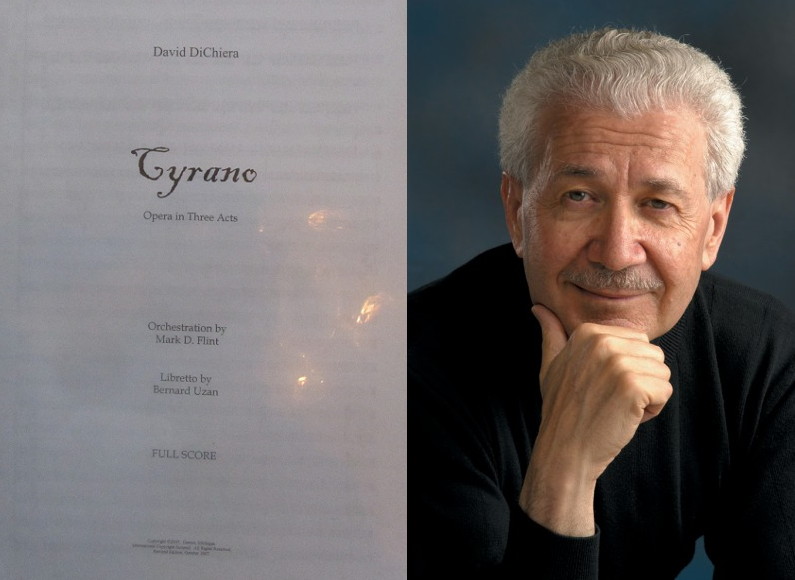
This Music Stand was designed to hold the score to the opera "Cyrano" composed by the late David DiChiera.
DiChiera was an American composer and founding general director of Michigan Opera Theater.
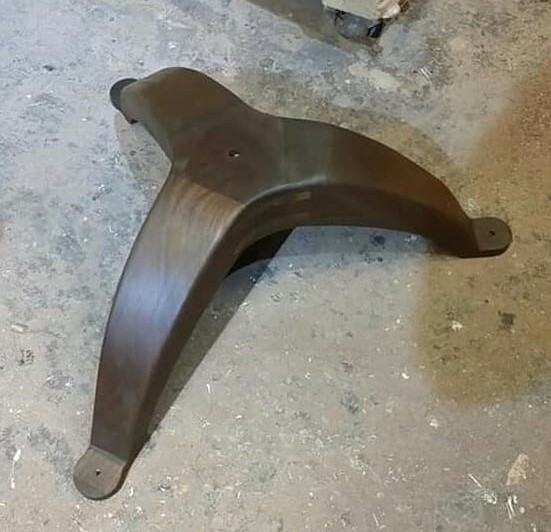
The finish for the Desk and the Tripod Base is Antique Walnut gel stain by General Finishes with a top coat of Shellac and Wax . The brass and the center post in Ash are sprayed lacquer.
Your compositions, choice of materials, and craftsmanship keep getting better, Alan. You didn't mention who the customer is, unless I missed it in a previous post, but this will certainly be a treasured piece.
I have enjoyed seeing how these complex stands come together. Do you have ideas/plans for extending the combination of metal and wood to other furniture- small tables and shelves for example?
As displayed the stand legs seem reversed by 180 degrees from what I would have guessed typical, but then I find myself going the opposite direction in life often. It seems the back leg should be opposite the performer" to provide support" and the front legs spread "to embrace the performer" and keep the legs out of the way.
How are the pictures taken- camera, phone? Size reduction has made them fuzzy. A photographer friend showed me a simple way to sharpen such photos I could share. for example 5 MEG picture shrunk to 70 kb:
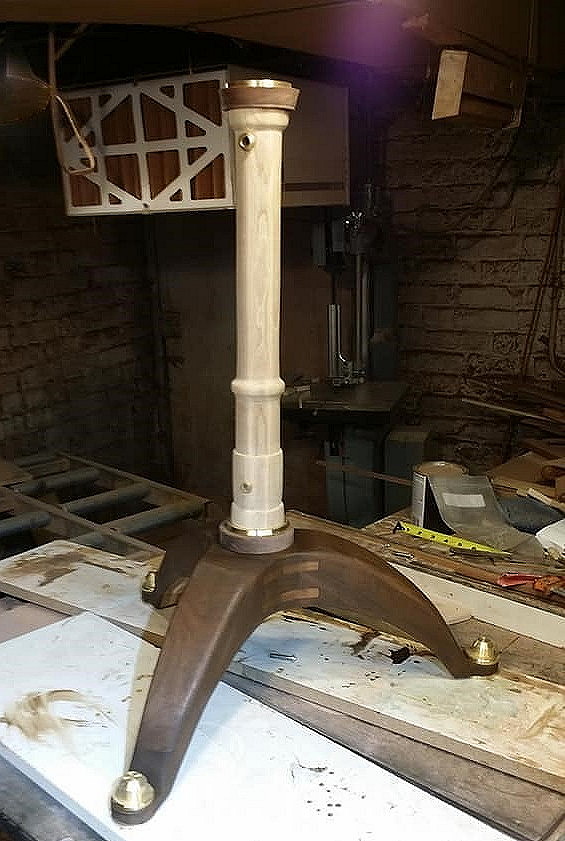
Hi David--Good Question-I should have noted that I was going to have the entire piece with a lacquer finish as it would allow a consistent finish for wood and brass. The post was ready for finish before the desk or the base. So I applied the lacquer to the post. As the Walnut desk and tripod base fabrication came along I knew I would be applying some sort of stain before the top coat. I had expectations that this stain would not just unify the walnut but blend the loose tenons I used on the tripod base. There are times when my brain just short circuits and in retrospect I ask myself "What were you thinking?" In this case I didn't used walnut for the loose tenons but cherry- as you can see- even with a gel stain applied the tenons stood out from the rest of the piece.
My remedy was to apply a toned shellac. I mixed Transtint liquid dye with Zinsser amber shellac.
The final result was satisfactory to me. It toned the tenons to the rest of the walnut.
Although the wood grain is less apparent- I like the result.
The stand was commissioned by friends of the late David DiChiera. The stand was designed to hold the score to DiChiera's opera "Cyrano".
Cyrano is an opera in three acts to a libretto in French by Bernard Uzan, based on the play Cyrano de Bergerac by Edmond Rostand.
The opera premiered on 13 October 2007 at the Michigan Opera Theatre, Detroit. DiChiera died of pancreatic cancer on September 18, 2018 with a funeral held at the Detroit Opera House on September 21, 2018. I was approached by two of his friends to make this stand about a year ago.
I have enjoyed seeing how these complex stands come together. Do you have ideas/plans for extending the combination of metal and wood to other furniture- small tables and shelves for example?
Yes and no-Lot's of ideas in my head but I have no room in my house for any more speculative pieces. So I have to wait for a client that is open to my suggestions for such implementation.
As displayed the stand legs seem reversed by 180 degrees from what I would have guessed typical, but then I find myself going the opposite direction in life often. It seems the back leg should be opposite the performer" to provide support" and the front legs spread "to embrace the performer" and keep the legs out of the way.
This is a valid question and I think it will vary for each end user. I set the base this way because I like my feet to straddle that leg. Others may want the exact opposite. This position can easily be reversed by removing the brass pole/desk assembly and turning it around 180 degrees.
The entire Ash pole can also be rotated in any degree desired as the pole is connected to the base with a 3/8-16 bolt. Simply un-tighten the bolt- rotate the post to the desired setting and re-tighten the bolt. Obviously the end user will likely choose the preferred setting then leave it.
I don't have good pictures of the attachment method-hopefully these renderings illustrate how the post is attached to the base
A 3/16 bolt comes up through the base- and is tightened into a threaded 3/4 aluminum hex stock that is inserted into the Ash pole. A 1/4 inch threaded rod runs perpendicular through the Ash pole and the Aluminum hex stock.
When the 3/8 bolt is tightened to the hex stock it pulls then entire upper assembly tight to the base.
How are the pictures taken- camera, phone? Size reduction has made them fuzzy. A photographer friend showed me a simple way to sharpen such photos I could share. for example 5 MEG picture shrunk to 70 kb:
I use a 14X canon digital camera.
I miss my Canon AE SLR for film-I knew how to make aperture and shutter speed adjustments to allow for depth of field preference etc--I just haven't taken the time to learn the features of this camera.
Furniture conservators and the like use tinted shellac to perform all sorts of magic but it is a technique absent from my tool box. Maybe if I see enough examples like this one I'll learn to use it. I'm slow to learn new tricks, but WC has provided motivation to learn some before.