WoodCentral Forums

Est. 1998 — 27 years of woodworking knowledge

Pioneer Wood Uses (book)

Posts

Pioneer Wood Uses (book)

#1

Pioneer Wood Uses (book)

Don Stephan

A customer described reading a book identifying surviving wooden relics of Pioneer life that suggested preferred woods (maple, walnut, oak, et cetera) for different tools, furnishings, and so on. Does anyone know a title for such a book? It might be very helpful for my annual 4th grade talk on trees and wood during the elementary school Pioneer Days program.

I know a few preferred uses, such as elm for wagon wheel hubs, dogwood for loom shuttles, black ash for pounded wood splints, but I would like to add to the list.

Thanks.
Re: Pioneer Wood Uses (book)

#2

JL

Re: Pioneer Wood Uses (book)

JL

One resource you might check would be the Foxfire books.

Re: Pioneer Wood Uses (book)

#3

Re: Pioneer Wood Uses (book)

Bill Houghton, Sebastopol, CA

You might look up some of Eric Sloane's books.

Re: Pioneer Wood Uses (book)

#4

If Sloane's books are what you are looking for

Dick Coers

I have a couple I would sell. I'll find them and let you know what I have.

Re: Pioneer Wood Uses (book)

#5

Chestnut

Bill Tindall, E.Tn.

Chestnut was a staple of pioneer life. Fence posts, siding, other rot resistant applications

Locust and cedar for fence posts. My uncle who worked on RR said butternut was good for ties. Horse chestnut and poplar for bread mixing bowls. Ash and hickory for handles.

White oak for shingles and barrels.

Re: Pioneer Wood Uses (book)

#6

Re: Pioneer Wood Uses (book)

Tom Dunlap

Black ash splits for baskets

Re: Pioneer Wood Uses (book)

#7

Re:Sycamore

Larry Clinton At Frankfort, (Central) Indiana

Don't know how accurate he was but an old gentleman that had a farm I was cutting firewood on told me as I was dropping a large sycamore about that species.

He was a well educated man and said that in the sailing ship days (I would guess 1700's) that wood wrights would venture into Indiana to obtain tall sycamores for ship masts. As I remember he said they would gird the selected trees and then return in a year or so and fell them.

Some I cut on his farm were at least 80 to 100' tall, and my 36" chain saw required 2 cuts to sever the trunk.

Re: Pioneer Wood Uses (book)

#8

ship masts

Bill Tindall, E.Tn.

In colonial times eastern white pine trees were marked "for the Crown" to be reserved for ship masts. Sycamore is resistant to splitting, something you will soon find out if one is destined for firewood. Could be important for ship masts. Why one would need to go to Indiana to find them is a puzzle. Sycamore grows anywhere damp east of the mountains. In the 1700's it would have been a daunting task to move a sycamore from Indiana to an eastern port.

Re: Pioneer Wood Uses (book)

#9

Re:Sycamore

William Duffield

Around here, sycamore is called buttonwood, for easily deduced reasons.

Re: Pioneer Wood Uses (book)

#10

Re: Pioneer Wood Uses (book)

Yonak

A very fine novel I've read recently, called The Overstory, reveals lots of interesting tidbits about different trees and types of wood, including historical uses.

Re: Pioneer Wood Uses (book)

#11

Re: Pioneer Wood Uses (book)

Paul Leuba

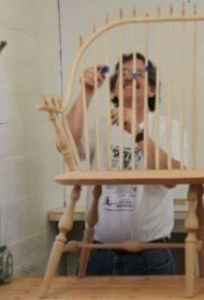
In the construction of Windsor style chairs for pub and everyday use in colonial times the following woods were used for the designated components:

Saddle (seat) : poplar, white pine (good for carving)

Legs, Arm Posts, and Stretchers: Maple (turns well on a lathe and strong)

Back Spindles: Oak, Ash (flexible, strong, good for spoke shaving when green)

Arm, Curved Back Support : Oak, Ash (flexible, strong, steam bends well when green)

Paul in Hunt Valley, MD

Re: Pioneer Wood Uses (book)

#12

Re: Pioneer Wood Uses (book)

Bill Tindall, E.Tn.

Back Spindles: Oak, Ash (flexible, strong, good for spoke shaving when green)

mine from early 1700's NY are hickory

Re: Pioneer Wood Uses (book)

#13

Re: Pioneer Wood Uses (book)

Don Stephan

Just requested it from the public library. Only 150 requests in front of me.

Re: Pioneer Wood Uses (book)

#14

Re: Chestnut

Hank Knight

That's interesting. I would have guessed that butternut would be too soft for RR ties. What is butternut's characteristic that makes it desirable for RR ties?

Re: Pioneer Wood Uses (book)

#15

Re:Kingstree South Carolina

Hank Knight

The town of Kingstree lies in South Carolina's southern Piedmont region. Its name goes back to Colonial times when the king reserved all suitable trees for his own use as masts for ships of the Royal Navy. I've always been a little puzzled by this because Kingstree lies pretty far south of what I understand to be the southernmost limit of the growth range of the Eastern white pine, the King's preferred species for ships' masts.

Re: Pioneer Wood Uses (book)

#16

as I recall, rot resistant....but

Bill Tindall, E.Tn.

But this is childhood memory and family legend.

Just looked it up....butternut is among the WORSE for rot resistance

Re: Pioneer Wood Uses (book)

#17

Nearer to the great lakes??


Re: Pioneer Wood Uses (book)

#18

Ships stores

Tom Dunlap

I’m curious about how suitable sycamore would be as a mast of any size. Also, the practical and historical issue of moving large tree parts from the Indiana region to the shipyards on the east coast

The Carolinas were a huge source of ships stores during the age of wooden ships. Beyond masts there is a need for shapes to make the framework for trees line oak for frigate hulls. Tar and oakum. Cotton for sails. Fiber for ropes

Re: Pioneer Wood Uses (book)

#19

Re: ship masts

Yonak

I was under the impression that poplar trees were regularly used for masts because they are tall and straight. For this reason and for lumber to be shipped back to the Mother Country, I had understood that south Georgia is full of pines because the hardwoods were wiped out by King George 300 years ago. Perhaps Danny Hamsley of Perry, GA can weigh in on this.

Re: Pioneer Wood Uses (book)

#20

not so

Bill Tindall, E.Tn.

For this reason and for lumber to be shipped back to the Mother Country, I had understood that south Georgia is full of pines because the hardwoods were wiped out by King George 300 years ago.

I don't know anything about ship masts. But I do know that where it likes to grow there are hardwood forests in Ga. A mill at Jesup pulps hardwood from the area for paper and cellulose used for chemical derivitization to make cellulose products like acetate, gunpowder, etc. The hot sandy soils in the south won't grow poplar. Poplar regenerates so well that it could not be wiped out where it likes to grow. In fact it pioneers back into abandoned farm land within a generation.

Re: Pioneer Wood Uses (book)

#21

Re: Live Oak

Hank Knight

Live oak trees, the classic Southern oaks you see with low branches draped with Spanish moss, were prized for the curved structures in ship construction: stems, knee braces, etc. The wood is very hard, resilient and somewhat rot resistant. They were and are plentiful in the coastal Piedmont areas of South Carolina, Georgia and North Florida. One of my ancestors owned a large plantation on the St. John's River just south of Jacksonville. For many years it provided naval stores to the British and the Spanish who fought over the territory. The plantation was immune to the conflict because both sides valued the products and protected the plantation - until the Spanish the the Indians burned the family home and ran them off the land in the 1840s.

Re: Pioneer Wood Uses (book)

#22

Re: ship masts

Tom Dunlap

In all of my reading, fiction, nonfiction and historical I’ve never picked up that any hardwood species was ever used for spars. I might have missed something though. By the time of ship building in American Colonial era most masts were made in sections not one single tree. Many masts were made from sections and fastened back together to eliminate the pith. This made a stronger mast whose performance could be replicated and repaired easier than a single piece.

There are descriptions of mast repairs in Patrick O’Brian’s Master and Commmander. Done at sea after storms or battle, a shipyard is no where at hand

Re: Pioneer Wood Uses (book)

#23

Most foresters

DizD

surmise that the "Kings Tree" the town was named for was actually a spruce Pine (Pinus glabra), common in black river bottoms along the coast. It is one of the southern yellow pines but has a very soft needle, much like the feel of a white pine, not prickly like other southern yellow pines.

👍 This page answered my questions

Your vote helps other woodworkers quickly find the answers and techniques that actually work in the shop.