WoodCentral Forums

Est. 1998 — 27 years of woodworking knowledge

How to dovetail a pentagonal dawer

Posts

How to dovetail a pentagonal dawer

#1

How to dovetail a pentagonal dawer

Bill Tindall, E.Tn.

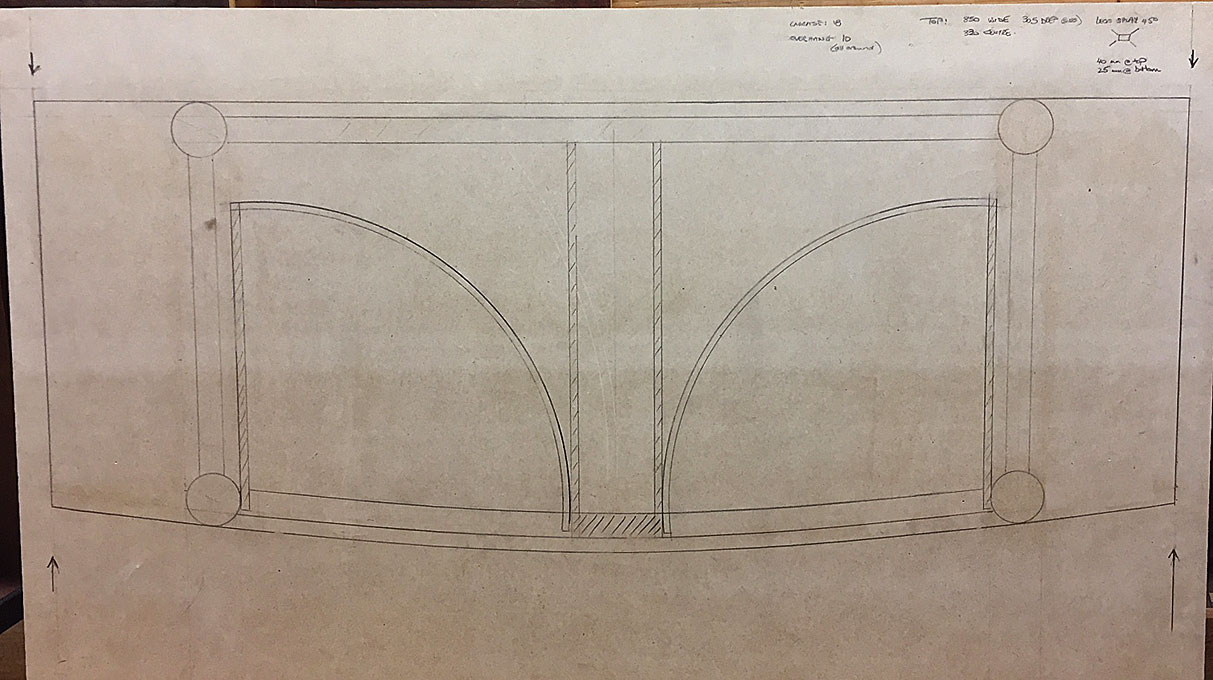
The drawer for the corner cupboard will be pentagonal to fit in the triangular shape of the corner cupboard. (actually it will be hexagonal as I will truncate the point of the back of the drawer. )

..........._________

........../...............\

......../..................\

|___________|

There will be a carved panel on each side of the drawer so the initial drawer depth will be like in a conventional straight-sided drawer and then it must angle in as it encountered the case sides.

I am about to just start trying to make the angled joint and see what problems develop. But probably somewhere there are instructions. This technique even stumped the Headley shop. "Never done one", was their reply.
Re: How to dovetail a pentagonal dawer

#2

Re: How to dovetail a pentagonal dawer

Keith Newton

This sounds like a good time to do fingerer box joints instead.

Re: How to dovetail a pentagonal dawer

#3

Re: How to dovetail a pentagonal dawer

Derek Cohen (in Perth, Australia)

Bill, if I understand you, the drawer recess has angled sides? If so, there are two choices you can make:

One is that you create a smaller recess within this area, such that a rectangular drawer will fit.

The second is to use a drawer which pivots from one side, rather than a standard rectangular drawer. I was planning on this (but decided on going with a different design):


Regards from Perth

Derek

Re: How to dovetail a pentagonal dawer

#4

I will dovetail it

Bill Tindall, E.Tn.

just remains to figure out how to lay it out. The first two attempts were failures but the second pointed the way to success......I think

Re: How to dovetail a pentagonal dawer

#5

Re: I will dovetail it

E Phillip Smith

Bill Thomas over on OWWM made very modern no square contemporary piece a couple years ago. He did a very good job of documenting the piece on the woodworking part of that forum. Can't remember the title of the piece. Will see if I can find it.

Re: How to dovetail a pentagonal dawer

#6

Re: I will dovetail it

Barry Irby

I know not.

I did a brief search on YouTube but what I got was dovetails for a hopper shaped piece. I know you don't waste bandwidth on youtube, but thought is there was something short and relevant there you might give it a peak.

Re: How to dovetail a pentagonal dawer

#7

Re: How to dovetail a pentagonal dawer

david weaver

Am I correct that its' the dovetails part way through the drawer that cause a problem, or the ones on the back?

Re: How to dovetail a pentagonal dawer

#8

Re: How to dovetail a pentagonal dawer

Bill Tindall, E.Tn.

4 sets of dovetails meet at a 135 degree angle, and two, the front two meet at 90 with half blinds into the drawer front.

I think I have it figured out. Major spring planting done, it is going to be hot then rainy which will drive me into shop to see if I got it figured out.

Re: How to dovetail a pentagonal dawer

#9

Bill, at some point, as the angle gets wider,

Keith Newton

It may become more advantageous to do tails on both sides, rather than tails and pins, which I've done by joining two boards end to end.

Re: How to dovetail a pentagonal dawer

#10

I really admire the way you tackle an issue.


Re: How to dovetail a pentagonal dawer

#11

Re: How to dovetail a pentagonal dawer

david weaver

I have an idea, but it's not an important one. Mine may not end up as tight as you'd want. But I would plan for that since they're hidden (and fill them out).

Apologies if someone already said this, but bending the sides on a form would also be interesting.

Re: How to dovetail a pentagonal dawer

#12

Re: How to dovetail a pentagonal dawer

AZ in Colorado Springs

I recall seeing a magazine article on this a looong time ago. I think this was for an oddly shaped valet to sit on top of a dresser, or something like that. I don't think they were addressing drawers.

I think the tail boards were cut with the base of the tail beveled as required. That angle was transferred to the end of the pin boards, which was beveled. Then layout the pins and cut essentially compound angles, since the base of the pins is not square.

Cutting the tails also would require cutting compound angles. Take care when laying out the base lines on both sides of the tail and pin boards. Probably need to lay a short offcut on the egde of the board, at the proper angle, to determine the baselines. When you prepare a satisfactory test piece, keep it for reference.

👍 This page answered my questions

Your vote helps other woodworkers quickly find the answers and techniques that actually work in the shop.