OT - Bending 3/4" Type L Copper Pipe
Hoa in Alameda
My wife asked me to build a trellis out of 3/4" type L copper pipe.
What tool do I need to bend it into a semi-circle of 4' diameter?
Thanks.
Est. 1998 — 28 years of woodworking knowledge
OT - Bending 3/4" Type L Copper Pipe
Hoa in Alameda
My wife asked me to build a trellis out of 3/4" type L copper pipe.
What tool do I need to bend it into a semi-circle of 4' diameter?
Thanks.
Re: OT - Bending 3/4" Type L Copper Pipe
David Yoho
I would think it's possible to do with a electrician's conduit bender. I have one you screw a piece of threaded pipe to as a handle. The only thing is - the few times I used it with an electrician present he did some math to figure out where to place the pipe in the bender and how much to crank the thing. When I was on my own, I just did it freehand without the math. To get the diameter you're after it might take some trial and effort.
Re: OT - Bending 3/4" Type L Copper Pipe
Garthinsandiego
All you need is soft copper (coil rather than straight) and a form of proper diameter. Soft copper bends readily by hand. The form can be constructed from any sheet material such as particle board or plywood. Or you can use what you have in hand such as an inverted patio table. Make sure that the form is on a flat surface to ensure that the final ring is flat.
Two additional recommendations: Get a helper to help hold the tubing flat and against the form and make sure to overlap the tubing at the ends. The first and last few inches of the tube will be at the wrong radius and difficult to conform to the form. Easier to overlap the bend and then cut back to get a uniform radius.
Great idea if...
David Yoho
he doesn't need the form to be more rigid. If not, your solution would be an easy one.
Re: OT - Bending 3/4" Type L Copper Pipe
Tom Norton
I have had good luck bending tubing by filling it with sand and bending around a form.
Re: OT - Bending 3/4" Type L Copper Pipe
Barry Irby
I built several trellises about twenty years ago. I still have a couple f them.
I used 1/2" copper, both soft and rigid. The larger ones have six vertical of rigid pipe about 6' tall with about six hoops of soft pipe around them. There are serpentine bends of soft pipe at the top that for a sort of minaret. The minaret closes onto a piece of 1/2" rigid with a turned wooden finial on top of that. The whole thing is wound around with copper ground wire on spirals. I also made some copper leafs and soldered them on to make a permanent vine. It's about 30" in diameter.
I also made some flat ones like ladders and a triangular one like a tripod. I donated the triangular one to charity. My neighbor about 5 houses up the street bought it without knowing I made it. It was like the cat came back. I ride past it every day. I have not met them and they still don't know I made it.
Some afterthoughts.....4' in diameter is huge. Think about it.
I suspect the copper drooling off the surface inhibited plant growth. At first it was very difficult to get anything to grow on them. Now they are aged and have patina and plants do better.
I donated one of mine to a charity auction. I was stunned when it sold for over $5,000. Was daydreaming about a big production run and then found out that almost anything at this particular auction would sell for $5,000.
On mine, for additional strength I inserted copper clad ground rod into the pipe legs, making them very sturdy. With the right pipe and rod, its a perfect fit.
The advice about bending more pipe than you need to make the circle is correct. Go 10 or 12 "diameters" over and then trim away the straight part.
I think you can clean the writing off the pipe with lacquer thinner if you care.
The tool ...
Mike Farinella
is called a "Hickey".
Similar to this one
Hoa in Alameda
Thanks for the ideas. My boss... uh... I mean... wife just wants something simple and solid for climbing roses (similar to the one in the photo attached). I'll probably make several of them so buying a bender, if it makes the job easier, is not a problem.
I actually made one about 20 yrs ago (still in service), using a form and bending the pipes by heating them up with a torch. But it was not fun; I don't want to repeat the experience. There must be a better way.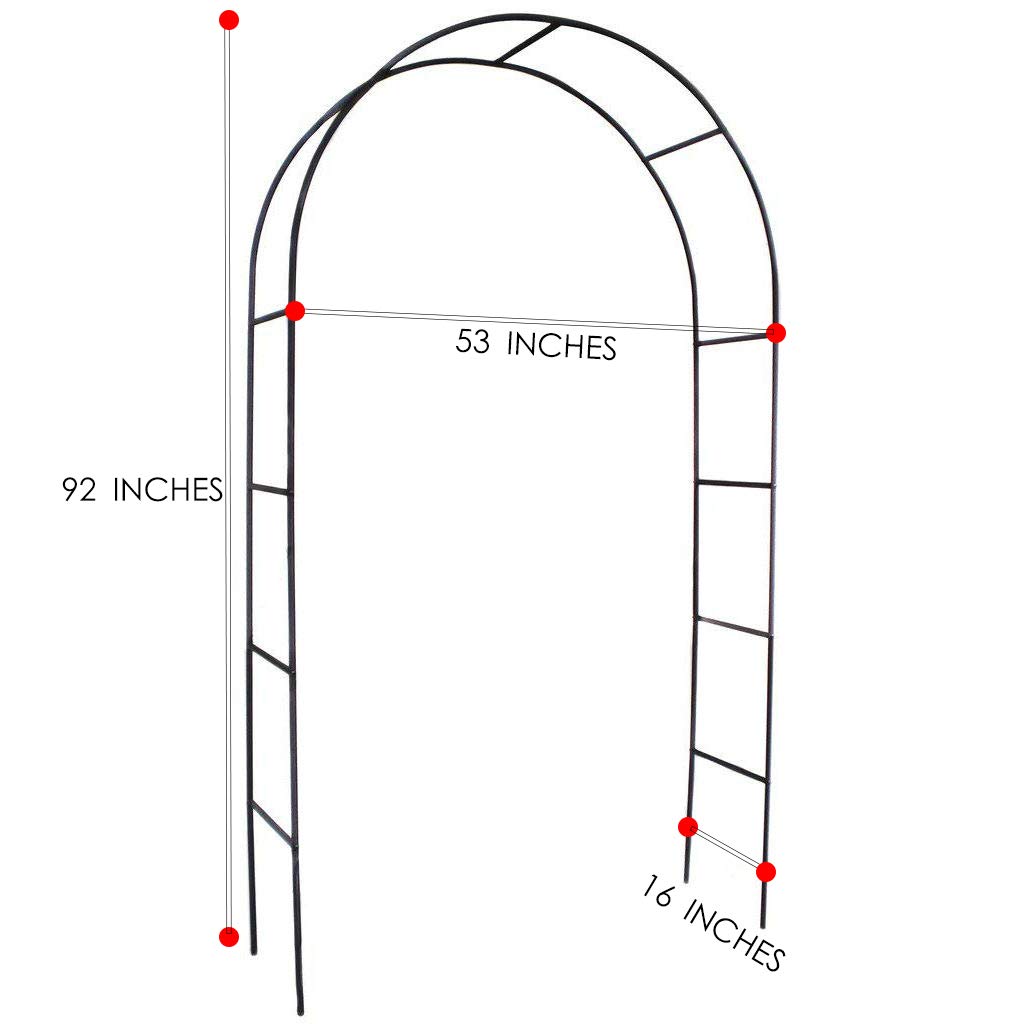
Ring roller
Henry Higginbotham
Check Horror Freight or eBay for a cheap ring roller, or maybe a tubing roller. Sand, as already suggested, would probably help.
Re: Similar to this one
Bruce, a MN Galoot
Do you want to do it, or do you just want it done? If the latter, take it to a muffler shop.
Re: Similar to this one *LINK*
Keith Newton
If you can use PVC, it would be easy. Just set up a steam pot and send it through the tube, which will turn it into a noodle that you can bend around a PB form.
There may be some flattening at the top T cross bar though, but I'd see about reaming out a T that would slide over the outside before steaming. You could probably drive some rebar or something into the ground that it would slip over to make it more sturdy.
PVC holds up well outside, is cheap and easy to work.
https://pvcpipesupplies.com/pvc-pipe/pvc-schedule-80-pipe?gclid=EAIaIQobChMIus-68KqK4gIVS77ACh0pSAveEAAYBCAAEgKVO_D_BwE
Re: Ring roller
walta
I think the conduit bender would work if you annealed (softened) the copper heat it and let it cool slowly.
Google “copper work hardening”
The conduit bender gives you an 8-12 radius that does not match your design.
One way to get that bend is to fill the pipe with pitch (tar) so the pipe will not collapse.
This youtube video should help.
https://www.youtube.com/watch?v=_eoGFpAiaoc
Sand could work if you totally fill the pipe and cap both ends.
Walta
Re: Similar to this one
John in NM
Harbor Freight's tubing roller might be what you need, though its a bit pricey for a single project. Nice thing about the roller is that it looks infinitely adjustable (within the understood limitations of "adjustable" in the HF universe). They make various copies of lightweight Hossfeld type benders that are a lot cheaper, but they don't have the big dies for larger diameter curves.
Re: Similar to this one
Barry Irby
An electrician used to working with conduit would have a conduit bender and could do this. Just draw the circle you want on a piece of cardboard or plywood and gently bend the pipe. You might be able to rent a conduit bender st Home Depot or a tool rental place. Clamp a cross piece on the tube so that you don't rotate it while bending. If it rotates it turns into a spiral.
Locally, years ago I found a metal fabrication shop that had tubing benders and they fabricated a handrail for a set of steps for me. I drew what I wanted and took them the pipe and in about half an hour I had what I needed. Come to think of it, that was back in the day. Recently, I went to a shop that had gone all CNC and asked them to do a small job (Chop up some 8' steel rods into three roughly equal pieces.) and they looked at me like I came in horse drawn wagon. They needed the CNC file and had no clue what "roughly" meant.
Re: Softening copper!
Larry Clinton At Frankfort, (Central) Indiana
The method for annealing (softening) copper is just the opposite of steel. To soften you heat the copper then cool it rapidly with cold water. It does work harden easily so you may have to repeat the process.
Re: Softening copper!
John K Jordan
A gentleman demonstrating metal spinning on the lathe had to stop and anneal copper workpieces repeated. He heated with a propane torch and quenched in water. Same method is needed for brass.
sand
John K Jordan
>>>I have had good luck bending tubing by filling it with sand and bending around a form.
Packing with sand will absolutely keep pipe from collapsing as the bend radius gets smaller. Not usually needed for a large radius.
A place near here called Tennessee Tube bending made things like heat exchangers from tubing with spiral or vane fins welded on the outside. They filled the tubes with sand then held the tube vertically and vibrated it to pack the sand. Those I saw were bent cold and the radius was usually tight.
BTW, (and further off the garden trellis topic) this works on a large scale too. When I was inspecting piping for nuclear reactors it was fascinating to watch the bending process for large steel pipe, perhaps 10-18" in diameter and maybe 20' or longer. The walls were typically an inch thick or more if I remember correctly. They welded a cap on one end, raised it vertically, then filled it with sand. To pack the sand they pounded the sides for hours with what looked like a jack hammer with a blunt head, moved up the pipe on a carriage. Then they heated just the section of the bend to bright orange by laying the pipe in a short gas furnace. Then it got interesting! A team in heat-protective suits positioned the pipe on a huge steel table, blocked it on one end, and pulled the other end with what looked like a 2" rope wrapped around a smooth vertical drum. This pulled the hot section around a form to make the bend. They had to work very quickly before the pipe cooled too much! Then another section would get heated to repeat for complex bends. The angles and dimensions had to be precise so the pieces would fit up properly in the field. Those I watched were fabricated in Kernersville NC to go into a power reactor Quad Cities, IL. I'd hate to see the bill.
JKJ
Re: Similar to this one
John in NM
That CNC shop is the type that folds up when they lose a big contract or two. Some shops depend on large contracts that overpay, and others take every opportunity to keep the place humming with small jobs in between big ones. The second type of shop lasts years because they can be flexible.
Re: Softening copper!
John in NM
Cooling speed doesn't matter with copper or silver. Not sure about brass, I never worked with it much. Quenching doesn't work against you when annealing these metals, so most workers quench for speed. Most quench in "pickle" which is a mild acid and helps remove the oxides left by heating.


