WoodCentral Forums

Est. 1998 — 27 years of woodworking knowledge

P&L 38 alkyd varnish

Posts

P&L 38 alkyd varnish

#1

P&L 38 alkyd varnish

Don Stephan

A person at the Pratt & Lambert support phone line said P&L 38 alkyd varnish apparently has been discontinued. After a couple days of research a few years ago I felt that alkyd varnish was a great finish for wooden bowls, and I have been using it since.

Is anyone familiar with another alkyd varnish that has great durability and clarity?

Re: P&L 38 alkyd varnish

#2

Re: P&L 38 alkyd varnish

Bill Tindall, E.Tn.

I had Joe send me a test panel done with PL38. It took weeks to fully harden and at that it was soft. But the luster and color was what I was looking for. Since, I visited someone finishing with traditional Waterlox. To my eye it looked the same and was substantially harder. I will be using Waterlox the next thing I finish.

A person in the club makes boxes professionally. He uses Minwax wiping varnish. His boxes look great but he wipes a multitude of coats to get the result.

Re: P&L 38 alkyd varnish

#3

Re: P&L 38 alkyd varnish

Don Stephan

Thanks for the feedback Bill. I can only guess the P&L 38 you were sent was perhaps compromised - I used it 50-50 with good mineral spirits and it was dry to the touch in little more than an hour.

After some mucking around the Internet this evening I haven't found a product like the P&L 38. The instructions for Waterlox if I remember correctly were 24 hours between coats. But I might have to get can, thin 50-50 with mineral spirits, and give it a test. An Internet search using "alkyd varnish" didn't seem to find any alternatives to P&L 38. The Waterlox did fare pretty well in a four varnish comparison on a video I found by Woodwhisperer.

Re: P&L 38 alkyd varnish

#4

Re: P&L 38 alkyd varnish

Bill Tindall, E.Tn.

Dry to the touch and fully cured is a different end result. If there is any odor of "varnish" the finish is still curing. It took weeks for the PL38 to fully cure though it may have gotten dry to the touch in an hour. If you are making wiping varnish from this stuff why not use wiping varnish to begin with?

Re: P&L 38 alkyd varnish

#5

Re: P&L 38 alkyd varnish

Don Stephan

I wanted the durability and clarity of P&L 38. Books and articles by the finishing writers I've grown to respect (Jeff Jewitt, Bob Flexner, and _______) led me to look for alkyd varnish over the other types of varnish for furniture and wooden utility bowls, and more than one of them felt P&L 38 was the clearest of the alkyd varnishes on the market. P&L 38 was not available as a wiping varnish, but mixing 50-50 with a good quality mineral spirits was easy and the result was so very easy to use.

Re: P&L 38 alkyd varnish

#6

Re: P&L 38 alkyd varnish

David Yoho

I can go along with Bill's suggestion of Waterlox. I used it for years as a wipe on topcoat. However, I've stated here before and will again, I changed from Waterlox to General Finishes Arm R Seal as my go-to wipe on finish.

Neither the Waterlox or Arm R Seal are an alkyd product but I think either would make a good substitute for the P&L varnish. For me, I like the General Finishes varnish better because I believe it dries clearer and the odor dissipates sooner than the Waterlox. It's also more affordable.

I never found it necessary to thin either one.

Re: P&L 38 alkyd varnish

#7

Re: P&L 38 alkyd varnish

Philip Duffy

Spot on, David! Could not agree more, but only 35 yrs of experience so far. P.

Re: P&L 38 alkyd varnish

#8

Correct

Joe in a Cleveland suburb

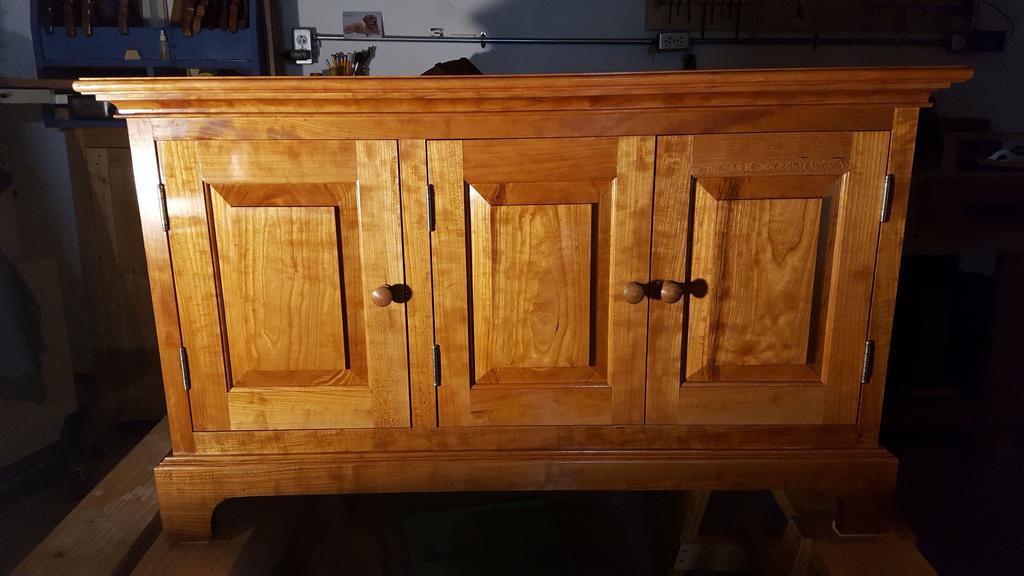
I used P&L 38 this past winter for the first time ever on a tv stand I made.

I tried P&L because of what I had read about; its color and so on. Wasn't easy to find (near Cleveland). Wasn't very cheap either as I recall.

But the color on cherry, to my eye, was/is very very nice. I thinned it a tiny bit and brushed it on. I always struggle with finishing, but this P&L went on so nice right off the brush. I was very happy with it. It was pretty soft for a while. Doing the thumbnail test, I was able to indent it for some time after brushing it on. I don't think I can now though.

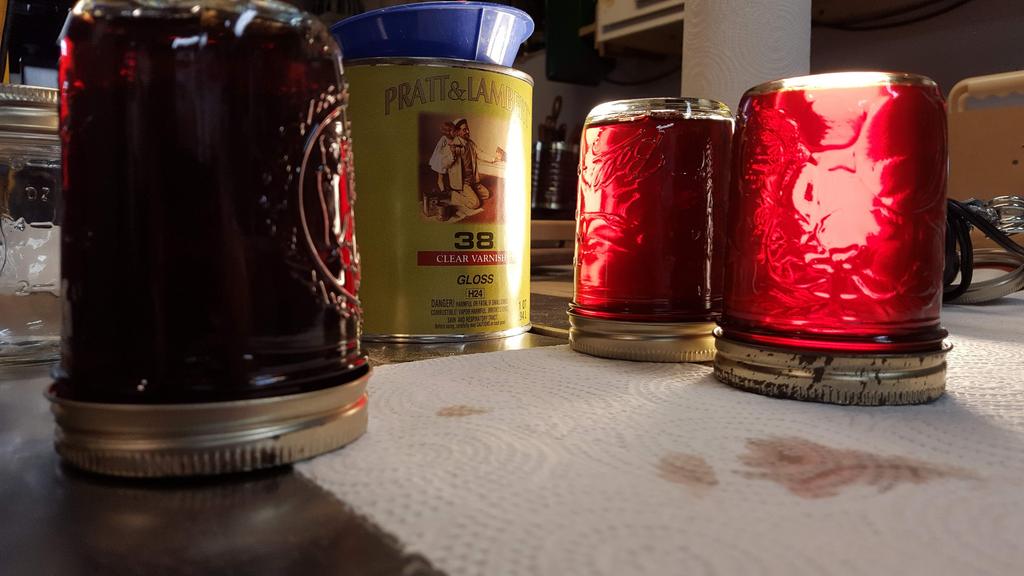
I decanted into smaller mason jars and its color is pretty dark and nice.

I am using big box store Minwax clear gloss poly on the bookcase I am making. Its color looks like thinned vegetable oil... or soy bean oil. :( I thin it a little bit and it does brush on nice though I have to admit.

I am not sure which Waterlox product Bill is referring to (Waterlox Original Gloss Finish?), and I remember Ellis has talked positively about here as well, but I remember it being pretty pricey when I tried it a number of years ago.

Too bad P&L 38 is going away. Looks like a lot of places on the Internet are still offering it.

tv stand I built quickly off the cuff... no plans or anything.

With the P&L #38


Color in the jars of the P&L 38


Re: P&L 38 alkyd varnish

#9

Re: P&L 38 alkyd varnish

Keith Mealy

Other alkyd varnishes that I know of are Cabot (nee McCloskey's Heirloom) and Sherwin-Williams Fast Dry Varnish (either does not say "polyurethane") I don't know if either is currently available. It's been quite a while since I used either. I think the last Cabot I found was at the nearby Do-It-Best Hardware store. (try the McCabe's in Madeira, Don).

Waterlox is a non-poly but it's phenolic (not alkyd) and uses tung oil vs. linseed or soya oil in its formulation.

Re: P&L 38 alkyd varnish

#10

Re: P&L 38 alkyd varnish

Don Stephan

Thanks for chiming in Keith, hope retirement suits you.

McCloskey web site only shows a man of war spar varnish, so they might have dropped the Heirloom product.

The Sherwin Williams web site isn't finishing the page for their Fast Dry Varnish so I can't get details.

General Finishes, like others, wants their sealer (Seal-A-Cell) used before their top coat (Arm-R-Coat) and the sealer calls for sanding no higher than 180 or 220, and I don't think one can avoid visible sanding scratches on bowls without going to a higher grit.

Haven't found a local seller but looking closely at Waterlox Low VOC tung based sealer and gloss finish.

Re: P&L 38 alkyd varnish

#11

where did you got your information

Bill Tindall, E.Tn.

from general application notes for Arm-R- Seal, which is the only oil based finish listed on web site

Sealer is unnecessary under this product.

"Finish sand between coats with a fine-grade (220-320) foam sanding pad or 400-grit sandpaper to improve smoothness and adhesion."

Re: P&L 38 alkyd varnish

#12

Re: where did you got your information

Don Stephan

You are correct that the web page for Arm R Seal on the General Finishes web pages gives instructions for applying the product directly to raw wood, but says to sand raw wood with 150 grit. That is going to leave lots of circular, visible sanding scratches on wooden bowls where the typical sanding method is 2" to 3" sanding pads in a regular or right angle drill. I am not at all confident the finish will make those circular 220 grit sanding scratches invisible, even sanding with a finer grit between coats of finish. But I might be wrong.

The top line on the back of the General Finishes Seal A Cell can says in part "Penetrating Sealer to be used as a basecoat for GF Arm R Seal . . ." which I interpreted to mean it is recommended as a basecoat. I haven't found mention on the Arm R Seal label of Seal A Cell. So, is there better adhesion using Seal A Cell as a basecoat for Arm R Seal? The inconsistency is confusing.

The manufacturer's web page sanding instructions for raw wood under Seal A Cell is again sand to 150. The label on the Seal A Cell can says to sand open grain raw wood with 120, 150, and then 180; sand closed grain raw wood with 150 and 220. Again, the inconsistency is confusing, and General Finishes web site does not offer a phone number of email address for manufacturer support.

Re: P&L 38 alkyd varnish

#13

Re: where did you got your information

Barry Irby

Sanding flat work to 150 with the grain is generally adequate, but sanding bowls on the lathe whether by hand or power is almost by definition cross grain. At least some of it will be. You could sand off the lathe by hand and try to sand with the grain, but I find that to be difficult and tedious.

It seems to me the question is does this finish require the 150 grit surface for some sort of "tooth" or are they suggesting it to reassure people it will be visually adequate on most flat work?

I power sand my bowls to at least 400 grit and have never had a finish problem that I could attribute to them being too smooth. Most of mine are finished with lacquer. A few with BLO and some with Urethane. Have not used Arm R Seal. I did use a can of Salad Bowl finish.

Re: P&L 38 alkyd varnish

#14

Worth testing

David Yoho

Don, just like any time before trying something new or different with a finish on a project try a test. Take a bowl sanded to your normal level and apply the Arm R Seal two ways - 0ne on each half of the bowl.

On one half apply it full strength and the other half thinned. The thinned product should act like a sealer coat by being able to penetrate better. If the thinned batch seems to work better, use that as your primer coat followed by a full strength application. Otherwise just use it full strength until completed.

I'm not sure you need to buy a can of another product to get this done. While it is good for GF it may not be a necessary expense for you.

Re: P&L 38 alkyd varnish

#15

Re: Worth testing

Don Stephan

Great suggestion! But I'm seriously considering returning the pints of GF Seal A Cell and Arm R Cell, and order the sealer and topcoat by Waterlox. The manufacturer of those products do not recommend stopping sanding with 220. And I received a Saturday reply to a question I posted on their web site just the day before. The reply mentioned in part that the sealer has less solids "so it penetrates better." So your suggestion would apply to Waterlox as well.

Re: P&L 38 alkyd varnish

#16

Re: Worth testing

David Yoho

I don't think you'll go wrong with the Waterlox. It is a tung oil based varnish and should go on nicely as a sealer coat thinned.

My only reservations about it from past experience is I feel it tends to slightly cloud figured woods like curly maple and quatersawn sycamore and it takes longer for the solvent odor to dissipate. However, that said, it is my go-to finish for cutting boards. I only apply one heavy coat, allow it time to soak in, and wipe away any excess to let dry. Done this way it seals the wood for a good while and doesn't produce shards of finish from heavy use.

Re: P&L 38 alkyd varnish

#17

Epifanes

david weaver

I went through a thing earlier this year where I wanted to find a "real" varnish (not a spar urethane) and purchased a quart of epifanes.

It worked fine, but would need to be thinned for wiping (shouldn't be an issue).

It has driers in it, as I'm sure all commercial true varnishes do. Smells like an oil refinery.

I went on beyond that and made pine/dammar resin and turpentine/flaxseed amber varnish. Without driers, it's not something most people would tolerate. Best I can tell with the MSDS on the commercial products, the driers are cobalt salts or something (like japan drier).

Looking at both my varnish and the epifanes, I can't really tell the difference in appearance, but I can tell that without UV light, my varnish will not fully cure for a VERY long time. Probably a month, and it's still reactive. I wanted to avoid driers in mine, but will be trying them going forward.

Long story short, if everything else disappears, there still appears to be a following in europe for varnish on boats, and epifanes would probably still be available.

I wouldn't advise making varnish unless you have an outdoor area that can sustain a potential fire. Making isn't any cheaper than buying, the product just smells and feels nicer. It feels more dry as it goes on, and less sticky than commercial varnishes, and washes off more easily if you get some on a hand or arm. Looks like lacquer when it's cured.

👍 This page answered my questions

Your vote helps other woodworkers quickly find the answers and techniques that actually work in the shop.